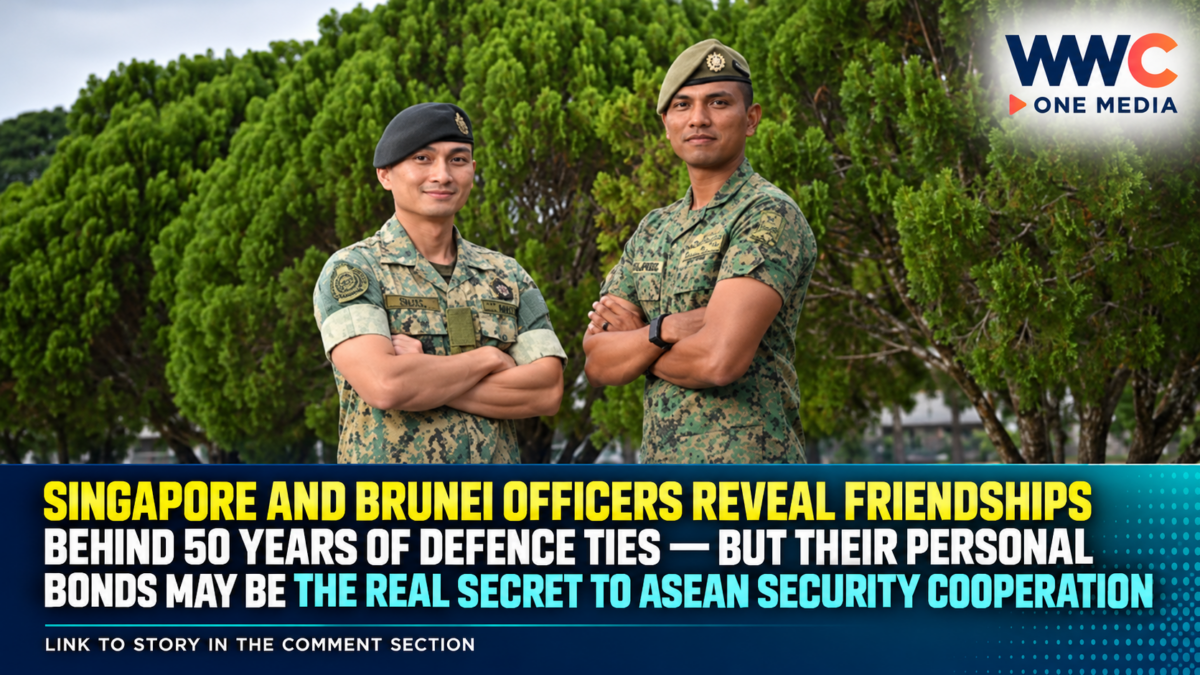
SINGAPORE — Behind the warships, helicopters and military parades celebrating 50 years of Singapore–Brunei defence relations lies a less visible force holding the partnership together: lifelong friendships between officers from both countries. From army commanders bonding over football and food to pioneering female air force officers supporting each other under pressure, the relationships have grown well beyond military exercises. But as Singapore and Brunei expand cooperation into drone training, naval operations and shared infrastructure, these personal bonds could prove increasingly important to the future of Southeast Asian security.
Singapore and Brunei marked five decades of formal defence relations on October 10, 2026, with a historic joint military parade attended by Prime Minister Lawrence Wong and Sultan Hassanal Bolkiah.
The ceremony at Brunei’s Muara Naval Base brought together 256 personnel and military assets from both countries’ armies, navies and air forces.
But behind the anniversary celebrations is another story — one that involves friendships formed in military classrooms, shared experiences during demanding exercises and personal relationships that have continued long after training ended.
In a Channel NewsAsia feature published on October 10, Singaporean and Bruneian military officers described how professional encounters developed into lasting friendships.
Their experiences highlight an important aspect of international defence cooperation: trust between countries is often strengthened by trust between individuals.
For Singapore and Brunei, those connections have been developing for half a century.
Two Army Officers Discover They Have More in Common Than Military Training
Lieutenant Colonel Shahreel Adam of the Singapore Army and Major Mahmud Afifi Mohd Kifli of the Royal Brunei Land Forces first met in 2023.
Both officers, now 37, were attending the Command and Staff Course at Singapore’s Goh Keng Swee Command and Staff College.
Their initial relationship was professional.
The course required them to spend long hours discussing operational planning, military leadership and strategic challenges.
But it did not take long for the two officers to discover shared interests outside their responsibilities.
They bonded over food, exchanged jokes about football results and found common ground in their personal experiences.
They later discovered they had both attended the University of Western Australia.
What began as a professional connection soon developed into a friendship that continued after the course.
The officers have maintained contact and met almost every year since.
Their relationship demonstrates how military education programmes can create connections extending far beyond the classroom.
Friendship Continues Across Singapore and Brunei
Shahreel and Afifi’s relationship did not end after graduation.
They met again when Shahreel’s unit trained in Brunei earlier in 2026.
They also caught up when Afifi visited Singapore for the Shangri-La Dialogue, one of Asia’s leading defence forums.
Their meetings frequently involve meals and conversations about professional challenges.
For Shahreel, the friendship provides an opportunity to exchange ideas with someone who understands the demands of military leadership.
Afifi similarly values the mutual understanding they developed during their training.
Shahreel has visited Brunei more than 10 times since his first trip as an officer cadet in 2008.
Those experiences have helped him develop familiarity with the country and its military personnel.
For the two officers, the relationship is a reflection of the trust already established between their armed forces.
But it also offers something more personal: a dependable friendship with someone who understands the responsibilities and challenges of military service.
Two Female Air Force Officers Break Barriers Together
Another friendship began during a historic training exercise in 2016.
Major Thng Lizhen of the Republic of Singapore Air Force and Major (Udara) Noraqidah Efinddi of the Royal Brunei Air Force became the first female platoon commanders to participate in the bilateral Exercise Airguard.
At the time, both were junior officers entering demanding leadership roles.
Their responsibilities required them to manage personnel, develop operational plans and demonstrate their capabilities during joint training.
They also faced the pressure of being among relatively few female leaders in their professional environments.
Thng, now 38, recalled the responsibility of leading a team of full-time national servicemen and regular personnel in Brunei.
Noraqidah, now 36, understood the challenge of working in settings where female officers were often underrepresented.
Their shared experience helped establish a sense of mutual support.
Rather than facing every challenge independently, they could exchange advice and encourage each other.
The relationship illustrates how cross-border military cooperation can also create opportunities for women in leadership.
A Night of Planning Became a Lasting Memory
One of the most memorable experiences for Thng and Noraqidah occurred during Exercise Airguard.
The two officers were preparing to brief senior military leaders.
After inspecting deployment sites at night, they spent hours refining their presentations.
They rehearsed, reviewed their plans and provided feedback to one another.
Their preparations continued until dawn.
The experience was demanding, but it became a lasting memory that both officers still recall with humor.
For Thng, the support she received from her Bruneian counterpart helped her manage the pressure of briefing senior leaders.
For Noraqidah, the experience reinforced the value of having another young female officer who understood her responsibilities.
Their friendship has continued for nearly a decade.
They remain in touch through messages and arrange meals when opportunities arise.
The importance of the relationship extends beyond personal encouragement.
Having trained together, the officers developed an understanding of each other’s communication styles and professional approaches.
That familiarity can make future cooperation easier.
Female Military Leadership Becomes Part of the Partnership’s Legacy
The experiences of Thng and Noraqidah highlight a wider issue within military organizations.
Leadership requires technical knowledge, judgment and the confidence to make decisions under pressure.
For officers entering roles where people with similar backgrounds have historically been less visible, professional support can be particularly valuable.
The two officers’ friendship created an opportunity to exchange experiences and develop confidence.
Their story also demonstrates that bilateral exercises are not limited to practicing operational procedures.
They can expose personnel to different leadership styles and organizational cultures.
Such opportunities help officers develop professionally while strengthening relationships between participating armed forces.
However, the story does not establish that all barriers facing women in military leadership have disappeared.
It provides a specific example of how international cooperation can support officers navigating demanding professional environments.
Navy Officers Become Friends Beyond the Sea
A third friendship developed between Colonel David Kan Shengyao of the Republic of Singapore Navy and Commander Mohammad Khairul Anuar Abdullah of the Royal Brunei Navy.
Both officers, now 38, met during the 53rd Goh Keng Swee Command and Staff Course in 2022.
They served as international liaison officers and sponsors, becoming learning partners during the programme.
Their professional relationship gradually became personal.
The officers discovered that they were navigating similar stages of life.
Both were raising two young children.
They began exchanging experiences involving marriage, parenthood and the challenges of balancing military careers with family responsibilities.
Their conversations extended beyond naval operations.
They discussed their children’s illnesses, family commitments and the pressures associated with spending long periods away from home.
These shared experiences helped deepen their friendship.
Military Families Become Part of the Story
The relationship between Kan and Khairul grew stronger as their families became acquainted.
Kan met Khairul’s family when they visited Singapore.
The officers continued exchanging messages during birthdays, career changes and overseas deployments.
Their friendship demonstrates how military relationships can expand into family networks.
Such connections may help officers cope with the demands of a profession that often involves travel, extended exercises and time away from loved ones.
For personnel serving at sea, these experiences can be especially familiar.
Naval deployments can require prolonged separation from families and unpredictable schedules.
Having a friend in another navy who understands those demands provides another form of support.
The two officers have also maintained professional contact through bilateral naval activities, including Exercise Pelican.
For them, personal trust and professional cooperation reinforce one another.
Exercise Pelican Keeps Naval Friendships Alive
The Singapore and Brunei navies have maintained close cooperation through Exercise Pelican.
In October 2026, the two forces completed the 44th edition of the exercise.
According to Singapore’s Ministry of Defence, Exercise Pelican 2026 was conducted from October 2 to 6 at Muara Naval Base in Brunei.
Activities included naval warfare drills, communications exercises, vessel manoeuvres and professional exchanges.
Personnel from Singapore’s Naval Diving Unit and the Maritime Security and Response Vessel Protector participated alongside their Bruneian counterparts.
The exercise demonstrates how repeated training can strengthen familiarity between military units.
For Kan and Khairul, such activities also provide opportunities to maintain professional contact.
Regular interaction is valuable because trust developed during courses and exercises can otherwise weaken if relationships are not maintained.
Exercises like Pelican therefore contribute to both operational coordination and lasting interpersonal connections.
Singapore–Brunei Defence Relations Began in 1976
The history of bilateral cooperation extends back five decades.
Brunei’s armed forces were established in 1961, while the Singapore Armed Forces were formed in 1965.
Formal defence relations between the countries began in 1976.
Since then, generations of Singaporean service personnel have trained in Brunei.
The relationship has grown to include regular military exercises, education exchanges and senior-level engagements.
Singapore’s Ministry of Defence describes longstanding personal relationships as an important foundation of bilateral cooperation.
The historical connection can be traced to senior officers who trained together before both countries’ modern defence structures were fully developed.
Singapore’s first Chief of Defence Force, retired Lieutenant-General Winston Choo, attended the Federation Military College in Port Dickson alongside several officers who later became senior Bruneian military leaders.
Among them were officers who subsequently served as commanders and senior defence officials.
Those early relationships helped build the mutual familiarity that supported later institutional cooperation.
Why Military Friendships Matter to National Security
Military cooperation depends on formal procedures, clear chains of command and established operational agreements.
But relationships between individuals can also influence how effectively organizations work together.
Officers who have trained alongside one another may better understand each other’s communication styles and professional expectations.
Shared experiences can reduce unfamiliarity when personnel meet again during future exercises.
They can also create opportunities for frank exchanges about operational challenges and lessons learned.
This does not mean personal friendship replaces official military command structures.
Operational decisions must still follow authorized procedures and national defence policies.
Rather, interpersonal trust can complement formal arrangements.
For countries such as Singapore and Brunei, sustained exchanges over several generations can contribute to institutional continuity.
This is one reason military education programmes remain an important component of bilateral defence diplomacy.
Lawrence Wong and Sultan Hassanal Bolkiah Mark the Golden Jubilee
The officers’ stories emerged as Singapore and Brunei celebrated the 50th anniversary of their defence relationship.
Prime Minister Lawrence Wong and Sultan Hassanal Bolkiah attended a joint military parade on October 10 at Muara Naval Base.
The ceremony involved 256 service personnel and assets from both armed forces.
The maritime component included naval vessels from Singapore and Brunei.
An aerial display featured Singapore H225M medium-lift helicopters alongside Brunei S-70i Black Hawk helicopters.
The two leaders also launched and toured a commemorative gallery recognizing milestones and personal relationships developed over five decades.
The anniversary highlighted the importance both countries attach to their longstanding partnership.
However, the event was not the announcement of a new mutual-defence treaty or a combined military command.
It celebrated existing cooperation while recognizing opportunities for future development.
New Military Initiatives Expand the Relationship
The golden jubilee has also included practical defence projects.
On October 1, the Republic of Singapore Air Force and Royal Brunei Air Force launched Exercise Vanguard.
The framework expands bilateral cooperation through established and new exercises, including training involving helicopters and unmanned aerial vehicles.
On October 8, the two navies opened a jointly developed underwater demolition range.
The facility will support naval diving training and professional exchanges.
The Singapore Army and Royal Brunei Land Force also held a groundbreaking ceremony on September 30 for the Binturan Bridge, intended to support future military training activities.
These developments show that cooperation is expanding beyond traditional exchanges.
They also demonstrate how personal relationships can operate alongside long-term investment in training facilities and operational capabilities.
However, the initiatives should not be presented as evidence that either country is preparing for an imminent conflict.
Their officially stated purpose is strengthening bilateral military cooperation.
Singapore and Brunei Strengthen Ties Across All Three Services
The latest anniversary initiatives involve the army, navy and air force.
For land forces, cooperation includes training access, professional development and infrastructure.
For naval personnel, Exercise Pelican and the underwater demolition range provide opportunities to build skills together.
For the air forces, Exercise Vanguard adds a broader structure for training activities.
These different programmes support a defence relationship that has become increasingly comprehensive over five decades.
CNA’s interviews show how the cooperation also operates at an individual level.
The army officers maintain friendships established in staff college.
The air force officers support one another through the challenges of leadership.
The naval officers share professional experience and family connections.
Together, these relationships illustrate a common theme: military cooperation can be strengthened when personnel see their counterparts as trusted colleagues rather than unfamiliar representatives of another institution.
What the Partnership Means for ASEAN
Singapore and Brunei are both members of ASEAN and participate in regional defence cooperation.
Their bilateral relationship contributes to broader efforts to maintain dialogue and professional engagement among Southeast Asian armed forces.
ASEAN countries differ in geography, military capabilities and security priorities.
Military exchanges can create opportunities to share expertise and improve communication despite those differences.
Strong bilateral relationships may also support regional confidence-building.
However, Singapore–Brunei defence cooperation does not represent an ASEAN-wide military alliance.
Nor does it establish that both countries have undertaken new obligations to intervene in one another’s conflicts.
Its importance lies in sustained bilateral training, defence dialogue and professional trust within a wider regional security environment.
The Next Generation Will Determine the Future
The anniversary has prompted both countries to consider how their relationship can remain relevant.
Senior-level contacts, shared training and military education will continue to be important.
New technologies and changing operational needs will also shape future cooperation.
However, the officers interviewed by CNA emphasized a more personal ambition.
They hope future generations of Singaporean and Bruneian service personnel will have similar opportunities to develop lasting friendships.
For Kan and Khairul, the relationship has already extended into their family lives.
For Thng and Noraqidah, shared leadership challenges became the foundation of mutual encouragement.
For Shahreel and Afifi, military education led to a friendship maintained through visits, meals and professional exchanges.
The officers’ stories show how formal defence programmes can create human connections that remain meaningful long after training concludes.
The Bigger Picture: Fifty Years of Defence Ties Built on Trust
Singapore and Brunei have reached an important milestone in their bilateral defence relationship.
Their 50-year partnership includes decades of military training, education exchanges and operational exercises.
The October 10 joint parade showcased the strength of that cooperation, while new projects demonstrated both countries’ commitment to its future.
But the personal stories told by officers from the army, navy and air force reveal another dimension.
Behind official ceremonies and institutional arrangements are individuals who have developed trust through shared challenges.
They have formed friendships across borders, supported one another professionally and maintained relationships with each other’s families.
Such connections cannot replace formal defence agreements or military readiness.
But they can help sustain cooperation across generations.
Singapore and Brunei have celebrated 50 years of defence ties with military displays, new training initiatives and official ceremonies.
Yet the deeper story is the network of personal relationships that has quietly strengthened the partnership over decades.
As both countries prepare their armed forces for future challenges, the next test may be whether today’s officers can pass on the same culture of mutual trust that helped build the relationship in the first place.