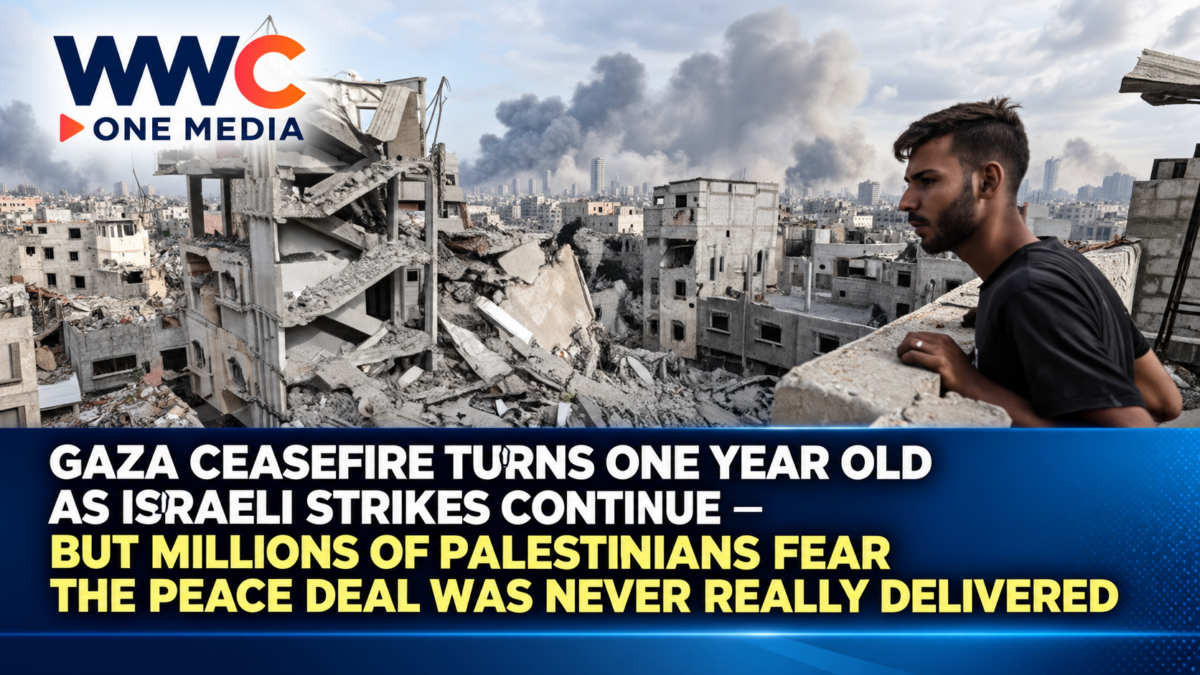
GAZA CITY — One year after a United States-brokered ceasefire promised to end the devastating war in Gaza, Palestinians remain trapped between continued Israeli military strikes, widespread destruction and a reconstruction process that has barely begun. With more than two million people facing severe humanitarian hardships and Israel retaining control of approximately 70% of the territory, residents say the agreement has delivered far less than the peace, security and recovery they expected.
A year after the world welcomed a diplomatic breakthrough intended to end the Gaza war, many Palestinians are asking a painful question: What happened to the peace they were promised?
The October 10, 2025, ceasefire agreement reduced the intensity of large-scale fighting and led to the release of the remaining living Israeli hostages held by Hamas.
But for families living among destroyed buildings, overcrowded shelters and displacement camps, the agreement has not brought a return to normal life.
According to an October 11 report by Channel NewsAsia, based on interviews conducted by Agence France-Presse (AFP), Gazans described continuing airstrikes, drone activity, shortages of basic necessities and deep frustration with stalled reconstruction.
Residents who expected to return to their homes say they are still living in temporary shelters.
For many, the gap between diplomatic declarations and conditions on the ground has become a source of profound anger and distrust.
The anniversary is therefore not simply a reminder of a ceasefire agreement.
It has become a test of whether international diplomacy can translate into lasting security, functioning institutions and a genuine recovery for Gaza’s population.
One Year After the Ceasefire, Palestinians Say Little Has Improved
In Gaza City, damaged buildings and makeshift displacement camps remain visible reminders of the war.
Families continue living in tents set up along streets and open spaces cleared from the rubble.
Fatima Awkal, a displaced resident interviewed by AFP, expressed anger that the ceasefire had failed to provide the relief she expected.
She described continuing deaths, injuries, shelling and the presence of drones overhead.
Her testimony reflects the frustration of civilians who believed the agreement would bring an end to the insecurity they had endured for years.
Another displaced resident, 51-year-old Ahmed Jonaid, said he had hoped to return home after the ceasefire.
Instead, he remains in temporary accommodation, collecting water for daily needs and living under difficult conditions.
His experience illustrates the difference between reducing major military operations and restoring ordinary civilian life.
A ceasefire may provide an opportunity for recovery, but that opportunity has limited value if people cannot safely return home, access essential services or rebuild their communities.
Reuters: Israeli Strikes Kill Five Palestinians on Ceasefire Anniversary
The continuing violence was underscored by fresh Israeli strikes on October 10, exactly one year after the ceasefire began.
Reuters reported that at least five Palestinians were killed in two separate incidents in Gaza City, citing local medical officials.
Four people were reportedly killed near Panda Mall, while another died in the Tuffah neighborhood.
The Israeli military said its operations targeted militants but did not provide detailed public information establishing the identities of all those killed.
The strikes demonstrate that the ceasefire has not resulted in a complete end to military action.
Israeli authorities accuse Hamas of rebuilding its military capabilities and violating the agreement.
Hamas rejects those accusations and alleges that Israel has undermined the truce through continued attacks and restrictions.
The competing allegations remain part of the dispute over compliance.
For civilians, the most immediate consequence is that violence continues despite the agreement’s stated aim of ending the war.
More Than 1,400 Palestinians Reportedly Killed Since the Ceasefire
According to Gaza health authorities, more than 1,400 Palestinians have been killed in violence since the ceasefire began in October 2025.
Reuters also reported that four Israeli soldiers had died during the same period.
These figures are attributed to the reporting authorities and should not be interpreted as independently verified counts for every individual incident.
They nevertheless demonstrate that the reduction in full-scale warfare has not eliminated deadly hostilities.
The wider war began after Hamas-led militants attacked Israel on October 7, 2023, killing approximately 1,200 people and taking 251 hostages.
Israel responded with a prolonged military campaign in Gaza.
By October 2026, Gaza health authorities reported that more than 74,000 Palestinians had been killed during the conflict.
The figures reflect the enormous human cost of the war, which has affected civilians, combatants, healthcare systems and essential infrastructure.
Although the current agreement significantly reduced the scale of fighting, its anniversary is being marked by continued casualties rather than a comprehensive peace.
Israel Controls Approximately 70% of Gaza
Another major obstacle is the territorial and security situation.
According to the October 11 CNA report, Israel controls approximately 70% of Gaza.
Israeli forces remain positioned across extensive parts of the territory, complicating civilian movement and the implementation of recovery plans.
Israel argues that military restrictions and security operations remain necessary to prevent Hamas from rebuilding its capabilities and launching future attacks.
Palestinian residents and humanitarian organizations warn that prolonged military control makes recovery far more difficult.
The dispute is central to the ceasefire’s unfinished second phase.
A lasting agreement would require decisions about military withdrawal, security arrangements, local governance and the prevention of renewed hostilities.
But those questions remain unresolved.
Without agreement on who controls Gaza and how security will be maintained, reconstruction projects face continued uncertainty.
United Nations: 82% of Gaza’s Standing Structures Damaged or Destroyed
The physical destruction remains one of the greatest barriers to recovery.
According to United Nations assessments cited by CNA, approximately 82% of Gaza’s standing structures had been damaged or destroyed as of mid-2026.
The destruction affects homes, schools, healthcare facilities, roads, utilities and commercial buildings.
For displaced families, returning home may be impossible when entire neighborhoods have been reduced to rubble.
Reconstruction also requires more than replacing destroyed buildings.
It involves restoring electricity, water systems, sanitation networks, transport infrastructure and public services.
Damaged roads and extensive debris make it difficult to transport equipment and materials.
Unexploded ordnance and potentially unstable structures present additional safety hazards.
The scale of destruction means that rebuilding Gaza will require sustained financial commitments, secure access and long-term coordination.
Without those conditions, even well-funded rebuilding proposals may struggle to progress.
More Than Two Million People Still Face Severe Humanitarian Conditions
The war displaced nearly all of Gaza’s population of more than two million people at least once, according to reporting summarized by CNA.
Many remain in tents, damaged buildings or temporary shelters.
Overcrowding, inadequate sanitation and limited access to clean water have contributed to health risks.
For families with young children, obtaining food, drinking water and basic medical care can remain a daily challenge.
Ahmed Shawan, a doctor working in Khan Younis, told AFP that the promised ceasefire had not translated into meaningful security for residents.
Healthcare facilities also face the long-term consequences of damaged infrastructure, limited resources and years of intense conflict.
A functioning recovery requires reliable medical supplies, sanitation, safe shelter and the restoration of routine healthcare.
Humanitarian assistance remains essential, but emergency relief alone cannot replace a stable civilian economy.
Aid Arrives, but Many Families Still Cannot Afford Essentials
Aid access has improved compared with some periods of the war, but major restrictions and logistical obstacles remain.
According to CNA, Israel continues to control entry points into Gaza and permits a limited flow of goods and assistance.
Israeli authorities have maintained that restrictions are necessary for security, including preventing materials from being diverted to Hamas.
Humanitarian organizations argue that the available supplies remain insufficient for a population facing extraordinary needs.
Ismail Hamouda, a 47-year-old displaced father from Jabaliya, described continuing shortages of drinking water, food and financial support.
Even when goods are physically available, many households lack the money required to purchase them.
This distinction is important.
Increasing the volume of imported goods may help stabilize markets, but families without income may still be unable to afford essentials.
A comprehensive recovery must therefore address aid access, employment, purchasing power and public services together.
Associated Press: Trump’s 20-Point Gaza Peace Plan Remains Stalled
Associated Press reported that several central provisions of the US-brokered agreement remain unfulfilled.
The 20-point peace framework was intended to establish a political transition, facilitate reconstruction, resolve the hostage issue and create a new security arrangement.
The initial ceasefire achieved some important results.
Major Israeli military operations were reduced, the remaining living hostages were released and humanitarian access improved from earlier periods.
However, the next stage has encountered significant political obstacles.
Hamas continues to exercise authority in parts of Gaza, while Israeli military control remains extensive.
The planned transition to new Palestinian governance has not progressed as originally envisioned.
The disagreement over Hamas disarmament is particularly significant.
Israel insists on stronger guarantees that Hamas will no longer pose a military threat.
The process has been complicated by disagreements over sequencing, security guarantees and the conditions for further Israeli withdrawal.
Hamas Disarmament Becomes a Major Obstacle
Disarmament is among the most difficult unresolved issues.
Israel argues that Hamas cannot retain military capabilities while a new political administration and security structure are established.
Israeli officials contend that allowing the group to maintain weapons would create the conditions for another conflict.
Hamas, meanwhile, has resisted elements of the proposed arrangements and disputes Israel’s interpretation of the agreement.
The disagreement has contributed to uncertainty over the ceasefire’s second phase.
AP reported that Israeli Prime Minister Benjamin Netanyahu rejected a subsequent disarmament proposal endorsed by President Donald Trump.
The dispute highlights the challenge of converting a temporary reduction in fighting into an enduring political settlement.
Neither military restrictions alone nor humanitarian funding can fully resolve Gaza’s future without an agreed security and governance framework.
Gaza’s Proposed New Government Has Yet to Take Control
The ceasefire plan envisioned a transition away from direct Hamas rule.
A new National Committee for the Administration of Gaza, or NCAG, was proposed to oversee civilian administration.
Technocrat Ali Shaath was designated to lead the body.
However, according to CNA, the committee has not established effective authority across Gaza.
Hamas continues to control important security functions in parts of the territory.
The absence of a functioning alternative administration complicates decisions about policing, public services, reconstruction and the management of humanitarian aid.
International donors are likely to demand credible oversight before committing large amounts of money to rebuilding projects.
Residents, meanwhile, need reliable institutions capable of delivering basic services and ensuring public safety.
The gap between the proposed governance arrangements and conditions on the ground remains a major barrier to recovery.
International Stabilisation Force Has Yet to Deploy
The peace framework also proposed an International Stabilisation Force to support security arrangements during the transition.
According to CNA, five countries, including Morocco, had agreed to participate in the force.
However, troops had not begun operating inside Gaza as of the October 11 reporting.
Associated Press also documented difficulties surrounding international troop commitments.
Indonesia had considered a deployment involving approximately 8,000 personnel, but the proposed contribution was delayed amid changing international circumstances.
The absence of a deployed force leaves an important part of the security transition unresolved.
A successful international mission would require agreement on its authority, composition, rules of engagement and relationships with Israeli and Palestinian institutions.
Without those arrangements, other parts of the peace plan may remain difficult to implement.
Washington Post: Gaza Reconstruction Projects Remain Blocked
The Washington Post reported on October 8 that proposed rebuilding projects were being held up by disagreements over Gaza’s future security and political arrangements.
The report said the Board of Peace established under Trump’s framework had access to approximately $280 million and had prepared numerous rebuilding proposals.
However, the projects were reportedly unable to move forward because of unresolved authorization and access issues.
The newspaper attributed much of the deadlock to Israeli Prime Minister Netanyahu’s position on disarmament and security.
Israeli officials maintain that preventing renewed threats is essential before wider changes can proceed.
The competing priorities have left residents caught between prolonged humanitarian need and slow-moving diplomacy.
For families living in tents, international disagreements have practical consequences: delayed housing, limited employment opportunities and continued uncertainty.
Palestinian Political Crisis Deepens as Elections Are Postponed
The difficulties surrounding Gaza’s future are also connected to wider Palestinian political divisions.
Reuters reported on October 10 that Palestinian President Mahmoud Abbas postponed planned legislative elections and scheduled both legislative and presidential polls for September 11, 2027.
Abbas cited security problems and obstacles affecting the organization of free elections.
The Palestinian Authority, dominated by Fatah, governs parts of the Israeli-occupied West Bank, while Hamas has exercised authority in Gaza.
The postponement extends a long period without renewed national elections.
Critics argue that the absence of fresh electoral mandates weakens public confidence in Palestinian political institutions.
Supporters of postponement contend that credible elections cannot be organized without adequate security, access and political agreement.
The division between Palestinian factions adds another obstacle to establishing legitimate and effective governance in Gaza.
Could Gaza’s Ceasefire Collapse Completely?
The risk of renewed large-scale hostilities remains a serious concern.
Continued strikes, disputes over disarmament and disagreements over Israeli military withdrawal have weakened confidence in the agreement.
However, the ceasefire has not been formally replaced by a return to the same intensity of military operations seen during the height of the war.
Its initial achievements also remain significant, particularly the hostage releases and reduction in major fighting.
The central danger is that persistent violations and unresolved political questions could erode those gains.
A sustainable outcome would require enforceable security arrangements, protection of civilians, humanitarian access and progress toward workable governance.
Without those elements, the region risks remaining in a prolonged state of instability.
What the Gaza Crisis Means for the Philippines and Asia
Developments in Gaza continue to attract attention across Asia, where governments maintain diplomatic, economic and humanitarian relationships with Middle Eastern countries.
Prolonged instability can influence regional security calculations and affect international humanitarian operations.
For the Philippines, the crisis also highlights the importance of monitoring developments affecting Filipinos working or traveling in the broader Middle East.
However, events in Gaza do not automatically establish an immediate threat to Filipino communities elsewhere in the region.
Any specific risks should be assessed through verified diplomatic and security advisories.
The humanitarian situation also raises wider international questions about the protection of civilians, access to essential services and the responsibilities of parties to armed conflict.
Those principles remain relevant regardless of the nationality of the affected population.
The Bigger Picture: A Ceasefire Without Recovery Leaves Gaza in Limbo
One year after the US-brokered ceasefire, Gaza remains caught between a reduction in full-scale war and the absence of lasting peace.
The agreement delivered important early developments, including the return of Israeli hostages and a reduction in major military operations.
But continued strikes, extensive Israeli military control, unresolved Hamas disarmament and stalled reconstruction have prevented the promised transformation of civilian life.
For Palestinians living among ruins, the anniversary offers few reasons for celebration.
Many remain displaced, without secure housing, reliable services or a clear timetable for rebuilding.
The international community now faces a difficult challenge.
It must determine whether the ceasefire framework can be revived through renewed negotiations and concrete implementation — or whether the current political deadlock will continue preventing meaningful recovery.
A year after the ceasefire was announced, Gaza’s residents are still waiting for the safety, homes and livelihoods they were promised.
But the bigger question is whether international leaders can overcome the political and security disputes blocking reconstruction before continued violence destroys what remains of the peace agreement.
For families who have already endured years of war, the measure of success is no longer the signing of another diplomatic document.
It is whether they can finally live without fear, return to safe homes and begin rebuilding their lives.