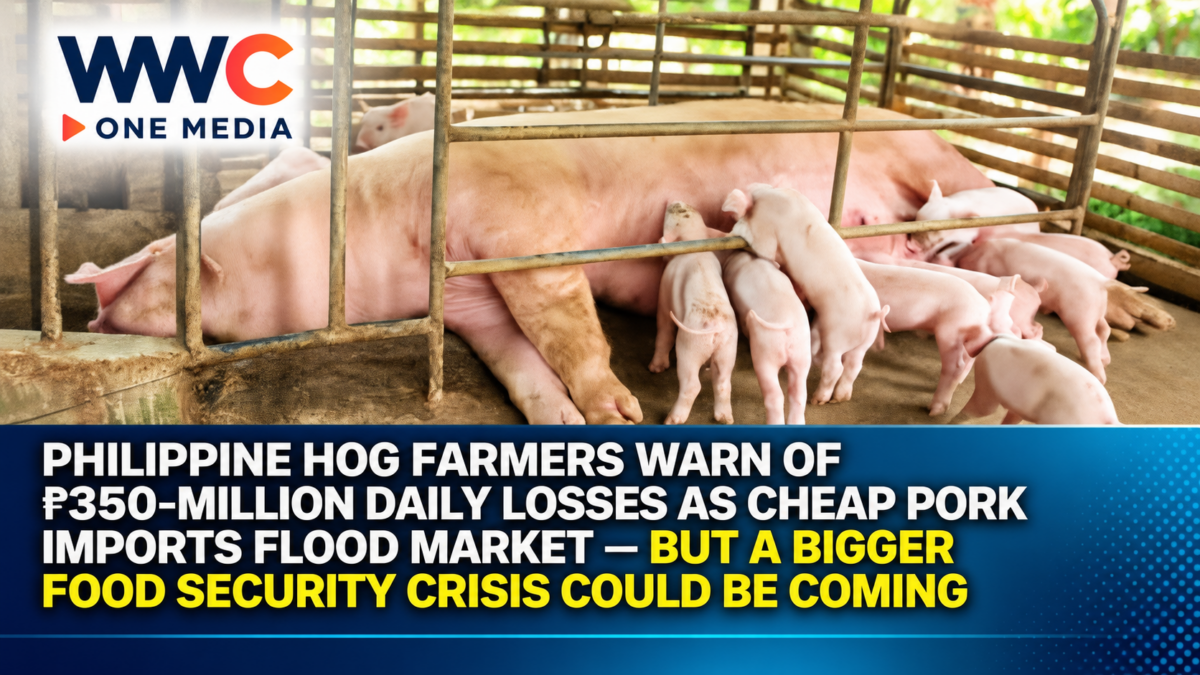
MANILA, PHILIPPINES — Filipino hog farmers are sounding the alarm over an escalating crisis in the country’s pork industry, estimating that plunging farmgate prices and competition from cheaper imported meat are costing local producers as much as ₱350 million every day. Industry groups are urging President Ferdinand Marcos Jr. to immediately restore higher pork import tariffs and restrict incoming shipments, warning that more farms could shut down if the government fails to act. But while producers demand protection, policymakers face another difficult question: can the Philippines save its hog industry without making pork more expensive for millions of consumers?
The Philippine hog industry is confronting one of its most difficult periods in recent years as farmers struggle with declining selling prices, competition from imported meat and the lingering financial damage caused by African swine fever.
Local producers say the economics of raising pigs have become increasingly unsustainable.
According to Bilyonaryo’s October 10 report, the National Federation of Hog Farmers Inc. (NFHFI) estimates that the domestic industry is suffering approximately ₱350 million in daily losses as imported pork continues to pressure farmgate prices.
The federation also claims that reduced tariffs on pork imports are costing the Philippine government approximately ₱27 billion annually in potential customs revenue.
Those amounts are industry estimates, not independently audited nationwide losses or confirmed government revenue shortfalls.
Nevertheless, the warning has intensified pressure on the Marcos administration to reconsider its import policies before additional local producers are forced to abandon their businesses.
The crisis could have consequences extending beyond commercial hog farms.
Feed manufacturers, corn growers, transportation businesses, meat processors and rural communities all depend on a functioning domestic livestock industry.
Hog Farmers Warn That the Industry Is Nearing Collapse
Agricultural organizations have issued an urgent appeal to President Marcos, arguing that current trade policies are placing Filipino producers at a severe disadvantage.
Jayson Cainglet, executive director of Samahang Industriya ng Agrikultura (SINAG), warned that the industry was approaching a breaking point.
The groups say some hog farms have already closed, while others are considering leaving the industry because selling prices are insufficient to cover production expenses.
Farm operators must continue paying for feeds, veterinary care, labor, electricity, water, transportation and biosecurity measures even when livestock prices decline.
For producers who borrowed money to rebuild operations after African swine fever outbreaks, falling revenues can make repayment increasingly difficult.
The crisis is particularly serious for smaller farmers, who generally have less financial flexibility than large commercial operations.
If prolonged losses cause more producers to exit the industry, rebuilding domestic hog production could become substantially more difficult.
Why Farmers Say They Are Losing ₱350 Million Every Day
The National Federation of Hog Farmers based its estimate on approximately 50,000 hogs and farmgate prices that industry representatives said had fallen to between ₱90 and ₱100 per kilogram in some affected transactions.
NFHFI vice president Jun Ona presented the estimate as an indication of the enormous financial pressure facing domestic producers.
Other industry organizations have reported somewhat different figures.
The Philippine Star and Daily Tribune reported that some hog raisers were receiving approximately ₱130 to ₱140 per kilogram despite production costs of about ₱180 to ₱190 per kilogram.
That suggests a loss of approximately ₱40 to ₱60 for every kilogram sold at those reported prices.
For a 100-kilogram animal, a ₱50-per-kilogram shortfall would represent approximately ₱5,000 in losses.
The precise loss varies according to farm efficiency, animal weight, selling price and actual operating expenses.
Importantly, not all reported estimates use identical farmgate prices, production assumptions or volumes.
An earlier industry estimate placed daily losses at approximately ₱250 million, while Bilyonaryo’s newer report cited a higher ₱350-million figure.
These should be treated as separate estimates from industry representatives rather than figures established through a single nationwide accounting exercise.
Pork Imports Put Increasing Pressure on Local Producers
Farm groups argue that the growing availability of imported meat is a major contributor to falling domestic hog prices.
Imported pork can compete directly with locally raised animals, particularly when import duties are lower and overseas suppliers offer products at competitive prices.
According to figures cited by hog producers and reported by Daily Tribune, Philippine pork imports reached approximately 851 million kilograms in 2025.
Industry representatives projected that shipments could reach around 939 million kilograms in 2026 if the prevailing pace continued.
The 2026 figure is a projection, not a final annual import total.
Industry groups argue that increasing imported supplies, combined with existing stocks in cold-storage facilities, can weaken demand for locally produced pork.
That can put downward pressure on prices paid to farmers.
However, pork import volumes alone do not explain every movement in livestock prices.
Domestic production, meat inventories, consumer demand, feed costs, transportation and disease conditions also influence the market.
The Department of Agriculture has acknowledged that rising imports are affecting farmers at a time when domestic hog production is recovering.
Farmers Demand Immediate Restoration of Higher Pork Tariffs
At the center of the industry’s appeal is a demand for President Marcos to restore higher duties on imported pork through an executive order.
The groups want tariff rates returned to 30% for in-quota pork imports and 40% for shipments exceeding the minimum access volume, or MAV.
The MAV system allows a specified quantity of agricultural imports to enter at a lower tariff rate.
Shipments exceeding the quota are subject to a higher tariff.
The rates currently identified by the Department of Agriculture are 15% for in-quota shipments and 25% for out-of-quota shipments.
Local producers argue that restoring the earlier tariff structure would reduce the price advantage enjoyed by some imported pork products.
Higher tariffs could also generate additional customs revenue for the government, depending on actual import volumes, declared values and market responses.
However, increasing import duties can raise costs for importers, processors and consumers.
That trade-off is central to the government’s decision.
Farmers Reject Government’s 2027–2028 Tariff Plan
The Department of Agriculture has already proposed restoring pork tariffs gradually.
Under the government’s announced approach, rates would rise to 25% for in-quota imports and 35% for out-of-quota shipments in 2027.
They would then return to 30% and 40%, respectively, in 2028.
The phased plan is intended to give the market time to adjust while addressing concerns about domestic producers’ profitability.
But agricultural groups argue that waiting until 2027 and 2028 would prolong the pressure on farmers.
They say some businesses may not survive long enough to benefit from the proposed increases.
Their position is that decisive intervention is needed immediately rather than through gradual adjustments extending over two years.
President Marcos therefore faces competing policy objectives: protecting local agricultural livelihoods while preserving affordable food supplies.
Industry Groups Also Want Temporary Import Restrictions
Beyond tariff increases, hog farmers are demanding temporary restrictions on additional pork imports.
Their proposal includes suspending new shipments and restricting the release of existing imported pork stocks from cold-storage facilities until market conditions improve.
The groups argue that suspending new shipments would have limited effect if significant quantities of previously imported meat continued entering the domestic market.
They believe existing inventories could keep local prices depressed even after new import applications are restricted.
However, an import suspension would require careful legal, commercial and food-supply assessment.
Officials would need to consider existing contracts, quarantine rules, domestic supply availability and applicable international trade commitments.
Restrictions on releasing imported food already in storage would also need to account for product safety, spoilage risks and the rights of affected businesses.
At the time of the latest reports, these measures were demands from industry organizations rather than a confirmed nationwide import ban.
₱27 Billion in Government Revenue Allegedly Lost to Lower Tariffs
Another major claim involves government revenue.
NFHFI vice chairman Alfred Ng estimated that reduced import duties were costing the government approximately ₱27 billion annually.
According to Bilyonaryo, the estimate was calculated using an assumed import cost of $3 per kilogram and the difference between existing and proposed tariff rates.
The federation argues that higher duties could help protect local producers while increasing customs collections.
However, the actual revenue impact would depend on import quantities, customs valuation, tariff classification and changes in importer behavior.
Higher tariffs could reduce import volumes, which would affect collections.
The ₱27-billion figure should therefore be understood as an industry projection of potential foregone revenue, not an officially established fiscal loss.
Department of Agriculture Acknowledges the Growing Problem
The government’s own statements confirm that domestic hog producers are facing serious pricing difficulties.
In a September 25 announcement, the Department of Agriculture said Agriculture Secretary Francisco Tiu Laurel Jr. met with hog industry leaders to discuss falling farmgate prices.
The department acknowledged that imported pork was putting pressure on prices while local production recovered.
On September 28, the Presidential Communications Office reported that the administration was considering stronger controls on imported pork.
Possible measures included tighter quarantine procedures, improved import valuation checks and additional restrictions on certain products competing with domestic pork.
The Palace also said local hog production had increased by approximately 6% during the first half of 2026.
That recovery is encouraging, but producers argue that increased domestic output is being absorbed into a market already pressured by substantial imports.
For the government, the challenge is ensuring that recovery in livestock production translates into sustainable earnings for farmers.
African Swine Fever Remains a Major Obstacle
The current financial crisis comes after years of disruption caused by African swine fever, or ASF.
The disease began severely affecting Philippine hog production in 2019 and led to major herd losses across the country.
The Department of Agriculture has acknowledged that the national swine population has not fully returned to its pre-ASF level of approximately 13 million animals.
In May 2026, the agency announced an expanded repopulation program aimed at restoring domestic production.
The initiative included the planned procurement of approximately 32,000 breeding female pigs, known as gilts.
Authorities also outlined the goal of adding around six million hogs by 2028.
The effort is intended to improve domestic supply and reduce long-term reliance on imported pork.
However, disease prevention, financing and market profitability remain important challenges.
Farmers may hesitate to restock their operations if they believe future livestock sales will not cover their costs.
Cheap Pork Today Could Create Supply Risks Tomorrow
Low meat prices may initially appear beneficial to consumers.
But agricultural economists generally recognize that persistently unprofitable farm prices can discourage domestic production and investment.
If large numbers of local farmers reduce operations, the country could become more dependent on imported supplies.
That dependence may create risks when international prices rise, foreign suppliers experience disease outbreaks or transportation costs increase.
However, the opposite policy choice also carries risks.
Restricting imports too aggressively could reduce available supply and contribute to higher retail pork prices.
Consumers, especially lower-income households, could face additional financial pressure.
A sustainable policy needs to balance the survival of domestic producers with dependable access to reasonably priced food.
The central question is not simply whether pork imports should be allowed.
It is how domestic production, imported supply and agricultural support can be managed without destabilizing either farm incomes or household budgets.
Corn Growers and Feed Suppliers Could Also Be Affected
The hog industry supports an extensive network of other agricultural and commercial activities.
Livestock farms purchase feeds containing corn, soybean meal and other ingredients.
They also require veterinary products, equipment, transportation, labor and farm services.
If hog production contracts, demand for these inputs may weaken.
That could affect feed manufacturers and agricultural suppliers, particularly in rural areas where livestock production forms an important part of the local economy.
SINAG has warned that a prolonged downturn could spread beyond pig farmers to other agricultural producers.
However, the extent of those broader effects would depend on how many farms reduce operations and whether demand for their suppliers’ products can be replaced by other customers.
Stronger Quarantine and Anti-Smuggling Measures Also Demanded
Industry groups are also calling for stricter controls at Philippine ports.
Their proposals include mandatory quarantine inspections at first-entry ports and risk-based laboratory testing for food safety and animal diseases.
They also want customs authorities to update import reference values regularly to help detect potential undervaluation.
Undervaluation occurs when imported goods are declared at values lower than their actual customs value, potentially reducing duties owed.
Farm organizations argue that stronger verification would help ensure legitimate competition between imported and locally produced products.
However, allegations of undervaluation or improper import declarations should not be treated as proof that all importers are engaged in illegal conduct.
Effective enforcement requires evidence-based investigation, accurate customs procedures and consistent application of food safety rules.
ABS-CBN and The Philippine Star Report Rising Industry Pressure
Independent reporting confirms that the dispute has become a major national agricultural concern.
ABS-CBN News reported on October 9 that hog industry representatives were calling for immediate tariff increases and temporary import restrictions.
The Philippine Star separately reported farmers’ concerns over farmgate prices that had fallen below production costs.
Daily Tribune also documented public appeals from industry representatives and agricultural organizations.
Although the reports differ in some financial estimates, they describe the same fundamental issue: Filipino hog raisers believe the combination of low farmgate prices and large imported pork supplies threatens their ability to remain in business.
The Department of Agriculture’s own statements confirm that the government is considering policy changes to address the pressure.
But as of October 11, the latest industry demand for immediate restoration of the full 30% and 40% tariff rates had not been confirmed as an implemented policy.
What the Crisis Means for Filipino Consumers
The dispute is not limited to farmers and importers.
Pork is widely used in Filipino households, restaurants and food businesses.
Price changes can affect popular dishes, processed meat products and food service operations.
If the government increases pork tariffs or restricts imports, some costs could eventually be passed on to wholesalers, retailers or consumers.
However, the size and timing of any retail price changes would depend on existing stocks, domestic supply, competition and market conditions.
Lower farmgate prices also do not necessarily translate into proportionate reductions at supermarkets and wet markets.
Retail prices reflect transportation, slaughtering, refrigeration, distribution and other costs.
That difference is one reason policymakers need to examine the entire supply chain rather than focusing exclusively on farmgate prices or import volumes.
The goal should be to ensure that farmers receive sustainable compensation while consumers continue to have access to affordable meat.
The Bigger Picture: A Major Test of Philippine Food Security
The growing pressure on the Philippine hog industry has become a significant test of the Marcos administration’s agricultural policies.
Farm organizations argue that continued reliance on lower-tariff pork imports is undermining the recovery of domestic production.
Their warnings come after years of financial damage caused by African swine fever, high production costs and unstable market conditions.
The government has acknowledged the problem and proposed restoring import duties in stages.
But producers insist that gradual action will not be enough.
They want immediate tariff increases, temporary import restrictions and tighter quarantine and customs enforcement.
The decision carries important consequences.
Stronger protection could improve conditions for domestic producers but may also increase costs for meat buyers.
Maintaining low import duties could support imported supply but leave local farms exposed to continued price pressure.
Philippine hog raisers estimate that they are losing as much as ₱350 million every day, warning that more farms may close unless the government intervenes.
But the bigger question is whether the Philippines can protect its domestic pork industry without triggering higher food prices for the very households it is trying to serve.
For President Marcos, the next policy decision could shape not only the future of local hog farming but also the country’s long-term dependence on imported food.