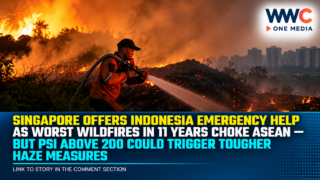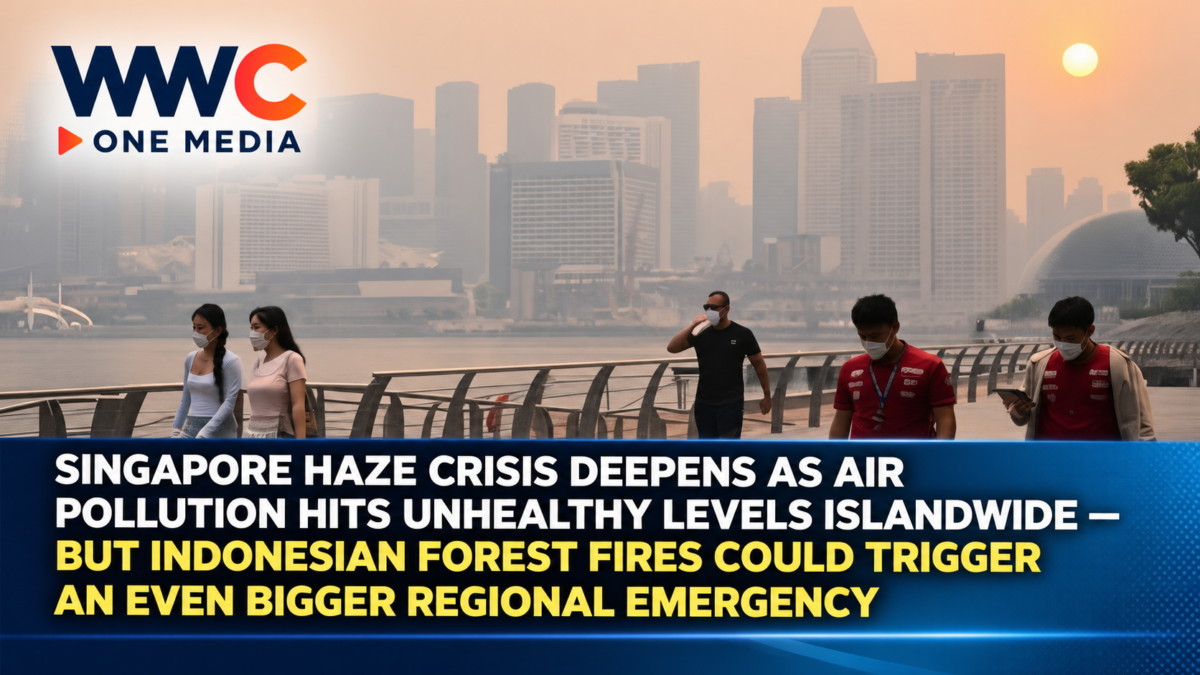
SINGAPORE — Singapore is battling another wave of severe transboundary haze as air quality remains unhealthy across all five regions, prompting government agencies to prepare emergency health measures while smoke from Indonesia’s forest and land fires continues drifting toward the city-state. With pollution readings reaching their highest levels of the 2026 haze season and the Formula 1 Singapore Grand Prix taking place this weekend, authorities are warning that conditions could deteriorate further.
Singapore’s battle against worsening air pollution has entered a critical period as thick haze continues to blanket the island, raising concerns about public health, outdoor activities and the wider environmental emergency unfolding across Southeast Asia.
According to Channel NewsAsia on Sunday, October 11, the 24-hour Pollutant Standards Index (PSI) remained in the unhealthy range across all five regions of Singapore.
At 7 a.m., the index ranged from 116 to 153, while hourly PM2.5 readings stood between 56 and 108 micrograms per cubic meter, classified as elevated.
Singapore’s National Environment Agency (NEA) warned that air quality could remain unhealthy to high unhealthy over the following 24 hours.
The main concern is smoke from forest and land fires in Indonesia, particularly southern Sumatra and Kalimantan, which continues to cross international borders as prevailing winds carry polluted air toward Singapore.
While scattered rainfall could bring temporary relief, continued dry conditions in parts of Indonesia mean the haze threat has not disappeared.
For residents, businesses and visitors, the immediate concern is whether pollution levels will climb high enough to trigger additional restrictions on outdoor activities.
Singapore Records Its Worst Haze Readings of 2026
The latest deterioration follows several days of increasingly poor air quality.
On Friday, October 9, Singapore’s central region recorded a 24-hour PSI reading of 192 at 5 p.m., the highest level of the country’s 2026 haze season up to that point.
The reading approached the Very Unhealthy category, which begins at 201.
Although air quality improved somewhat overnight, pollution remained at unhealthy levels across the country on Saturday and Sunday.
The NEA had earlier warned that the 24-hour PSI could exceed 200 if smoke continued flowing into Singapore from Indonesia.
A reading above 200 would represent a significant deterioration and activate stronger public-health precautions.
The situation remains highly dependent on wind direction, fire activity and rainfall.
A temporary improvement in readings does not necessarily mean the broader regional haze episode has ended.
Understanding Singapore’s Pollution Levels
Singapore uses the 24-hour PSI to communicate overall air quality and guide health precautions.
The index considers several air pollutants, including fine particulate matter.
The main PSI classifications are:
- Good: 0–50
- Moderate: 51–100
- Unhealthy: 101–200
- Very Unhealthy: 201–300
- Hazardous: Above 300
During haze episodes, officials also publish one-hour PM2.5 readings to help residents assess shorter-term changes.
PM2.5 refers to airborne particles measuring 2.5 micrometers or less in diameter.
Because these particles are extremely small, they can penetrate deeply into the lungs and contribute to respiratory and cardiovascular health problems.
Children, older people, pregnant individuals and those with existing heart or lung conditions may be particularly vulnerable.
The hourly PM2.5 readings are different from the 24-hour PSI and should not be interpreted using the same numerical classification bands.
Singapore Activates 28-Agency Haze Task Force
As the pollution threat intensifies, Singapore has convened its Haze Task Force, comprising 28 government agencies.
The coordinated response is intended to ensure that public services, educational institutions, healthcare facilities and community organizations can react quickly if conditions worsen.
Authorities have prepared additional measures that could be implemented if the 24-hour PSI exceeds 200.
These include distributing N95 masks to eligible Singaporeans and establishing air-conditioned haze shelters at community clubs and selected community facilities.
The measures would provide additional support for residents who have difficulty avoiding polluted outdoor environments.
Government agencies are also monitoring the effects on schools, outdoor workers and public activities.
The task force’s activation demonstrates the seriousness of the threat, although it does not mean every emergency measure has already been implemented.
Schools Could Close if Pollution Reaches Hazardous Levels
Singapore’s Ministry of Education is preparing for the possibility of more severe air pollution.
Education Minister Desmond Lee said schools could be closed if the forecast 24-hour PSI for the following day exceeds 300 and enters the Hazardous category.
Any closure decision would be announced around 8 p.m. the preceding evening through schools and official Ministry of Education communication channels.
At Very Unhealthy levels, preschools are expected to stop outdoor and strenuous indoor activities.
Other educational institutions may adjust physical activities and sporting events according to prevailing health guidance.
The government has emphasized that decisions will depend on updated forecasts rather than a single short-term pollution reading.
As of the October 11 report, Singapore had not announced a blanket nationwide school closure under the hazardous-level threshold.
The possibility nevertheless highlights how a prolonged haze episode could disrupt normal daily life.
Formula 1 Singapore Grand Prix Faces a Haze Test
The worsening air pollution comes during one of Singapore’s most internationally visible sporting weekends.
The Formula 1 Singapore Grand Prix is taking place at Marina Bay, attracting international visitors, racing teams, sponsors and entertainment audiences.
Reuters reported on October 8 that motorsport authorities were monitoring the pollution situation and preparing contingency measures.
The Fédération Internationale de l’Automobile (FIA) indicated that entertainment and some outdoor activities could be modified if conditions deteriorated.
However, the race was still expected to proceed under the preparations described in the reporting.
Organizers have coordinated with authorities over public-health precautions, including access to medical assistance and protective equipment if necessary.
The timing creates additional pressure for event organizers because the Singapore Grand Prix involves thousands of spectators and extensive outdoor activity.
The haze could also affect visitor comfort and the wider tourism experience.
Nevertheless, a potential disruption should not be confused with a confirmed race cancellation.
Financial Times: Haze Threatens Singapore’s Global Events Reputation
The Financial Times reported that the pollution episode was creating additional challenges for Singapore’s international events and tourism industry.
The Grand Prix weekend includes major concerts, hospitality programs and corporate gatherings.
These events attract international visitors and generate spending for hotels, restaurants, retailers and service providers.
Previous Singapore Grand Prix events have contributed substantially to tourism revenue over the years.
Persistent haze could complicate outdoor programming, increase medical requirements and discourage some visitors from spending extended periods outside.
The situation also highlights a broader vulnerability for Singapore.
Despite strong domestic environmental controls and urban infrastructure, the country remains exposed to pollution originating beyond its borders.
Its ability to maintain clean air can therefore be influenced by environmental conditions and land-management practices in neighboring countries.
Reuters: Indonesia Faces Its Worst Wildfires in 11 Years
The current haze episode is closely connected to a major environmental crisis in Indonesia.
Reuters reported on October 5 that the country was experiencing its most severe wildfire conditions in approximately 11 years.
Forest and peatland fires have affected parts of Sumatra and Kalimantan, releasing large amounts of smoke into the atmosphere.
Hot and dry conditions have made containment particularly difficult.
Peatland fires are especially dangerous because they can continue burning beneath the surface, making them difficult to extinguish and allowing them to reignite.
Environmental organizations have warned that degraded peatlands are highly vulnerable when water tables fall and vegetation dries out.
Although Indonesian authorities reported a decline in some hotspot counts, experts cautioned that this did not guarantee the fires were under control.
The intensity and duration of the fire season have renewed concern about land degradation, deforestation and the long-term management of peat ecosystems.
Indonesia Expands Firefighting Operations
Indonesian authorities have been increasing their response to the crisis.
Earlier reporting by Channel NewsAsia documented the expansion of wildfire management efforts beyond several priority provinces.
Officials identified Riau, Jambi, South Sumatra and provinces across Kalimantan as important areas requiring attention.
Firefighting operations have involved ground personnel, monitoring systems and aerial water-bombing activities.
Authorities are also tracking changes in wind direction because smoke from Indonesia can travel across national borders.
Indonesia’s Forestry Ministry previously warned that wildfire activity could persist into late October or early November.
The duration will depend partly on rainfall and the arrival of wetter weather conditions.
For Singapore, this means a sustained improvement in local air quality may depend as much on regional fire suppression and changing weather patterns as on domestic preparedness.
Malaysia Also Faces School Closures and Health Risks
The haze emergency is not limited to Singapore.
Reuters reported on October 9 that Malaysia had ordered school closures in several states and federal territories because of worsening air pollution.
The decision reflected growing concerns about the health of students and school employees.
The South China Morning Post separately reported that school closures across several Malaysian regions were renewing calls for stronger enforcement against companies linked to fire-prone land in Indonesia.
Environmental organizations have urged governments to examine corporate land-use practices and strengthen accountability where evidence supports enforcement action.
However, the existence of fires near plantation or concession areas does not automatically establish that a particular company deliberately started them.
Responsibility must be determined through credible investigations and applicable legal processes.
The wider crisis demonstrates how one country’s environmental emergency can quickly become a regional public-health problem.
Respiratory Illnesses Rise in Fire-Affected Parts of Indonesia
The health consequences are particularly serious near the source of the fires.
Channel NewsAsia previously reported that Indonesian health data showed more than 113,000 acute respiratory infection cases across affected regions as of September 9.
The reported total had risen sharply from approximately 50,900 cases recorded earlier that month.
Children younger than five represented a substantial proportion of those cases.
The figures reflect reported illness in areas experiencing severe smoke pollution.
They do not establish that every case was caused exclusively by wildfire smoke.
Nevertheless, the increase underscores the public-health burden facing communities close to major burning areas.
Residents exposed to prolonged smoke may experience respiratory irritation, worsening asthma symptoms and other health complications.
Healthcare access and protective measures can be particularly challenging in rural locations close to active fires.
Why Haze Keeps Returning to Southeast Asia
Transboundary haze has affected Southeast Asia for decades.
The problem is often associated with forest clearing, agricultural land management and fires in degraded peatland ecosystems.
During extended dry seasons, vegetation becomes more flammable and fires can spread rapidly.
Peat soils create additional challenges because they contain significant amounts of organic material that can burn underground.
Once ignited, peat fires can release smoke for extended periods.
Wind patterns then transport the pollution across borders, affecting countries far from the source.
Climate variability, drought and changes in rainfall can intensify fire conditions.
Land-use practices and enforcement also influence the scale of the problem.
Addressing recurring haze therefore requires more than responding after pollution reaches major cities.
Long-term solutions include better fire prevention, peatland restoration, land management, monitoring and regional cooperation.
ASEAN Faces Renewed Pressure to Find a Permanent Solution
The latest haze episode is raising questions about the effectiveness of regional environmental cooperation.
ASEAN countries have long recognized transboundary haze as a shared problem requiring coordinated action.
The ASEAN Agreement on Transboundary Haze Pollution provides a framework for cooperation on prevention, monitoring and response.
However, enforcing effective environmental protections across different jurisdictions remains difficult.
Countries have different legal systems, economic priorities and enforcement capabilities.
Environmental groups argue that stronger transparency, corporate accountability and peatland protection are needed to reduce recurring smoke pollution.
The latest crisis could renew demands for better satellite monitoring, public disclosure of fire locations and closer cooperation between national authorities.
Yet lasting progress will depend on sustained enforcement and prevention efforts rather than emergency measures alone.
How Singapore Residents Can Protect Themselves
As the haze persists, residents are being advised to monitor official air-quality updates and adjust their activities according to current conditions.
During periods of unhealthy pollution, prolonged or strenuous outdoor activities should be reduced, particularly for people who are more vulnerable to particulate pollution.
Those with heart or lung conditions should follow medical advice and take extra precautions.
Where possible, people can remain in indoor environments with effective filtration and keep windows closed when outdoor pollution is high.
Properly fitted N95 masks can help reduce exposure to particulate pollution during necessary outdoor activities, although they do not remove every air pollutant.
Ordinary surgical masks provide less reliable protection against fine airborne particles.
The appropriate precautions depend on pollution levels, individual health conditions and official guidance.
Residents can follow the latest readings and forecasts through Singapore’s National Environment Agency.
What the Haze Means for the Philippines and the Rest of ASEAN
Although Singapore and Malaysia are among the countries most visibly affected, the broader situation has implications for the region.
Forest-fire smoke can move across Southeast Asia depending on atmospheric conditions.
Air quality in different countries can change rapidly as winds shift.
For the Philippines, any assessment of direct haze exposure must rely on local monitoring and official weather or environmental advisories.
Poor air quality in Singapore does not automatically mean the same pollution conditions are present throughout the Philippines.
However, the regional crisis demonstrates the importance of coordinated environmental monitoring and preparedness.
It also highlights the economic consequences of severe air pollution, particularly for tourism, transportation, education, public health and outdoor employment.
The Bigger Picture: Singapore’s Haze Crisis Is an ASEAN-Wide Warning
Singapore’s latest haze episode is a reminder that air pollution can cross national borders and disrupt daily life even in countries with advanced infrastructure and strong environmental controls.
The return of unhealthy conditions across all five regions has prompted a coordinated government response.
Authorities are preparing protective measures for vulnerable residents while schools and event organizers remain alert to possible changes in air quality.
Indonesia is confronting serious wildfire conditions, while neighboring Malaysia has already experienced school closures.
For Singapore, the immediate objective is to protect public health and maintain essential activities while waiting for pollution levels to improve.
But the longer-term challenge is considerably larger.
Preventing recurring haze will require effective fire management, environmental enforcement and cooperation across Southeast Asia.
Singapore’s unhealthy air quality has already triggered heightened government preparedness and renewed concern over respiratory health.
But the bigger threat lies beyond the city-state’s borders, where persistent forest and peatland fires could continue sending smoke across ASEAN as long as dry conditions remain.
And unless regional governments address the underlying causes of recurring land fires, Southeast Asia may face the same dangerous cycle of toxic haze, economic disruption and public-health emergencies for years to come.