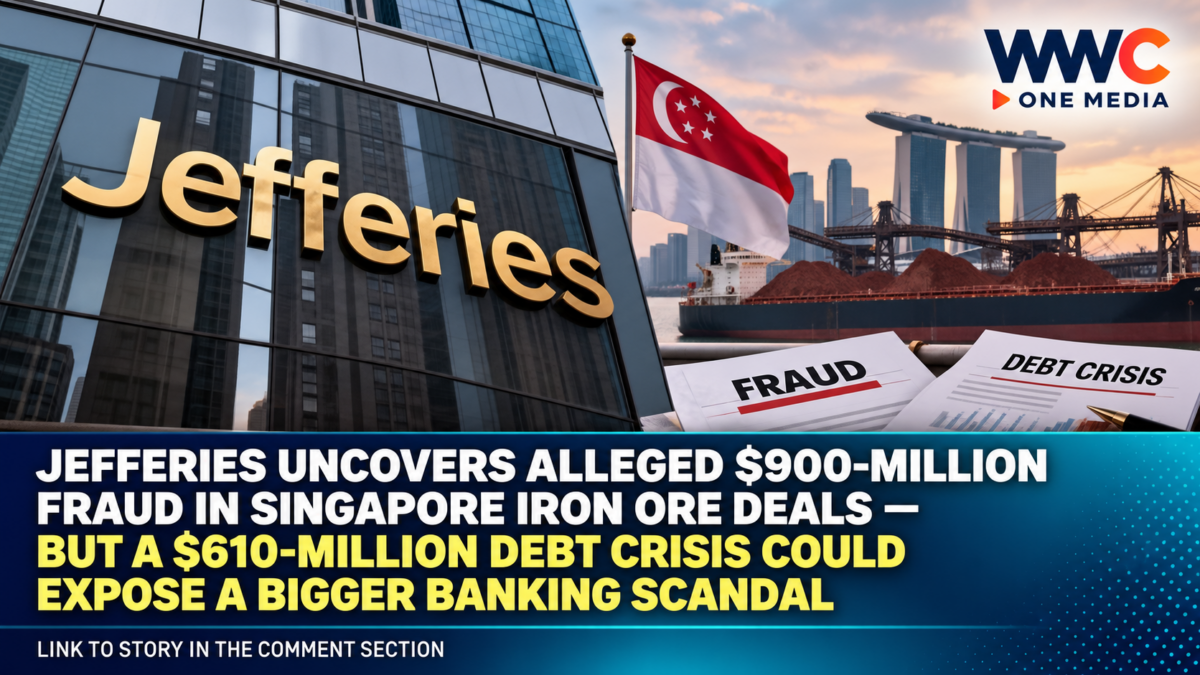
Wall Street investment bank Jefferies is confronting a rapidly expanding financial controversy after a fund it manages alleged widespread document falsification involving nearly $900 million in iron ore financing transactions linked to Singapore-based Radiant World and Sapphire Minmetals. With hundreds of millions of dollars in outstanding obligations, major trading companies disputing invoices and legal battles spreading across international jurisdictions, the allegations are raising serious questions about the safeguards protecting the global commodities financing industry.
The global commodities trading industry is facing a potentially far-reaching financial scandal as fresh allegations emerge involving one of Singapore’s prominent iron ore traders and a major Wall Street financial institution.
A fund managed by Jefferies Financial Group has presented new evidence alleging that Radiant World and Sapphire Minmetals engaged in extensive falsification of trade finance documentation.
According to Bloomberg’s October 10 report, the fund alleges that at least 50 receivables-financing transactions, carrying a combined face value of nearly $900 million, were supported by fabricated or falsified documents.
The revelations significantly expand the reported scale of the dispute, which has already drawn in major banks, commodity traders and regulators across multiple countries.
However, the $900 million represents the stated face value of transactions under scrutiny. It is not a confirmed amount stolen, an established financial loss or the amount of Jefferies’ direct exposure.
The allegations have not been established by a final court judgment, and the companies involved have denied wrongdoing.
Jefferies Fund Alleges Fraud Across Nearly $900 Million in Deals
The latest claims emerged in an affidavit filed by lawyer Christopher Bushell on behalf of a Jefferies-managed trade finance fund.
According to Bloomberg, the affidavit alleges that Radiant World and Sapphire Minmetals falsified legal and financial documents on a large scale.
The fund says it has identified at least 50 receivables associated with nearly $900 million in purported transactions.
Receivables financing allows trading companies to obtain funding using payments they expect to collect from customers.
In a legitimate transaction, a lender or investment fund advances money against an authentic invoice or contractual payment obligation.
When the buyer pays the invoice, the financier recovers its investment.
But if the underlying transaction was fabricated, already settled or otherwise invalid, the lender may have no enforceable payment claim against the supposed buyer.
That is the central concern in the Jefferies case.
The fund alleges that financing was advanced on the basis of documents connected to transactions that did not represent genuine outstanding payment obligations.
If proven, the alleged scheme would expose significant weaknesses in how lenders verify trade documentation and assess the authenticity of commercial transactions.
More Than $610 Million Outstanding as Fund Seeks Recovery
The dispute has created substantial uncertainty over money owed to the Jefferies-managed fund.
According to Bloomberg, LAM Trade Finance Group II, part of the Point Bonita Capital investment structure, is owed more than $610 million under financing arrangements involving Radiant World and Sapphire Minmetals.
More than $550 million of that amount was linked to purported sales to global commodity trading companies Glencore and Vitol.
However, both trading houses have disputed the validity of relevant transactions.
The fund says Glencore and Vitol provided evidence indicating that documents relating to supposed purchases had been falsified.
Both companies have also maintained that they do not owe the amounts claimed under the disputed transactions.
That creates a major challenge for the fund.
If the named buyers never entered into the transactions described in the financing documents, the fund may be unable to recover the money from them.
Instead, recovery could depend on litigation against the trading companies that obtained financing, their owners and any assets available to creditors.
The amount ultimately recoverable remains uncertain.
London Court Freezes Nearly $500 Million in Assets
The dispute has already produced significant legal action in Britain.
A London court granted a worldwide freezing order of approximately $499 million against Radiant World, Sapphire Minmetals and their majority owners, Pinkesh Nahar and Rakesh Sethi.
Such an order is intended to prevent defendants from moving or disposing of assets while litigation is ongoing.
It does not establish that the defendants committed fraud.
The legal action includes claims concerning alleged deceit, conspiracy, breach of contract and restitution.
For the fund, securing assets could be crucial to preserving the possibility of recovering money if its claims ultimately succeed.
But even a freezing order does not guarantee that sufficient assets will be available.
Creditors may still have to identify recoverable property, establish legal entitlement and navigate competing claims from other lenders.
Glencore and Vitol Reject Disputed Payment Claims
Two of the world’s best-known commodity trading companies have become central to the controversy.
Glencore and Vitol were named in documents relating to financing transactions involving Radiant World and Sapphire Minmetals.
According to the allegations, the Jefferies-managed fund believed it had purchased receivables connected to sales involving these companies.
But the named buyers challenged the authenticity of the underlying obligations.
Bloomberg previously reported that Jefferies began reviewing its exposure after attempts to verify transaction documentation revealed discrepancies.
The dispute intensified when creditors sought direct confirmation from the supposed customers.
The question of whether lenders independently verified the invoices before providing financing could become a major focus of subsequent legal and industry scrutiny.
For large financial institutions, the case highlights the danger of relying on documents that appear commercially legitimate but have not been independently authenticated.
Reuters: Radiant World Faces Investigations and Multiple Creditor Claims
The Jefferies dispute forms part of a much broader crisis surrounding Radiant World.
Reuters reported on October 2 that the Singapore-headquartered trader was facing legal proceedings and investigations in several jurisdictions.
Radiant World, founded by Indian entrepreneur Pinkesh Nahar, had grown into a substantial international commodities business.
The company reported revenue of approximately $9.6 billion for its financial year ending September 2025.
Its operations involved iron ore and other metals, linking it to international commodity supply chains.
However, its financial position came under mounting pressure after creditors raised concerns about the validity of invoices and other commercial documents used to obtain funding.
Reuters reported that Singapore authorities were examining the situation, while creditors pursued claims and asset-protection measures in different jurisdictions.
Radiant World has denied fraudulent conduct and characterized aspects of the controversy as a commercial dispute.
The competing allegations remain subject to investigation and court proceedings.
Singapore Court Appoints KPMG as Interim Judicial Managers
Another major development came when Singapore’s High Court placed Radiant World under interim judicial management.
KPMG was appointed to oversee the process following creditor concerns about the company’s financial condition.
The appointment was requested in proceedings involving Mizuho Bank, which had extended approximately $100 million in credit linked to disputed trade documents.
Judicial management is intended to provide court-supervised oversight of a company facing financial distress.
Depending on the circumstances, appointed managers may assess financial records, protect assets, examine business operations and consider options for creditors.
Their involvement also reflects the seriousness of the concerns surrounding Radiant World’s financial position.
For creditors, obtaining a reliable picture of available cash, inventories and outstanding liabilities is essential to determining whether meaningful recoveries are possible.
The judicial-management process does not itself establish that criminal fraud occurred.
Reuters: New York Fed Payment Records Become Part of Investigation
The controversy is also reaching the United States.
On October 6, Reuters reported that a US federal judge authorized Mariner Atlantic Multi-Strategy LLC to seek payment records from the Federal Reserve Bank of New York and the Clearing House Interbank Payments System.
The documents relate to transfers associated with Radiant World.
Mariner had filed a criminal complaint in Switzerland involving allegations that fabricated transaction documents were used to obtain approximately $48.6 million in financing.
The fund is pursuing banking records to help investigate the movement of payments associated with the disputed transactions.
The ruling does not mean the Federal Reserve has been accused of participating in wrongdoing.
Rather, the requested records could provide information about payment flows through established financial infrastructure.
This development underscores the international complexity of trade finance investigations.
Transactions can involve a Singapore-based trader, a European lender, an American payment system and customers operating across multiple countries.
Establishing what happened may therefore require evidence from several legal and financial jurisdictions.
Financial Times: Glencore Faces a Separate $2-Billion Legal Battle
The Financial Times has also documented a separate dispute involving Radiant World and Glencore.
Radiant and related companies have pursued claims totaling approximately $2 billion against the global commodities group.
The claims concern disputed trading arrangements and allegations about the companies’ commercial relationship.
Glencore has denied the accusations and is contesting the case.
The dispute adds another layer of complexity because Glencore is both a named party in contested receivables and a defendant in separate litigation brought by the trading companies.
These proceedings should not be confused with the Jefferies fund’s allegations.
The $2 billion figure refers to a separate legal claim, not an additional amount of proven fraud or a confirmed loss.
Nevertheless, the legal conflict illustrates how the breakdown of relationships among major commodity traders can generate extensive cross-border litigation.
A $9.6-Billion Trading Business Under Financial Pressure
One reason the allegations have attracted international attention is Radiant World’s rapid rise.
The Singapore-headquartered company built a substantial metals-trading operation and reported billions of dollars in annual revenue.
Large commodity trading businesses often rely heavily on revolving credit facilities, short-term financing and bank relationships.
Because physical cargoes may be bought and sold across international markets before final settlement, financing plays an essential role in maintaining liquidity.
But large reported revenues do not necessarily indicate that a trader holds comparable cash reserves.
The Financial Times reported that court disclosures raised serious concerns about the amount of readily available cash and the company’s ability to satisfy creditor claims.
For lenders, the difference between reported turnover, genuine receivables and recoverable assets has become central to assessing the possible financial damage.
Why the Allegations Could Shake Commodity Trade Finance
The controversy exposes vulnerabilities in a market that finances enormous volumes of international trade.
Commodity traders frequently use financing backed by invoices, cargo documents, letters of credit and other commercial records.
These instruments help businesses obtain capital while goods move through global supply chains.
But the system depends on confidence that the documents accurately represent genuine transactions.
When multiple lenders provide funding to the same trading group, inconsistent documentation can become difficult to detect, especially if creditors do not independently confirm obligations with end buyers.
Potential weaknesses include duplicate financing, falsified invoices, misleading payment instructions and inadequate verification of counterparties.
The Radiant allegations could encourage lenders to tighten their procedures.
Financial institutions may demand stronger confirmation from buyers, more detailed transaction audits and enhanced monitoring of borrower exposures.
These measures could improve protection against fraud.
However, they could also increase financing costs for legitimate commodity trading companies.
Is Jefferies Facing a $900-Million Loss?
An important distinction must be made between the value of disputed transactions and the amount a financial institution could ultimately lose.
The nearly $900 million cited in the latest allegations represents the face value of receivables identified by the fund as allegedly fraudulent.
It does not mean Jefferies itself has lost $900 million.
The fund’s outstanding obligations are reported at more than $610 million, and actual recovery will depend on legal proceedings and available assets.
Jefferies Financial Group also has a limited direct ownership interest in the relevant Point Bonita fund.
According to the reporting, its stake is approximately 5.9%.
Consequently, the financial impact on Jefferies as a corporation cannot be determined simply by treating the entire disputed transaction amount as its own loss.
Third-party investors in the fund may also be exposed to potential losses.
The extent of any impairment remains dependent on valuations, recoveries and the resolution of disputed claims.
Why Singapore and Asian Financial Markets Should Pay Attention
The Radiant controversy is especially relevant to Singapore, one of Asia’s leading commodity trading and financial centers.
The city-state hosts major international traders, banks, logistics businesses and trade finance providers.
Its role as a regional financing hub depends partly on investor confidence in regulatory oversight, commercial documentation and legal enforcement.
A high-profile dispute involving allegations of falsified invoices could prompt financial institutions to reassess lending practices across the sector.
Other Asian markets could also be affected if lenders become more cautious in extending financing to commodity traders.
For countries such as the Philippines, which rely on international trade for energy, raw materials and industrial products, tighter credit conditions could indirectly influence financing costs and supply-chain activity.
However, there is no evidence that the Radiant case has caused a systemic banking crisis or widespread disruption to Asian commodity shipments.
Any broader consequences will depend on the findings of investigations and the responses of banks, regulators and trading companies.
Could More Banks Become Entangled in the Scandal?
Beyond Jefferies, several financial institutions have appeared in reporting about disputes involving Radiant World.
These include Mizuho Financial Group, Deutsche Bank, Intesa Sanpaolo and Singapore-based financing platform Incomlend.
Bloomberg reported that the allegations involving nearly $900 million in transactions identified by the Jefferies-managed fund came in addition to roughly $500 million in alleged fraudulent financing cited by other banks and creditors.
However, these figures represent claims and allegations involving different creditors.
They should not be presented as a confirmed combined loss, and any overlapping exposures would need to be reconciled before calculating a consolidated figure.
The wider investigation may reveal additional information about financing practices and the authenticity of trade transactions.
For now, the precise financial impact across the creditor group remains uncertain.
The Bigger Picture: A $900-Million Fraud Allegation Tests Global Banking Safeguards
The allegations involving Radiant World and Sapphire Minmetals have become a major test for the international commodities financing industry.
What began as concerns over questionable invoices has developed into an international legal confrontation involving major banks, global trading companies, court-appointed managers and financial investigators.
The Jefferies-managed fund’s latest claims significantly expand the amount of trade documentation under scrutiny.
But the central issue extends beyond the size of the disputed transactions.
It concerns whether financial institutions can reliably verify the assets and commercial obligations they use to support hundreds of millions of dollars in lending.
For banks and investors, the case raises uncomfortable questions about credit checks, documentation controls and the risks of complex international trading relationships.
For the companies accused, the legal proceedings will determine whether the allegations can be substantiated and what liabilities, if any, follow.
Nearly $900 million in disputed trade receivables has placed a major Wall Street-linked investment fund at the center of a widening international controversy.
But the bigger question is whether the Radiant World dispute represents an isolated breakdown in trade finance controls — or exposes vulnerabilities that could force banks around the world to rethink how they lend billions to commodity traders.