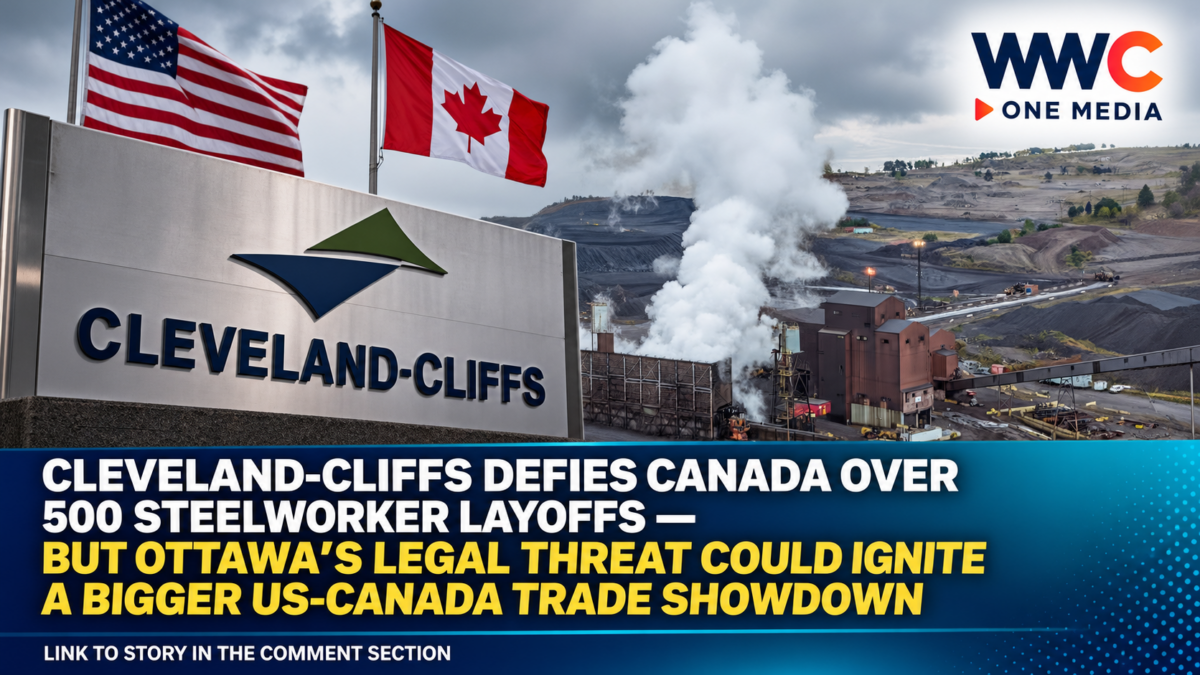
HAMILTON, CANADA — A growing industrial dispute between the Canadian government and one of America’s largest steel producers is threatening to become a major test of cross-border trade relations.
Cleveland-Cliffs, the Ohio-based steelmaking company that acquired Canadian producer Stelco in 2024, has informed Ottawa that it intends to proceed with hundreds of layoffs at its Ontario operations.
According to an October 10 Bloomberg report citing The Globe and Mail, Stelco has rejected the Canadian government’s argument that the planned workforce reductions violate commitments made during the company’s acquisition.
The company argues that extraordinary changes in market conditions, including the ongoing trade dispute between the United States and Canada, have made portions of its Canadian production commercially unsustainable.
But Canadian officials insist that Cleveland-Cliffs cannot simply abandon employment obligations that formed part of Ottawa’s approval of the multibillion-dollar takeover.
The confrontation could now move from factory floors and corporate boardrooms into the courts.
And the consequences could extend far beyond the workers directly affected.
Cleveland-Cliffs Pushes Ahead With Up to 500 Job Cuts
The dispute centers on Stelco’s operations in Hamilton and Nanticoke, Ontario, two locations with deep connections to Canada’s steel industry.
In late September, Cleveland-Cliffs announced plans to indefinitely idle cold-rolled and coated steel operations at Stelco’s Hamilton Works facility.
The company said its restructuring could affect as many as 500 workers across its Canadian operations.
Approximately 350 employees were directly associated with the Hamilton production shutdown, while the broader figure includes additional positions affected by the company’s operational plans.
Stelco indicated that some affected employees would be offered opportunities to work at its Lake Erie Works operation in Nanticoke.
However, job-transfer opportunities do not necessarily mean every affected worker will retain equivalent employment, pay, seniority or working conditions.
The planned shutdown represents a significant change for Hamilton, a city whose economic development has been closely connected to steelmaking for generations.
For workers and their families, the dispute is not simply about corporate restructuring.
It concerns the future of industrial employment in communities already facing pressure from changing trade policies and global competition.
Bloomberg: Stelco Rejects Ottawa’s Claims of Broken Promises
The latest development came after Stelco formally informed Canadian Industry Minister Mélanie Joly that it would continue implementing its workforce reductions.
Bloomberg reported on October 10 that a company letter argued the layoffs did not breach the employment undertakings attached to Cleveland-Cliffs’ acquisition of Stelco.
The company pointed to the impact of US tariffs and the broader Canada-US trade conflict, describing these circumstances as external factors beyond its control.
Ottawa disputes the company’s interpretation.
The central disagreement concerns whether legally binding employment commitments can be modified or excused because of major changes in market conditions.
The issue is particularly sensitive because the Canadian government approved Cleveland-Cliffs’ acquisition of Stelco only after securing undertakings intended to protect Canadian workers.
If the disagreement remains unresolved, the government could seek legal remedies under the Investment Canada Act.
However, a violation has not yet been established by a final court ruling.
Canada’s $3.4-Billion Stelco Deal Comes Under Scrutiny
Cleveland-Cliffs acquired Stelco in 2024 in a transaction reported at approximately C$3.4 billion.
The takeover was expected to strengthen Cleveland-Cliffs’ North American manufacturing operations and expand its access to steel production assets.
But Canadian approval came with conditions.
According to The Globe and Mail and The Canadian Press, Cleveland-Cliffs agreed to maintain employment protections for a five-year period.
Those commitments included preserving the number of unionized employees and maintaining the vast majority of non-unionized positions.
The government considers these undertakings legally binding.
That distinction is critical because investment approvals involving foreign companies can include enforceable conditions intended to protect Canadian jobs and other national economic interests.
If Ottawa concludes that the company’s workforce reductions breach those commitments, it may pursue enforcement measures.
The potential remedies could include court orders compelling compliance and monetary penalties.
A forced sale or divestiture has also been discussed among possible legal outcomes, although such a measure would require further legal steps and is not an automatic consequence of the dispute.
The final outcome will depend on the terms of the acquisition commitments, applicable law and any judicial proceedings.
Prime Minister Mark Carney Accuses Company of Betraying Workers
Prime Minister Mark Carney has sharply criticized the company’s decision.
Following the announcement of the planned layoffs, Carney accused Cleveland-Cliffs of betraying Canadian workers and warned that his government would consider legal action.
The prime minister also emphasized that Ottawa had explored financial measures intended to help preserve steel production and employment.
The government’s position is that foreign investors must honor the commitments they make when acquiring important Canadian businesses.
Industry Minister Mélanie Joly reinforced that message by demanding that Stelco provide a plan showing how it would meet its obligations.
The government gave the company five business days to respond.
Joly also questioned the company’s attempt to use US tariffs as a justification for layoffs, noting that Cleveland-Cliffs chief executive Lourenco Goncalves has publicly supported protective American steel tariffs.
For Ottawa, the dispute raises a broader policy question.
Can Canada continue attracting foreign investment while ensuring that companies respect employment guarantees negotiated as part of major acquisitions?
The government’s response could influence how future foreign takeovers are evaluated and monitored.
Reuters: Trump’s 50% Steel Tariffs Are at the Center of the Crisis
The current dispute is closely connected to the deterioration of trade conditions between Canada and the United States.
Reuters reported that Cleveland-Cliffs linked its Canadian production cuts to American tariffs on imported steel.
President Donald Trump’s administration increased tariffs on many steel and aluminum imports to 50% in June 2025.
These measures have created significant pressure for Canadian producers that traditionally rely on customers south of the border.
The United States is a crucial export destination for Canadian steel products.
When tariffs increase the cost of Canadian-made steel entering the American market, producers may find it more difficult to compete with domestic US suppliers.
Cleveland-Cliffs argues that the resulting loss of competitiveness has undermined the economics of certain Stelco products, particularly galvanized steel.
The company also points to competition from imported products and insufficient demand in the Canadian domestic market.
However, Canadian officials and labor representatives argue that these pressures do not automatically release the company from its employment obligations.
The dispute therefore combines two separate questions: whether the business has a legitimate commercial reason to reduce production, and whether the proposed layoffs comply with legally binding commitments.
Cleveland-Cliffs CEO Says No Government Funding Could Save the Operation
Cleveland-Cliffs chief executive Lourenco Goncalves has defended the restructuring.
In an interview with Global News, Goncalves argued that the problem was insufficient demand rather than a temporary shortage of financing.
He said Stelco could not economically continue producing the same volume of galvanized steel without access to the US market.
According to Goncalves, the Canadian market alone cannot absorb the company’s production capacity.
The executive also rejected suggestions that government subsidies or financing incentives would have been sufficient to justify maintaining operations at existing levels.
Global News reported that Canadian officials had discussed possible assistance, including financing arrangements and measures to help the company access additional markets.
But the company maintained that the underlying economics remained unfavorable.
The dispute has therefore developed into a fundamental disagreement about the responsibilities of corporate owners.
Cleveland-Cliffs argues that it must adjust production to match market realities.
Ottawa argues that the company must honor its obligations even during difficult market conditions.
Neither position, by itself, determines the eventual legal outcome.
The Canadian Press: Workers Could Return If Trade Agreement Is Reached
Despite the escalating confrontation, Cleveland-Cliffs has indicated that the layoffs may not be permanent under every possible scenario.
According to an October 9 Canadian Press report, Goncalves said affected workers could be recalled if Canada and the United States reach a steel trade agreement that restores more favorable market conditions.
The chief executive argued that current demand does not justify maintaining galvanized steel production at existing levels.
He also said the company has been advocating stronger protections against foreign steel imports into Canada.
The possibility of recalling workers offers some hope for affected employees.
But it also highlights how closely their employment prospects have become tied to government trade negotiations.
A future trade agreement could improve demand and manufacturing economics.
However, the timing, terms and likelihood of such an agreement remain uncertain.
Until those questions are resolved, workers face uncertainty over whether their positions will return.
Associated Press: Canada-US Trade War Threatens Industrial Jobs
The Associated Press reported that Carney’s government regards the layoffs as a serious breach of trust.
The news agency noted that the dispute has unfolded as Canadian steel producers struggle with US tariffs and weakening market access.
The controversy is particularly politically sensitive because the head of Cleveland-Cliffs has supported the American trade measures that Canadian producers say are damaging their competitiveness.
At the same time, the company maintains that production decisions must reflect prevailing economic conditions.
The disagreement has become a symbol of the tensions between corporate efficiency, domestic employment protections and international trade policy.
For Canadian policymakers, it raises concerns about reliance on foreign-owned industrial businesses during periods of economic confrontation.
For American companies investing in Canada, it highlights the potential consequences of employment commitments negotiated during acquisitions.
The Globe and Mail: Nationalization Debate Adds New Pressure
The Globe and Mail also reported that Goncalves dismissed the possibility of nationalizing Stelco as Ottawa sought ways to preserve employment.
Nationalization would involve bringing a private business under government ownership, an extraordinary intervention requiring legal and financial decisions.
There is no indication that Canadian authorities have completed or formally ordered such a takeover.
Nevertheless, discussion of the possibility reflects the seriousness of the dispute.
Steel manufacturing is widely regarded as strategically important because it supports construction, transportation, automotive production, energy projects and defense-related supply chains.
Countries seeking greater economic independence often view domestic steelmaking capacity as an essential industrial asset.
The Stelco dispute has therefore become part of a wider discussion about Canada’s long-term manufacturing security.
What the Dispute Means for North America’s Steel Industry
The Cleveland-Cliffs confrontation comes at a difficult time for North American steelmakers.
Manufacturers are adjusting to tariff barriers, changes in demand, international competition and rising operating costs.
For producers operating across both sides of the US-Canada border, trade restrictions can create complicated commercial pressures.
A business that benefits from American tariffs through its US operations may simultaneously suffer losses at Canadian facilities that depend on exports to the United States.
Cleveland-Cliffs is an example of this contradiction.
The company’s American operations may benefit from protection against certain imported steel products.
But its Canadian subsidiary faces barriers when selling into the US market.
The result demonstrates how national trade policies can have different effects across the operations of multinational corporations.
The broader concern is that prolonged trade friction could encourage companies to consolidate production, delay capital spending and reconsider cross-border investment plans.
Why the Philippines and Asia Should Pay Attention
Although the dispute involves Canada and the United States, its implications extend into global manufacturing and trade.
Asian steel-producing economies, including China, Japan, South Korea, India and Vietnam, are closely connected to international steel markets.
Changes in North American tariffs and import restrictions can redirect trade flows and affect competition in other regions.
For the Philippines, developments in international steel markets can influence the cost and availability of products used in construction, manufacturing and infrastructure.
However, the effects are not straightforward.
Cheaper imported steel could benefit some buyers, while increased import competition could create pressure for domestic steel producers.
Exchange rates, shipping costs, domestic regulations and supply conditions would also affect the outcome.
The Stelco dispute additionally illustrates the importance of understanding how foreign-investment agreements protect employment and industrial activity.
As Asian governments compete for investment, the balance between attracting international capital and safeguarding local economic interests remains a major policy issue.
Could Ottawa Force Cleveland-Cliffs to Reverse Its Layoffs?
The next phase of the dispute will depend on how the Canadian government responds to Stelco’s formal position.
Ottawa could continue negotiations, demand further information or pursue enforcement under the Investment Canada Act.
The company could also challenge the government’s interpretation of its commitments.
Any court proceedings would likely examine the specific terms of the 2024 acquisition agreement and the circumstances surrounding the workforce reductions.
A court could potentially determine whether the company remains obligated to preserve employment levels despite changes in market conditions.
However, legal action would not necessarily restore every affected position immediately.
The dispute could also be influenced by future developments in US-Canada trade relations, including negotiations over steel tariffs.
That leaves several possible outcomes: a negotiated settlement, revised production arrangements, legal enforcement or continued conflict.
As of October 11, the available reporting does not establish that the government has successfully compelled Cleveland-Cliffs to reverse the layoffs.
The Bigger Picture: A Steel Layoff Dispute Becomes a Test of Canada’s Economic Sovereignty
Cleveland-Cliffs’ decision to proceed with hundreds of planned layoffs has transformed an industrial restructuring into a major confrontation over trade, investment and employment rights.
For the company, the argument centers on economic viability.
Management maintains that US tariffs and limited domestic demand have made certain Canadian steel operations commercially unsustainable.
For Canada’s government, the question is whether a foreign company can reduce employment despite legally binding commitments made less than two years earlier.
The dispute also highlights the consequences of escalating trade barriers between two economies with deeply integrated industrial supply chains.
As Canada weighs its legal options, affected workers face uncertainty over their jobs, while investors watch for potential financial and regulatory consequences.
The battle over Stelco is no longer simply about whether hundreds of steelworkers will lose their jobs.
It is becoming a test of whether Canada can enforce employment protections against a major American industrial company at a time when the US-Canada trade relationship is under severe pressure.
And with Cleveland-Cliffs refusing to abandon its restructuring plans, the next confrontation could unfold in a Canadian courtroom — potentially setting an important precedent for foreign-owned companies operating across the country’s manufacturing sector.