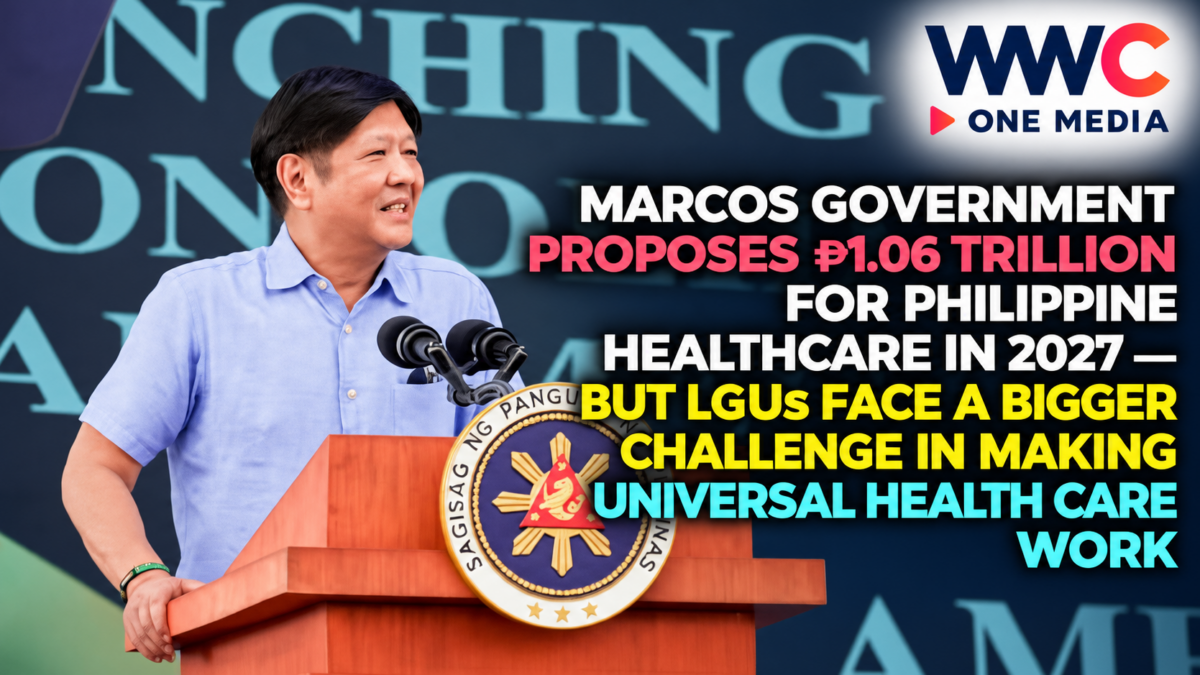
MANILA, PHILIPPINES — The Marcos administration is making a massive financial commitment to healthcare, proposing ₱1.06 trillion in consolidated health-sector funding for 2027 as economic managers push local government units (LGUs) to take a stronger role in delivering Universal Health Care to millions of Filipinos.
But behind the enormous budget proposal lies a difficult question: Can the Philippines transform record-scale healthcare funding into reliable medical services when many local governments still struggle to finance basic primary care?
Finance Secretary Frederick Go, Department of Budget and Management Secretary Kim Robert De Leon and Health Secretary Dr. Edwin Mercado have thrown their support behind strengthening city, municipal and provincial healthcare systems.
The three officials outlined their priorities during the first Unilab Foundation Executive Symposium, held at the Bayanihan Center in Pasig City on September 28, 2026.
According to Bilyonaryo’s October 9 report, the administration is seeking to increase the consolidated health-sector funding equivalent to approximately 3.19% of gross domestic product, compared with 2.68% in 2026.
The Department of Budget and Management has separately confirmed the ₱1.06-trillion proposal in its official presentation of the 2027 national budget.
The objective is ambitious: make affordable healthcare available not only in major hospitals but also in barangay health stations, rural health units and local government hospitals nationwide.
Yet independent government research shows that the funding gap at the community level remains enormous.
Inside the proposed ₱1.06-trillion health budget
2027 HEALTH SECTOR
₱1.06T
Consolidated proposed allocation
UHC IMPLEMENTATION
₱362.73B
Reported funding support
PHILHEALTH SUBSIDY
₱74.45B
Proposed national subsidy
HEALTH FACILITIES
₱14.54B
Proposed enhancement funding
Sources: Bilyonaryo, BusinessMirror and DBM, September–October 2026. These amounts are proposed allocations, not yet final enacted 2027 appropriations.
During the symposium, De Leon identified several priorities within the 2027 spending plan.
| Funding priority | Proposed amount |
|---|---|
| Department of Health and attached agencies | ₱270.98 billion |
| PhilHealth subsidy | ₱74.45 billion |
| Health Facilities Enhancement Program | ₱14.54 billion |
| Medical assistance for financially vulnerable patients | ₱24.24 billion |
| Cancer Assistance Fund | ₱3.75 billion |
The proposed medical assistance allocation is intended to benefit approximately 1.7 million indigent and financially incapacitated patients, while the PhilHealth subsidy is designed to strengthen financial protection for more than 11 million Filipinos.
The health facilities program would support improvements to DOH and LGU hospitals, specialty centers and other medical infrastructure.
These figures come from the government’s proposed budget presentation. They represent different program categories and should not all be treated as additional, non-overlapping allocations on top of the ₱1.06 trillion.
The hidden healthcare crisis: LGUs are spending less than half of what primary care needs
A March 2026 study by the government-backed Philippine Institute for Development Studies (PIDS) identified a major funding gap in local healthcare.
Researchers estimated that providing a basic yet comprehensive primary healthcare package requires approximately ₱1,800 to ₱1,900 per person annually.
However, actual LGU health spending averaged only around ₱850 per person, according to reporting on the study.
Estimated annual healthcare spending per person
Minimum required
Pesos per person₱1.8K
₱0₱500₱1K₱1.5K₱2KActual LGU averageMinimum requiredUpper estimate
Sources: PIDS Discussion Paper 2026-07 and Manila Bulletin, March 2026. The estimate concerns primary healthcare service requirements and is not a nationwide minimum mandated LGU budget.
The research found that many provinces and highly urbanized cities would need to increase local health spending by two or three times to support mandated primary healthcare services.
The problem is not limited to the country’s poorest localities.
Even some financially capable LGUs have failed to prioritize primary healthcare sufficiently.
Researchers also found that increased fiscal transfers following the Mandanas-Garcia ruling had not consistently produced corresponding increases in local health investment.
This is a serious warning for the administration’s proposed funding strategy.
More money at the national level does not automatically mean better healthcare in every barangay.
Finance Secretary Go: PhilHealth reform must reach ordinary Filipinos
Finance Secretary Frederick Go described Universal Health Care as both a social obligation and an economic priority.
He emphasized four requirements for its successful implementation: adequate financing, fair distribution of resources, strong institutions and cooperation across government and society.
Go also highlighted the Department of Finance’s RISE 30 agenda and PhilHealth’s YAKAP primary care program.
The goal is to strengthen preventive services, early diagnosis and access to treatment before medical conditions become more expensive or difficult to manage.
Go stressed that the success of healthcare reforms should be judged by whether local governments become better funded, better managed and more responsive to their communities.
The focus reflects a broader shift away from measuring healthcare success by budget size alone.
Health Secretary Mercado warns that funding alone cannot fix the system
Health Secretary Edwin Mercado emphasized that a resilient healthcare system depends on what happens behind the scenes as much as what happens inside hospitals.
Budget preparation, procurement, staffing, administrative controls and financial management all determine whether local clinics can actually deliver medical services.
A hospital may receive funding but still struggle to serve patients when equipment purchases are delayed or essential medicines are unavailable.
Likewise, opening new health centers does not necessarily translate into better treatment without enough doctors, nurses and functioning referral systems.
Mercado warned that implementing the Universal Health Care Act requires strong institutions capable of sustaining services, not simply releasing additional appropriations.
His message reinforced the symposium’s central theme: building local healthcare systems that can continue providing treatment after initial funding and assistance programs have been delivered.
Leni Robredo and provincial governors bring local healthcare challenges to the table
The symposium gathered approximately 200 government leaders, public health professionals, researchers and development partners.
Participants included Naga City Mayor Leni Robredo, Cebu Governor Pamela Baricuatro, Iloilo Governor Arthur Defensor Jr., Negros Occidental Governor Eugenio Lacson and other local executives.
The discussions explored the different challenges facing urban centers, rural communities and geographically isolated provinces.
Robredo highlighted the importance of improved local health information systems so government officials can identify community needs and make informed decisions.
Cebu’s representatives shared experiences with implementing UHC, while other provincial leaders discussed local financing, service delivery and institutional capacity.
The differences matter because the healthcare requirements of a densely populated city may be very different from those of a remote island municipality.
A successful national healthcare strategy must therefore allow local governments to respond to actual community needs while maintaining common standards of care.
Why Filipinos still pay heavily for healthcare despite government programs
One of the clearest measures of the country’s healthcare challenge is the amount families must pay directly for treatment.
According to the Philippine Statistics Authority, Filipino households accounted for 41.2% of current health expenditure in 2025.
Who financed Philippine healthcare in 2025?
Government and compulsory schemes
Household out-of-pocket payments
Voluntary health schemes
Source: Philippine Statistics Authority, 2025 Philippine National Health Accounts, released June 18, 2026.
The figures show that patients and their families still shoulder a substantial share of healthcare costs.
This includes direct payments for services, medicines and other expenses not fully covered by insurance or public healthcare programs.
For lower-income households, these costs can force difficult financial decisions.
The administration’s proposed funding could help reduce that burden if it successfully expands PhilHealth benefits, improves local service delivery and makes medicines more accessible.
But the critical measure will be whether household medical expenses actually decline.
Philippines also secures ₱48 billion in ADB-backed healthcare financing
The proposed national budget is being accompanied by another significant healthcare reform initiative.
On October 2, the Department of Finance announced a financing agreement with the Asian Development Bank worth approximately ¥119.745 billion, equivalent to around ₱48 billion.
The agreement supports the third subprogram of the Build Universal Health Care initiative.
Its priorities include stronger healthcare financing, more integrated service delivery, improved health information management and greater accountability.
The reforms also address healthcare challenges involving gender-specific needs and climate-related risks.
The financing agreement is separate from the national budget proposal and should not be described as an additional ₱48 billion in enacted 2027 healthcare appropriations.
Congress will still determine the final healthcare allocations
The ₱1.06 trillion remains a proposed consolidated health-sector funding amount.
Congress must complete the national budget process before the final 2027 General Appropriations Act can determine authorized spending.
On September 25, the House of Representatives reported approving a proposed ₱353.8-billion allocation for the Department of Health and its attached agencies and corporations, including PhilHealth.
The House said that 61% of the DOH budget would be directed toward regional health centers.
That figure is not directly comparable with the broader ₱1.06-trillion consolidated health-sector amount, which uses a wider budget coverage
As lawmakers finalize the spending plan, several implementation questions remain:
- How much funding will directly support primary healthcare in underserved communities?
- Can LGUs improve procurement, staffing and local health financing?
- Will PhilHealth coverage result in lower medical bills for patients?
- How will the government measure actual improvements in healthcare access?
The answers will determine whether the proposed spending produces lasting benefits.
The bigger picture: A trillion-peso commitment faces a barangay-level reality check
The Marcos administration is proposing one of the country’s largest consolidated healthcare funding commitments, signaling that Universal Health Care remains a national priority.
But the independent research paints a sobering picture.
Many local governments spend less than half of what researchers estimate is necessary for adequate primary healthcare. Meanwhile, Filipino households continue paying a substantial portion of their medical bills directly.
These realities suggest that the country’s healthcare problem cannot be solved through national allocations alone.
Funding must translate into adequately staffed clinics, dependable medicine supplies, functioning hospitals, efficient insurance coverage and accountable local government institutions.
The Philippines may be preparing to commit ₱1.06 trillion to healthcare — but the real measure of success will be whether ordinary Filipinos can finally receive treatment without sacrificing their family’s financial security.
That is the challenge awaiting the administration, Congress and local governments as the country prepares for 2027.