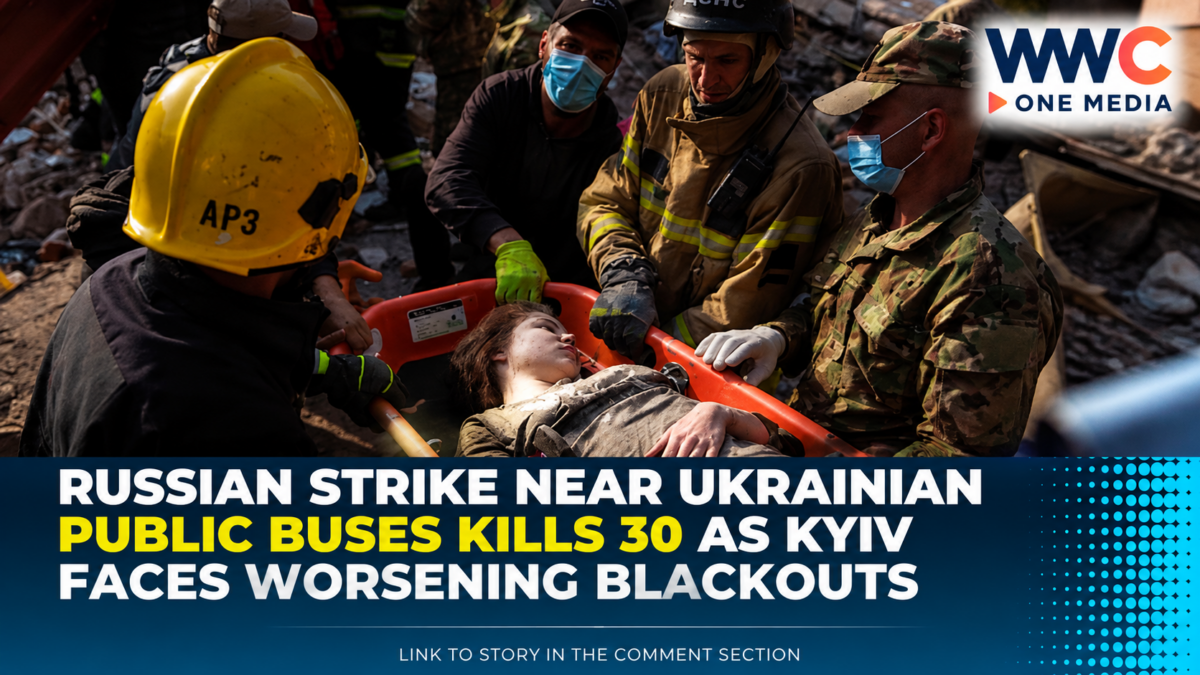
KYIV, Ukraine — A Russian-guided bomb exploded near public buses carrying passengers in eastern Ukraine, killing 30 people and injuring at least 18, as a widening wave of Russian attacks intensified pressure on Ukrainian civilians and worsened emergency power outages in the capital, Kyiv.
The attack occurred on Thursday (Oct. 8) near a bus stop in Kramatorsk, in Ukraine’s Donetsk region, where public transport was subsequently suspended because of deteriorating security. Ukrainian officials accused Russian forces of deliberately targeting civilians, while the incident came amid intensified aerial attacks on cities and critical infrastructure ahead of winter.
The deadly strike was part of a broader escalation that has damaged residential areas, disrupted essential services and prompted renewed calls from Ukrainian President Volodymyr Zelenskyy for additional air-defence support from Western allies.
Bomb explodes near buses in eastern Ukraine
The attack took place in the morning near buses filled with passengers in Kramatorsk, one of the major Ukrainian-controlled cities in the Donetsk region.
A Russian-guided bomb exploded beside the vehicles, killing at least 30 people, according to Ukrainian authorities. At least 18 others were reported injured.
Oleksandr Honcharenko, head of the city’s military administration, condemned the attack and accused Russia of targeting civilians. He said the rescue operation was complicated by subsequent Russian drone attacks, which created further dangers for emergency responders.
Authorities suspended public transport in Kramatorsk and neighbouring Sloviansk as the security situation deteriorated. Officials said the decision was intended to reduce the risk to passengers and drivers amid continuing attacks.
The incident has renewed concerns about the risks faced by civilians who rely on public transport in frontline areas, where daily activities can expose residents to sudden aerial attacks.
The precise circumstances of the strike and the full extent of the damage remain subject to further reporting and investigation.
Another deadly strike hit a residential building
The attack in Kramatorsk came a day after a Russian missile struck a residential building in Pryluky, a town in Ukraine’s northern Chernihiv region.
The death toll from that attack rose to 22, including five children. At least 54 people were reported injured as rescuers searched through the wreckage for survivors and people who remained unaccounted for.
Images from the scene showed damaged apartments, shattered walls and debris scattered around the building. Some residents whose homes had been heavily damaged reportedly had nowhere else to stay and spent the night in their apartments despite the destruction.
The two attacks underscored the dangers facing civilians across Ukraine as Russian forces continue to launch missiles, drones and guided bombs against targets in different regions.
The latest casualties have also intensified pressure on Ukraine’s government to secure additional protection for population centres, particularly as colder weather approaches and the country’s energy needs increase.
Kyiv faces emergency power outages
The aerial attacks have also worsened Ukraine’s energy challenges.
Energy company DTEK said the national grid operator, Ukrenergo, had ordered emergency power outages in Kyiv. These emergency measures differ from scheduled rolling blackouts and can disrupt electricity supplies with little notice.
Authorities have urged households to prepare for possible prolonged outages by keeping emergency supplies, storing drinking water and maintaining backup power sources where possible.
The warnings come as Ukraine prepares for another winter in which damage to power infrastructure could affect heating, lighting, communications and other essential services.
Russia has intensified attacks on infrastructure in recent weeks, with reported targets including energy facilities, railways, telecommunications networks, industrial sites, gas stations and grain-export infrastructure. The attacks place additional pressure on a country already dealing with extensive wartime damage.
For residents, the risk extends beyond immediate damage from missiles and drones. Disruptions to electricity and other services can complicate medical care, emergency response and everyday life, particularly for older people and those who depend on powered medical equipment.
Unexploded missile warheads found near homes
Kyiv police said bomb-disposal specialists had defused two unexploded ballistic missile warheads that landed near residential buildings. Each warhead weighed approximately half a tonne, according to authorities.
The discovery highlighted the continuing danger posed by weapons that fail to detonate on impact. Unexploded munitions can threaten residents and emergency crews even after an immediate attack has ended.
Russian drones also struck Kyiv’s Obolonskyi and Desnianskyi districts late on Wednesday, killing four people and injuring 12 others, including four children, police said.
The attacks in the capital, combined with the strikes in eastern and northern Ukraine, demonstrate the geographic reach of the latest aerial campaign. They have also complicated emergency planning as officials attempt to protect civilians while maintaining essential services.
Zelenskyy seeks more air-defence support
Zelenskyy travelled to Pryluky on Thursday alongside visiting British Foreign Secretary Ed Miliband, who announced new sanctions against Russia.
The Ukrainian president warned that Russian missile and drone attacks could intensify as winter approaches. He called on NATO countries and other partners to provide additional defensive equipment, including anti-ballistic capabilities, ammunition for combat aircraft and interceptor systems.
Zelenskyy said international support needed to translate into concrete deliveries that could help protect lives.
Ukraine has repeatedly appealed for stronger air defences as Russia expands its attacks on cities and infrastructure. Interceptors and other defensive systems are intended to destroy incoming weapons before they reach their targets, although Ukraine’s ability to protect every threatened area remains limited by the scale and frequency of the attacks.
The latest strikes are likely to add urgency to discussions between Kyiv and its allies over the supply of military assistance.
Zelenskyy also said a Ukrainian delegation would meet representatives of US President Donald Trump in the United States beginning Friday to discuss strengthening Ukraine’s air defences and other issues.
Ukraine strikes Russian infrastructure
While Russian attacks continued across Ukraine, Kyiv also reported strikes against targets inside Russia.
Ukraine’s General Staff said Ukrainian forces had hit a large oil-refining and petrochemical complex in Salavat, in Russia’s Bashkortostan region, approximately 1,200 kilometres east of Moscow. The claim could not be independently verified.
Russian technology company Yandex separately said one of its data centres in the western Ryazan region had been damaged in a Ukrainian drone attack, taking the facility offline.
Drones also reached Russia’s Omsk region in western Siberia. Regional Governor Vitaly Khotsenko said most had been intercepted by air defences, while one reached an industrial area. A Russian independent news outlet reported a fire at an oil refinery in Omsk, although there was no official confirmation of that report.
The reported attacks reflect the increasingly long-range nature of the conflict, with both sides seeking to disrupt military, industrial and logistical capabilities far from the main front lines.
International concerns grow as winter approaches
The latest attacks have raised fresh concerns about civilian safety, infrastructure resilience and the humanitarian consequences of continued aerial warfare.
Turkey’s Foreign Minister Hakan Fidan said his government had presented proposals to Russia and Ukraine aimed at protecting civilian shipping in the Black Sea. He warned that escalating military operations could disrupt commercial trade and grain exports.
Meanwhile, Lithuania announced the deployment of approximately 100 additional soldiers to help secure its border with Russia’s Kaliningrad exclave, reflecting broader security concerns among NATO members bordering Russian territory.
For Ukraine, however, the immediate priority remains protecting residents from further attacks and keeping essential services operating as temperatures fall.
The deaths in Kramatorsk and Pryluky, together with the worsening electricity disruptions in Kyiv, illustrate the mounting pressure on civilians as the war continues.
With Russian aerial attacks intensifying and Ukraine seeking more defensive support, the coming weeks will be critical for communities already facing damaged homes, interrupted power supplies and the threat of further strikes.