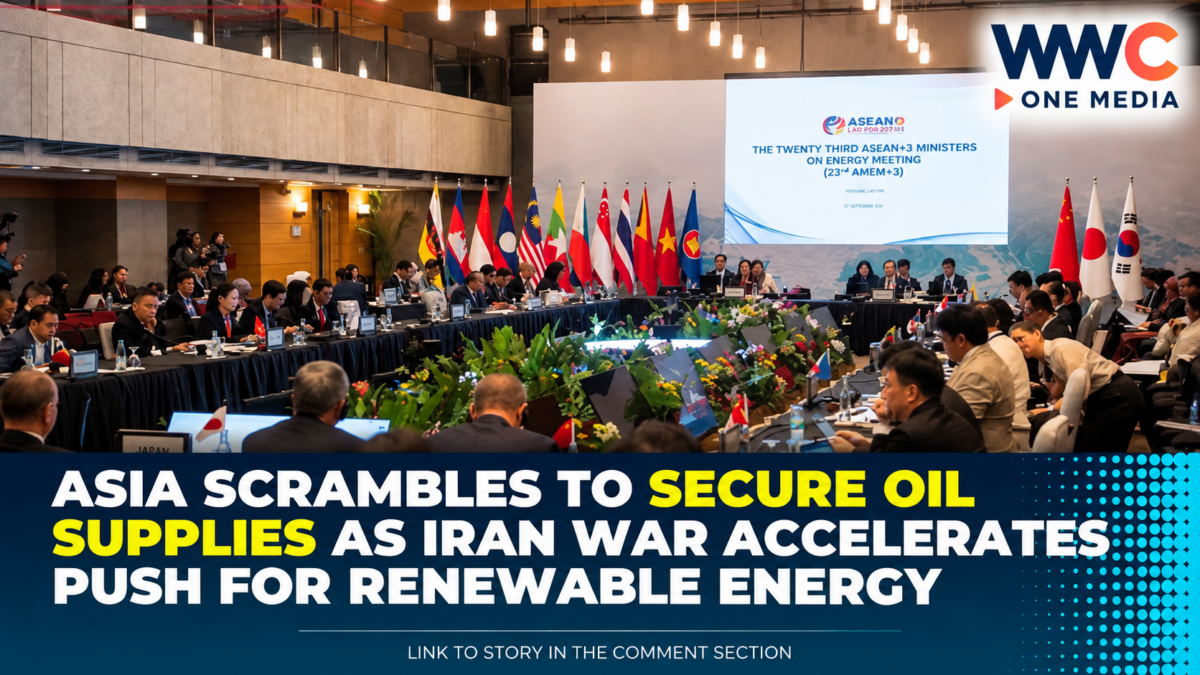
MANILA — Asian countries are stepping up efforts to secure oil supplies, build strategic fuel reserves and accelerate renewable energy projects as the war involving Iran exposes the region’s vulnerability to disruptions in global energy markets.
Southeast Asia has been particularly affected by the crisis because of its reliance on oil transported through the Strait of Hormuz, a critical shipping route connecting the Persian Gulf with international markets. Before the war began, about 80 per cent of the oil transported through the strait from the Gulf was destined for Southeast Asia, according to a Reuters report published on Oct. 8. citeturn336281news5
The disruption has prompted governments to reconsider how they store fuel, diversify energy supplies and share resources during emergencies. Regional leaders are also looking to renewable energy and cross-border electricity connections to reduce their exposure to future supply shocks.
Southeast Asian nations plan stronger oil reserves
Nine Southeast Asian countries, together with Japan and Australia, have committed to supporting the development of national oil stockpiling systems and exploring voluntary arrangements for regional joint reserves.
The initiative is intended to improve the region’s ability to respond when international supply routes are disrupted or fuel shipments become more expensive.
Japan is helping coordinate efforts to strengthen crude oil reserves through the Asia Zero Emission Community, a framework that brings together Japan and Asian partners to pursue energy security and decarbonisation.
Japanese officials have also discussed cooperation with Saudi Arabia and the United Arab Emirates, two major oil-producing countries, to improve Asia’s capacity to store crude oil and manage potential supply emergencies. citeturn336281search0turn336281search1
The proposals reflect a growing recognition that access to energy depends not only on securing suppliers but also on having enough storage and transport infrastructure to manage periods of disruption.
However, regional stockpiling arrangements will require countries to agree on where supplies are held, who pays for storage and how fuel is allocated during an emergency.
Philippines targets national oil reserve by 2027
The Philippines, which imports nearly all its oil and fuel requirements, plans to establish a national oil reserve by the end of 2027.
Energy Secretary Sharon Garin said the reserve could eventually be developed into a regional stockpiling hub, allowing other countries to store crude oil or petroleum products in the Philippines while giving the host country priority access to those supplies during an emergency.
The proposal would give the Philippines a more formal role in regional energy security while helping it manage the risks associated with dependence on imported fuel. citeturn336281search0
The timing is significant because the country has faced higher fuel costs and supply pressures during the conflict. A reserve could provide a buffer against temporary disruptions, although its effectiveness would depend on storage capacity, financing, supply agreements and the speed at which fuel could be released.
The initiative is also being pursued as the Philippines chairs the Association of Southeast Asian Nations (ASEAN) in 2026, placing regional energy cooperation among the bloc’s priorities.
ASEAN raises renewable energy ambitions
Alongside efforts to secure oil supplies, ASEAN countries have pledged to expand renewable energy as part of a longer-term strategy to reduce dependence on imported fossil fuels.
The bloc is targeting renewables to account for 30 per cent of total primary energy supply and 45 per cent of installed power capacity.
The goals represent a significant increase from the region’s current position. Renewables accounted for 14.1 per cent of primary energy supply, while renewable sources made up 33.7 per cent of installed power capacity, according to figures cited in the latest ASEAN energy outlook. citeturn336281search0turn336281search1
Renewable energy can help countries reduce exposure to volatile international fuel prices, particularly where solar, wind and other domestic resources can replace imported fossil fuels.
But expanding capacity will require investment in electricity grids, energy storage, transmission infrastructure and systems capable of balancing variable renewable generation with demand.
The transition is also complicated by rapidly growing electricity consumption across Southeast Asia, driven by industrialisation, urbanisation, air-conditioning demand and the expansion of data centres.
The International Energy Agency has warned that regional electricity demand is expected to grow by an average of 5.4 per cent annually through 2030, adding pressure to already stretched energy systems. citeturn336281news6
Regional power grid agreement gains momentum
ASEAN countries have also reached an enhanced preliminary agreement to accelerate development of a regional power grid, an initiative that has been discussed for decades.
The concept was first announced in December 1997, but progress has been constrained by differences in national electricity markets, infrastructure requirements, financing and cross-border arrangements.
Garin said the original timeline envisaged connections extending towards 2045, which officials now consider too distant given the region’s changing energy needs.
The revised approach is intended to speed up implementation and improve the ability of countries to exchange electricity across borders. citeturn336281search0
A regional grid could allow countries with surplus electricity to supply neighbours facing shortages. It could also make it easier to integrate renewable energy resources located far from major population centres.
For example, cross-border transmission could help connect renewable generation in one country with demand in another, reducing the need for every nation to meet all its electricity needs independently.
Nevertheless, the plan will require substantial investment and agreements on pricing, reliability, grid management and the rules governing emergency electricity transfers.
Iran war exposes Southeast Asia’s energy vulnerability
The crisis has highlighted the risks faced by Southeast Asian economies that rely heavily on imported oil and gas while experiencing rapid growth in electricity demand.
The closure or disruption of major shipping routes can affect fuel availability, push up prices and increase costs for transport, manufacturing and power generation.
The International Energy Agency has warned that Southeast Asia’s energy-security challenges are intensifying as demand grows faster than the region’s ability to expand reliable power supplies. Countries have responded through fuel conservation, changes in import sources and, in some cases, greater reliance on coal to maintain electricity supply. citeturn336281news6
Such emergency measures can help prevent immediate shortages, but they also illustrate the difficulty of balancing energy security with emissions-reduction commitments.
The longer-term challenge is to ensure that alternative energy sources and regional infrastructure develop quickly enough to reduce vulnerability before another major disruption occurs.
Balancing immediate security with long-term transition
Oil stockpiles, diversified suppliers and renewable energy address different parts of the same problem.
Strategic reserves can help countries withstand short-term disruptions, while renewable energy and cross-border electricity links can reduce the need for imported fossil fuels over time.
Neither approach is a complete solution on its own. Stockpiles require substantial capital and can only cover a limited period of demand, while renewable projects and regional grids take time to finance, build and integrate.
For ASEAN, the latest commitments mark an effort to address both immediate supply risks and longer-term structural weaknesses in the region’s energy system.
The challenge now will be turning those commitments into functioning reserves, operational power connections and renewable projects capable of meeting rising demand.
As the Iran war continues to expose vulnerabilities in global energy markets, Asia’s response could shape how the region prepares for future crises — and how quickly it can move towards a more diversified energy system.