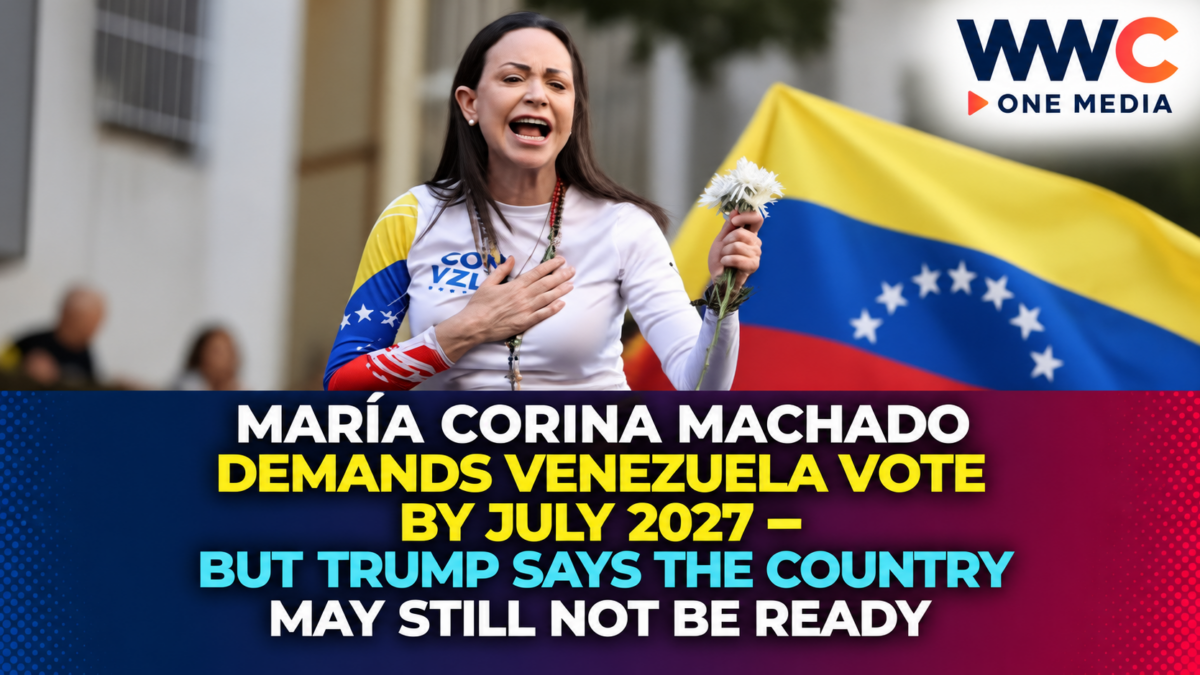
CARACAS — Venezuelan opposition leader María Corina Machado is demanding a presidential election by July 2027, opening a potentially decisive confrontation over how quickly Venezuela should move from its U.S.-backed post-Maduro transition toward a fully elected government.
Machado told the Financial Times there is:
“more than enough time”
to organize a credible election by next July.
She wants the vote held on:
July 24, 2027,
the birthday of Venezuelan independence hero:
Simón Bolívar.
But the date is about far more than symbolism.
Machado is effectively telling:
Washington
acting President Delcy Rodríguez
and
Venezuela’s political institutions
that the transition cannot remain open-ended.
Her argument is simple:
Political stability ultimately requires:
a government chosen by Venezuelans.
MACHADO WANTS A VOTE NEXT YEAR
Machado says Venezuela should organize presidential elections by:
July 2027.
That would accelerate the political timetable dramatically.
The opposition leader argues the country already has sufficient time to:
rebuild electoral institutions
update voter rolls
allow political parties to organize
and
bring international observers into the process.
But the government has not agreed to that deadline.
DELCY RODRÍGUEZ HAS PROMISED ELECTIONS — WITHOUT SAYING WHEN
Acting President:
Delcy Rodríguez
has publicly committed Venezuela to eventual elections.
Speaking at the United Nations in September, Rodríguez said Venezuela would transition toward what she called:
“full democracy.”
But she did not announce a date.
That difference matters.
Machado wants:
a calendar.
Rodríguez is promising:
a process.
Those are not the same thing.
TRUMP HAS BEEN EVEN MORE CAUTIOUS
President Donald Trump has also resisted demands for an immediate vote.
In July, Trump said Venezuela was:
“not really ready”
for elections.
He praised Rodríguez for the progress made since Maduro’s removal.
Washington’s strategy has therefore prioritized:
stability
oil production
economic recovery
and
institutional restructuring
before rushing toward a presidential election.
Machado is now challenging that sequence.
THIS IS BECOMING A FIGHT OVER WHAT “TRANSITION” ACTUALLY MEANS
There are essentially two competing visions.
Machado’s vision is:
democracy first.
Hold elections quickly.
Create a legitimate government.
Then use that legitimacy to attract investment and rebuild the economy.
The U.S.-backed approach so far has looked more like:
stability first.
Keep the state functioning.
Restore oil production.
Repair institutions.
Then hold elections.
The difference may determine Venezuela’s political future.
MACHADO SAYS DEMOCRACY IS NECESSARY FOR ECONOMIC STABILITY
Machado’s economic argument is important.
She believes Venezuela cannot fully recover without:
political legitimacy
and
rule of law.
Foreign companies considering billions of dollars in investment need confidence that contracts will survive changes in government.
They need predictable:
tax rules
property rights
courts
and
regulation.
Machado argues a properly elected government would provide that credibility.
OIL IS AT THE CENTER OF EVERYTHING
Venezuela possesses the world’s largest proven crude-oil reserves.
But decades of:
underinvestment
political instability
sanctions
and
infrastructure deterioration
have dramatically reduced production.
Venezuela once produced more than:
3 million barrels per day.
Current production is around:
1.25 million barrels per day.
That means enormous capacity remains trapped underground.
Rebuilding it could transform the economy.
BUT IT WILL COST TENS OF BILLIONS
ConocoPhillips chief economist Helen Currie recently warned that restoring Venezuela’s oil industry could require:
tens of billions of dollars
and at least:
a decade.
That means Venezuela desperately needs private capital.
But companies will not commit that money simply because the country has oil.
They need:
political stability
fair fiscal terms
and
credible legal protections.
That is exactly where the election debate becomes an economic debate.
MACHADO IS ALSO QUESTIONING WHO CONTROLS THE OIL MONEY
Another major issue is:
transparency.
Machado told the Financial Times that proceeds from Venezuela’s oil sales must be managed openly.
Washington now has unusually strong oversight of portions of Venezuela’s energy revenue and investment structure.
That arrangement emerged after the collapse of Maduro’s government and the rapid restructuring of relations between:
Caracas
and
Washington.
Machado is effectively asking:
Where is the money going?
Who approves spending?
Who audits the accounts?
And who ultimately controls Venezuela’s most valuable national resource?
THE U.S. HAS BECOME DEEPLY INVOLVED IN VENEZUELA’S OIL SECTOR
The scale of American involvement is extraordinary.
Washington has negotiated arrangements aimed at expanding access to Venezuelan oil.
U.S. officials have encouraged private investment.
American companies are exploring opportunities.
And the U.S. government has retained oversight over financial flows linked to certain oil arrangements.
That has created a situation that would have been almost unimaginable only a few years ago.
The United States is now deeply involved in rebuilding the same Venezuelan energy sector it spent years sanctioning.
WHY WASHINGTON CARES SO MUCH
Venezuela’s oil has become more valuable strategically because global energy markets remain tight.
The Iran conflict has disrupted supply.
The Strait of Hormuz remains unstable.
Brent crude has traded above:
$100 per barrel.
American gasoline prices have remained unusually high.
That gives Washington a strong incentive to bring Venezuelan crude back into the global market.
More Venezuelan production could help:
increase supply
and
reduce energy prices.
That creates tension between:
economic urgency
and
democratic urgency.
WASHINGTON MAY FEAR THAT A RUSHED ELECTION COULD DESTABILIZE THE RECOVERY
From the U.S. perspective, Venezuela still faces:
weak institutions
political polarization
economic fragility
and
security risks.
The Trump administration appears concerned that moving too quickly could destabilize the transition.
That does not mean Washington opposes elections.
It means it appears to prefer elections after more institutional reconstruction.
Machado thinks waiting carries its own danger.
MACHADO WARNS THAT DELAY COULD CREATE NEW INSTABILITY
Earlier this year, Machado warned that prolonged uncertainty could trigger:
civil unrest
and
political frustration.
Her argument is that Venezuelans already spent years fighting for political change.
If the transition produces:
oil deals
and
international investment
without producing an election,
public support could deteriorate.
That would be particularly dangerous if citizens begin to believe the post-Maduro order is simply replacing one unelected structure with another.
MACHADO HERSELF MAY STILL FACE A LEGAL OBSTACLE
There is another enormous unresolved issue.
Machado was previously barred from holding public office.
That ban prevented her from running in Venezuela’s:
2024 presidential election.
She had overwhelmingly won the opposition primary.
But Venezuela’s courts upheld her disqualification.
The opposition ultimately backed:
Edmundo González Urrutia.
Now, if Venezuela holds a new election, one of the first questions will be:
Can María Corina Machado actually run?
A FORMER JUDGE HAS NOW MADE AN EXPLOSIVE CLAIM ABOUT THAT BAN
The controversy intensified this week.
Former Venezuelan Supreme Court justice:
Bárbara César Siero
said she was forced to sign the ruling that helped bar Machado from office.
She alleged that authorities detained members of her family to pressure her.
Machado’s party has seized on the allegation and demanded her political disqualification be:
immediately lifted.
The accusation has not yet produced a final judicial reversal.
But politically, it gives Machado a powerful argument that the ban itself lacks legitimacy.
THAT COULD BECOME THE FIRST MAJOR TEST OF THE TRANSITION
If Rodríguez’s government truly intends to hold inclusive elections, officials will eventually need to answer a basic question:
Can the country’s most prominent opposition leader participate?
A presidential election without Machado could face immediate questions about legitimacy.
Allowing her to run, however, could fundamentally reshape the balance of political power.
That decision may be more consequential than the election date itself.
MACHADO REMAINS OUTSIDE VENEZUELA
Machado is currently outside the country.
She has repeatedly said she intends to return.
Her team says multiple attempts have failed.
U.S. Secretary of State Marco Rubio recently denied reports that Washington was deliberately preventing her return.
He said the U.S. had not instructed foreign governments to stop her from entering Venezuela.
That leaves another unresolved question:
If Machado is allowed to return, how will the Venezuelan government respond?
HER RETURN COULD BECOME A MAJOR POLITICAL EVENT
Machado remains one of Venezuela’s most recognizable political figures.
Supporters have organized rallies calling for her return.
If she re-enters the country, the event could instantly become a test of:
freedom of assembly
political tolerance
and
government restraint.
Any arrest or attempt to restrict her movements would damage claims that Venezuela is moving toward open political competition.
HER POLITICAL POSITION IS POWERFUL — BUT NOT UNCOMPLICATED
Machado won the:
2025 Nobel Peace Prize
for her campaign for democratic change.
That gave her enormous international visibility.
But her relationship with Washington is increasingly complicated.
She has strongly supported U.S. pressure on the former Maduro government.
Yet she is now pushing Trump to move faster than his administration appears comfortable with.
That creates an unusual political dynamic.
One of Washington’s closest Venezuelan opposition allies is now publicly challenging Washington’s timetable.
DELCY RODRÍGUEZ HAS BUILT A DIFFERENT KIND OF RELATIONSHIP WITH TRUMP
Rodríguez, once a leading figure in Maduro’s government, has emerged as the central figure in the U.S.-backed transition.
Trump has publicly praised her performance.
Her administration has cooperated with Washington on:
energy
investment
and
economic recovery.
That has frustrated parts of the opposition.
They argue the United States appears increasingly comfortable working with former Maduro insiders so long as:
stability improves
and
oil production rises.
THAT IS WHERE MACHADO’S PRESSURE BECOMES POLITICALLY DANGEROUS
Machado is forcing Washington to confront an uncomfortable contradiction.
The U.S. says it wants:
a democratic Venezuela.
But Washington also wants:
oil production
regional stability
and
predictable economic relations.
Those goals may not always move at the same speed.
If Rodríguez delivers economic stability but delays elections, what does Washington do?
That could become one of the defining questions of Venezuela’s transition.
VENEZUELA’S ECONOMY IS SHOWING SIGNS OF RECOVERY
Rodríguez said Venezuela’s economy could grow around:
6.5%
in the third quarter.
Oil production has risen around:
8% year to date.
The government expects approximately:
$12 billion
in public and private financing over the next two years.
Those figures suggest the economic environment has improved.
But recovery from a very depressed base is different from full normalization.
Venezuela still faces enormous structural problems.
MILLIONS OF VENEZUELANS HAVE LEFT THE COUNTRY
Years of economic collapse and political instability drove millions of Venezuelans abroad.
The diaspora extends across:
Latin America
the United States
and
Europe.
Any legitimate election must eventually address:
overseas voting
and
voter registration.
That is one reason organizing a credible national election is not simply a matter of choosing a date.
Election authorities would need substantial preparation.
ELECTORAL INSTITUTIONS THEMSELVES NEED REFORM
Another issue is:
institutional trust.
The electoral council and judiciary were heavily criticized during the Maduro era.
Opposition parties argue meaningful reform is required before another presidential vote.
That could involve replacing or restructuring:
electoral officials
and
judges.
Analysts have warned those reforms alone could take significant time.
That is one reason some observers believe even 2027 may be ambitious.
INTERNATIONAL OBSERVATION WOULD ALSO BE CRITICAL
A credible election would likely require significant foreign monitoring.
Potential observers could include representatives from:
the United Nations
the European Union
and
regional organizations.
International observers would be expected to examine:
voter access
media fairness
candidate eligibility
and
vote counting.
Without credible observation, any result could be contested immediately.
MACHADO’S JULY DEADLINE IS THEREFORE AGGRESSIVE
Her supporters argue it is achievable.
Critics may argue it risks compressing complex reforms into too short a period.
Both arguments contain legitimate concerns.
A long delay could undermine public confidence.
But a rushed vote without credible institutions could produce another disputed election.
The core challenge is not simply:
when to vote.
It is:
how to create a vote both sides will accept.
VENEZUELA HAS BEEN HERE BEFORE
The country’s:
2024 election
remains central to the current crisis.
The Maduro government declared victory.
The opposition rejected the outcome and said its own tally sheets showed:
Edmundo González
had won decisively.
The dispute intensified international pressure and political repression.
That experience means the next presidential election will face enormous skepticism.
Venezuelans will demand more than ballots.
They will demand confidence that ballots actually determine power.
A 2027 ELECTION WOULD ALSO CHANGE THE INVESTMENT STORY
If Venezuela successfully holds a widely accepted election, investment could accelerate dramatically.
The country needs capital for:
oil
electricity
roads
telecommunications
housing
and
industrial infrastructure.
Western energy companies have repeatedly indicated they are interested.
But they need confidence that political agreements will survive.
A credible election could reduce that uncertainty.
THE OIL INDUSTRY ALONE COULD ATTRACT TENS OF BILLIONS
Venezuela has enormous reserves.
But much of its infrastructure is:
old
damaged
or
underutilized.
Rebuilding production requires:
drilling
pipelines
upgraders
refineries
and
power infrastructure.
If political stability improves, companies including major U.S. and European energy groups could return aggressively.
That could become one of the biggest energy investment cycles in Latin America.
BUT OIL MONEY COULD ALSO BECOME A SOURCE OF POLITICAL CONFLICT
This is why Machado’s transparency demand is important.
When billions of dollars begin flowing through:
oil exports
and
foreign investment,
questions about corruption become unavoidable.
Who controls contracts?
Who selects investors?
How are royalties collected?
Where are revenues deposited?
How are they spent?
Venezuela’s history makes those questions especially sensitive.
THE U.S. CANNOT CONTROL THE TRANSITION FOREVER
Washington currently has extraordinary influence over Venezuela.
But ultimately, Venezuela must build institutions capable of operating without:
U.S. supervision.
That is arguably Machado’s broader point.
External oversight may stabilize a crisis.
But permanent legitimacy has to come from:
Venezuelan institutions
and
Venezuelan voters.
Otherwise the transition remains dependent on American political choices.
AND AMERICAN POLITICS CAN CHANGE QUICKLY
Trump is currently driving U.S. policy.
But future presidents may take different approaches.
Congress may impose different conditions.
Sanctions could change.
Energy priorities could change.
That uncertainty is another reason Venezuelan businesses and investors want durable domestic institutions.
A legitimate elected government provides more continuity than a transition based heavily on Washington.
JULY 24 IS ALSO A POWERFUL SYMBOLIC DATE
Machado’s proposed date is:
Simón Bolívar’s birthday.
Bolívar remains one of the most powerful political symbols in Venezuelan history.
Both:
the government
and
the opposition
invoke his legacy.
Holding an election on that date would allow Machado to frame the vote as:
a national democratic rebirth.
It is politically sophisticated symbolism.
But symbolism will matter little if the institutions behind the vote are not trusted.
THE BIGGER STORY: VENEZUELA’S REAL TRANSITION MAY NOW BE A RACE BETWEEN DEMOCRACY AND OIL
The fall of Nicolás Maduro changed Venezuela faster than almost anyone expected.
But removing one leader did not automatically create a democratic system.
Instead, the country entered a new phase.
Delcy Rodríguez remains in power.
Washington has enormous influence.
American companies are moving toward Venezuela’s energy sector.
Oil production is recovering.
Foreign capital is returning.
And Trump says stability must come before elections.
María Corina Machado is now challenging that order.
She is arguing that Venezuela cannot become truly stable until Venezuelans themselves choose the government.
That puts two competing clocks on the transition.
One clock measures:
oil production
investment
and
economic recovery.
The other measures:
political legitimacy.
Washington appears willing to let the first clock run faster.
Machado wants the second one accelerated.
The next year could determine which strategy wins.
Because Venezuela is no longer simply deciding:
when to hold another election.
It is deciding whether its post-Maduro future will be built first around:
oil and stability
or
votes and legitimacy.
And if María Corina Machado gets her way, Venezuelans will be asked to answer that question themselves by:
July 2027.