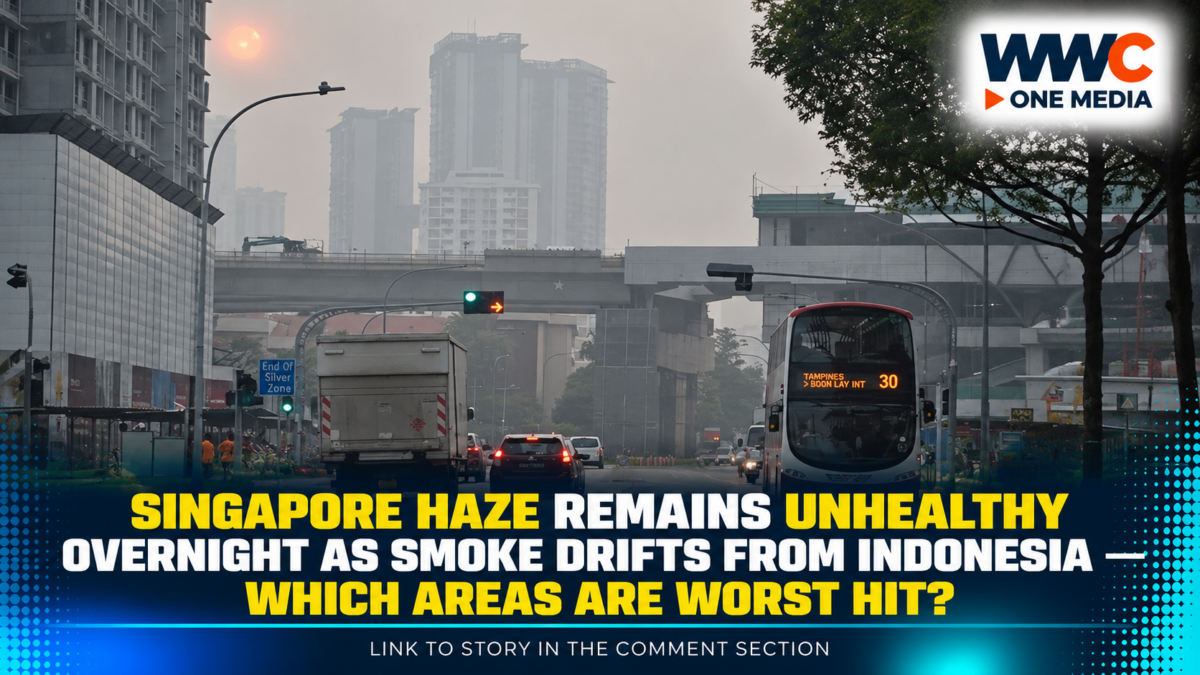
Singapore’s haze problem is showing little sign of easing, with unhealthy air quality recorded across all five regions overnight. The worsening conditions come as the city-state prepares for the Formula One Grand Prix weekend, raising fresh concerns about outdoor activities and public health.
Singapore residents woke to another morning of hazy conditions on October 9, 2026, as air pollution remained in the unhealthy range across the island.
The latest readings from the National Environment Agency (NEA) showed that the 24-hour Pollutant Standards Index (PSI) remained above the unhealthy threshold in every region at 6am.
The central region recorded the highest reading at 159, followed closely by the west at 155. The south registered 135, the east 134 and the north 109.
The readings underscore the continuing impact of transboundary haze, with smoke from fires in Indonesia drifting towards Singapore under prevailing southerly and south-easterly winds.
For residents, the immediate concern is how long the poor air quality will persist and whether conditions could worsen as major outdoor events get underway.
Which Parts of Singapore Have the Worst Haze?
The NEA’s 6am readings on October 9 showed unhealthy air quality across all five regions.
The central region recorded the highest 24-hour PSI at 159, followed by the west at 155. The north had the lowest reading at 109, but it was still within the unhealthy range.
Here is the regional breakdown:
- Central Singapore: PSI 159
- Western Singapore: PSI 155
- Southern Singapore: PSI 135
- Eastern Singapore: PSI 134
- Northern Singapore: PSI 109
Singapore classifies PSI readings between 101 and 200 as unhealthy.
The PSI is calculated using a rolling 24-hour average of six key air pollutants, including fine particulate matter known as PM2.5.
Although readings can vary between regions and throughout the day, the latest figures indicate that the haze remains a widespread problem rather than an issue confined to one part of the island.
PM2.5 Pollution Remains Elevated Across the Island
Fine particles are a particular concern during haze episodes because they can penetrate deep into the respiratory system.
At 6am, hourly PM2.5 readings were elevated in four regions, with the west recording 143, the central region 140, the south 134 and the east 117. The north recorded 92.
An hourly PM2.5 reading provides a more immediate indication of pollution levels than the 24-hour PSI.
Readings from 56 to 150 are considered elevated, while readings between 151 and 250 are classified as high.
The west and central regions have experienced particularly concerning pollution levels in recent days, with some hourly readings entering the high band overnight.
The figures highlight why residents should pay attention to both the PSI forecast and the latest hourly PM2.5 readings when making decisions about outdoor activities.
Why Is the Haze Not Clearing?
The continuing haze is linked to smoke from fires in neighbouring Indonesia.
In its October 8 advisory, the NEA said moderate to dense smoke plumes from southern and central Sumatra and West Kalimantan had been observed drifting towards Singapore.
Dry conditions were also expected to persist in the affected Indonesian territories, increasing the possibility that haze would continue reaching the island.
Prevailing south-easterly or southerly winds have helped carry the smoke towards Singapore.
Although brief showers occurred in parts of Singapore on October 8, they were not enough to bring sustained relief across the island.
The weather conditions in Indonesia and the direction of the winds will remain important factors in determining how quickly the haze improves.
Could Singapore’s Haze Get Worse Before It Gets Better?
The outlook remains uncertain.
In its October 8 evening advisory, the NEA forecast that Singapore’s 24-hour PSI would range from high-moderate to mid-unhealthy levels on October 9.
However, some areas experienced higher pollution readings during the night, demonstrating that conditions can fluctuate and that individual regions may temporarily record more severe pollution than the broader forecast suggests.
The central region recorded the highest PSI of the year so far at 167 on September 29.
With smoke continuing to drift across the region and dry conditions persisting in parts of Indonesia, residents should not assume that the haze will disappear quickly.
The latest readings and official forecasts will provide a clearer picture of whether the situation is improving or deteriorating.
What Does Unhealthy Air Quality Mean for Residents?
Unhealthy PSI readings are a signal for people to take precautions, particularly when spending extended periods outdoors.
The NEA advises members of the public to reduce prolonged or strenuous outdoor physical activity when air quality is unhealthy.
People who are more vulnerable to the effects of air pollution, including older adults, children, pregnant women and those with chronic heart or lung conditions, should take particular care.
Residents can take several sensible precautions:
- Check the latest PSI forecasts and hourly PM2.5 readings before planning outdoor activities.
- Reduce prolonged or strenuous outdoor exercise while air quality remains unhealthy.
- Consider moving outdoor activities indoors when pollution levels are elevated.
- Follow official health advisories, especially if symptoms develop or existing respiratory conditions worsen.
People who experience breathing difficulties or other concerning symptoms should seek appropriate medical advice.
The key is to make decisions based on the latest local readings rather than relying only on how visible the haze appears.
Will the Haze Affect Singapore’s Formula One Grand Prix Weekend?
The timing of the haze has attracted additional attention because Singapore is entering its Formula One Grand Prix weekend.
According to Reuters, the sport’s governing body, the Fédération Internationale de l’Automobile (FIA), said worsening haze could lead to restrictions on entertainment and other outdoor activities.
The night race itself was expected to proceed as planned, with local authorities monitoring air quality and contingency arrangements in place.
Race organisers have also indicated that haze is among the potential issues covered by their event contingency plans.
However, the situation remains dependent on changing environmental conditions and the advice of the relevant authorities.
The distinction is important: concerns about outdoor entertainment do not automatically mean the race will be cancelled.
Visitors and residents planning to attend outdoor events should continue checking official event announcements and air-quality updates.
What Should Singapore Residents Watch Next?
The next major indicator will be whether the haze improves as weather patterns change and conditions in Indonesia evolve.
The NEA’s daily advisories and hourly pollution readings will be particularly important over the coming days.
Residents should watch three key developments:
1. Changes in the 24-hour PSI
A sustained decline would indicate that overall air quality is improving. Continued readings above 100 would mean conditions remain unhealthy.
2. Hourly PM2.5 readings
These readings can reveal short-term changes in fine-particle pollution that may not immediately be reflected in the 24-hour PSI.
3. Winds and rainfall across the region
Changes in wind direction could alter how much smoke reaches Singapore, while rainfall in affected areas may influence fire activity and haze conditions.
Until the situation improves, monitoring official updates will be more useful than relying on assumptions about when the haze will clear.
The Bigger Picture: A Regional Haze Problem With Local Consequences
Singapore’s latest haze episode highlights how fires and dry weather beyond its borders can have immediate consequences for residents, businesses and major events.
Even when the source of the smoke lies outside the country, the resulting pollution can affect daily routines, outdoor exercise and public activities across the island.
The latest readings show that no region was spared from unhealthy 24-hour PSI levels at 6am on October 9.
Whether the haze eases will depend on a combination of weather conditions, fire activity and the movement of smoke across the region.
WWC ONE MEDIA G,A