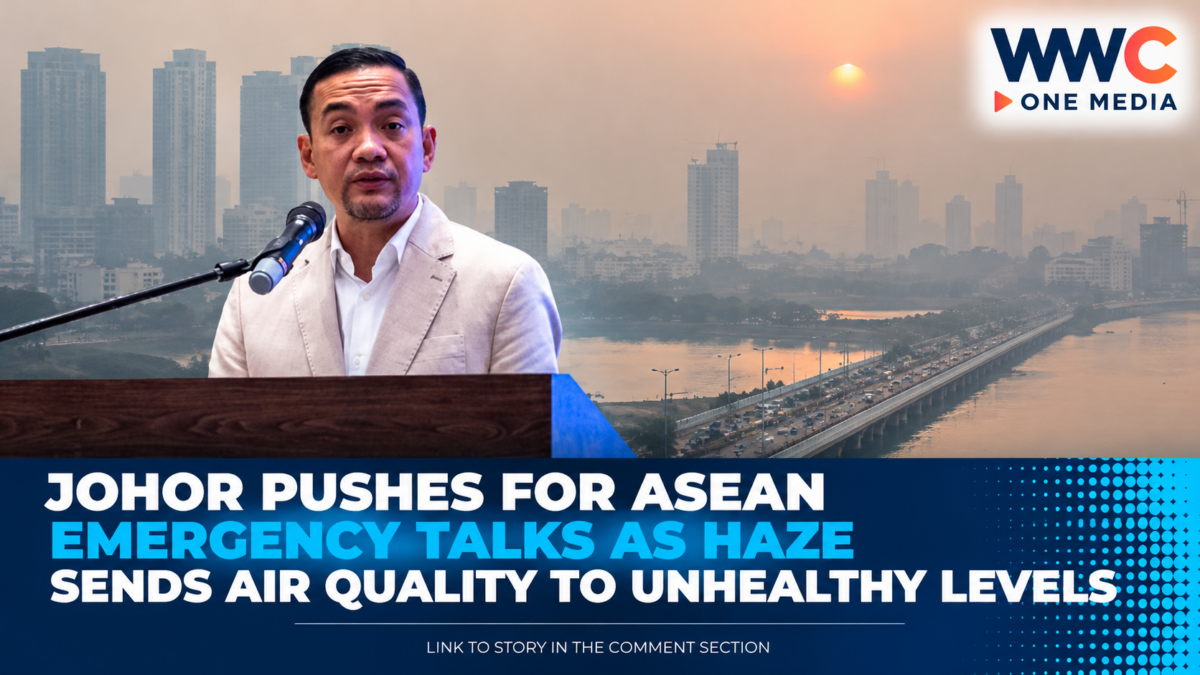
JOHOR BAHRU, Malaysia — Johor has called for an ASEAN emergency meeting to address worsening transboundary haze after air pollution reached unhealthy levels across parts of the state, prompting school closures and renewed concerns over public health.
Johor Menteri Besar Onn Hafiz Ghazi said ASEAN should take a more active role in coordinating a regional response, arguing that the haze had already crossed national borders and could not be addressed effectively by individual countries acting alone.
The appeal came as several areas in Johor recorded unhealthy Air Pollutant Index (API) readings. On Oct. 7, readings at eight monitoring stations ranged from 161 to 197, with Batu Pahat recording the highest level at 197.
Johor wants ASEAN to coordinate an emergency response
Onn Hafiz said ASEAN countries with the necessary expertise, equipment and capabilities could provide assistance according to regional needs and through mutual agreement.
He said closer cooperation could strengthen efforts in prevention, monitoring and response, allowing authorities to react more quickly to deteriorating air quality and haze conditions.
The proposal was raised during a meeting with Sigit Suryantoro Widiyanto, Indonesia’s consul general in Johor Bahru, where the Johor government conveyed its concerns about the situation and the need to intensify efforts to tackle the underlying causes of the haze.
Onn Hafiz stressed that Johor’s approach was not about assigning blame to a particular country.
Instead, he said the priority should be finding a collective solution because the effects of the pollution were already being felt across national borders.
Batu Pahat among the worst-hit areas
The deterioration in air quality has been particularly pronounced in Batu Pahat.
The district recorded an API reading of 208 on the night of Oct. 6, prompting authorities to close 335 education institutions there on Oct. 7.
As the haze continued to affect the state, the Regent of Johor, Tunku Mahkota Ismail, subsequently ordered the closure of all schools in Johor for two days.
The closure covers Oct. 8 and 9 and affects about 617,258 students across 1,198 schools under the Education Ministry. Home-based teaching and learning will be conducted during the closure to minimise disruption to students’ education.
The authorities said the measure was taken as a precaution to protect students’ health and safety amid deteriorating air quality across the state.
Haze is affecting more than one country
The current episode highlights the recurring regional nature of Southeast Asia’s haze problem.
Smoke from fires and other sources of air pollution can travel across national borders, particularly when wind conditions carry smoke from one country into neighbouring areas.
The ASEAN Specialised Meteorological Centre (ASMC) has warned that the regional hotspot and smoke-haze situation is expected to remain elevated during October.
Its latest outlook said El Niño conditions, above-normal temperatures and below-normal rainfall across much of southern ASEAN are contributing to conditions favourable for hotspots and haze. The centre also warned that the risk of transboundary haze would persist under prevailing southeasterly or southwesterly winds.
The regional outlook provides broader context for Johor’s concerns, although it does not by itself establish the source of any particular haze episode.
Johor says the issue is about public health
Onn Hafiz’s call for emergency talks was framed primarily as a public-health and regional-cooperation issue.
Unhealthy air pollution can pose greater risks to people with respiratory or cardiovascular conditions, children and other vulnerable groups. Prolonged exposure can also make outdoor activity more difficult for the wider population.
The worsening conditions have already affected daily life in Johor, with the closure of schools representing one of the most visible disruptions.
The state government is continuing to monitor API readings as authorities assess whether further measures are necessary.
Regional cooperation faces a familiar challenge
ASEAN has long sought to address transboundary haze through regional agreements and cooperation mechanisms.
However, haze episodes can be difficult to manage because they involve multiple jurisdictions, different environmental and enforcement systems, weather patterns and the challenge of identifying the exact sources of individual smoke plumes.
Johor’s latest proposal therefore goes beyond simply requesting assistance during a haze episode. Onn Hafiz is calling for ASEAN members to coordinate more closely on prevention, monitoring and emergency response.
He also said efforts to address the root causes of the haze should be intensified.
No finger-pointing, Johor says
The Johor government’s decision to engage Indonesia’s representative is significant because Indonesia is often closely associated with regional haze discussions, particularly when fires in parts of Sumatra and Kalimantan coincide with prevailing winds towards Malaysia and Singapore.
However, Johor has avoided directly attributing the current haze to Indonesia.
Onn Hafiz explicitly said the approach should not be about pointing fingers, but about developing a collective solution to a problem whose effects extend beyond individual national borders.
That distinction is important because air-quality conditions can be influenced by multiple factors, including local emissions, regional fires, weather and wind direction.
Singapore also affected by regional haze
The deteriorating conditions come as Singapore is experiencing its own period of unhealthy haze.
Singapore’s air quality recently entered the unhealthy range, with authorities warning that prevailing winds could continue carrying smoke into the city-state. The Federation Internationale de l’Automobile has also said outdoor entertainment activities surrounding this weekend’s Singapore Grand Prix could face restrictions if conditions worsen, although the race itself is not currently expected to be affected.
The simultaneous deterioration in air quality across parts of Malaysia and Singapore illustrates the regional dimension of the current episode.
What happens next
For Johor, the immediate priority is protecting residents as air quality remains unhealthy.
Schools across the state are closed for two days, authorities are monitoring pollution levels and the state government is pressing ASEAN leaders to consider an emergency meeting.
Whether ASEAN convenes such a meeting remains to be seen.
But Johor’s appeal reflects growing pressure for a coordinated regional response as the haze continues to affect public health, education and everyday life across borders.
With regional weather conditions expected to remain favourable for hotspots and smoke haze in the near term, the focus is likely to remain on whether air quality improves — and whether ASEAN members can translate calls for cooperation into faster action on the ground.