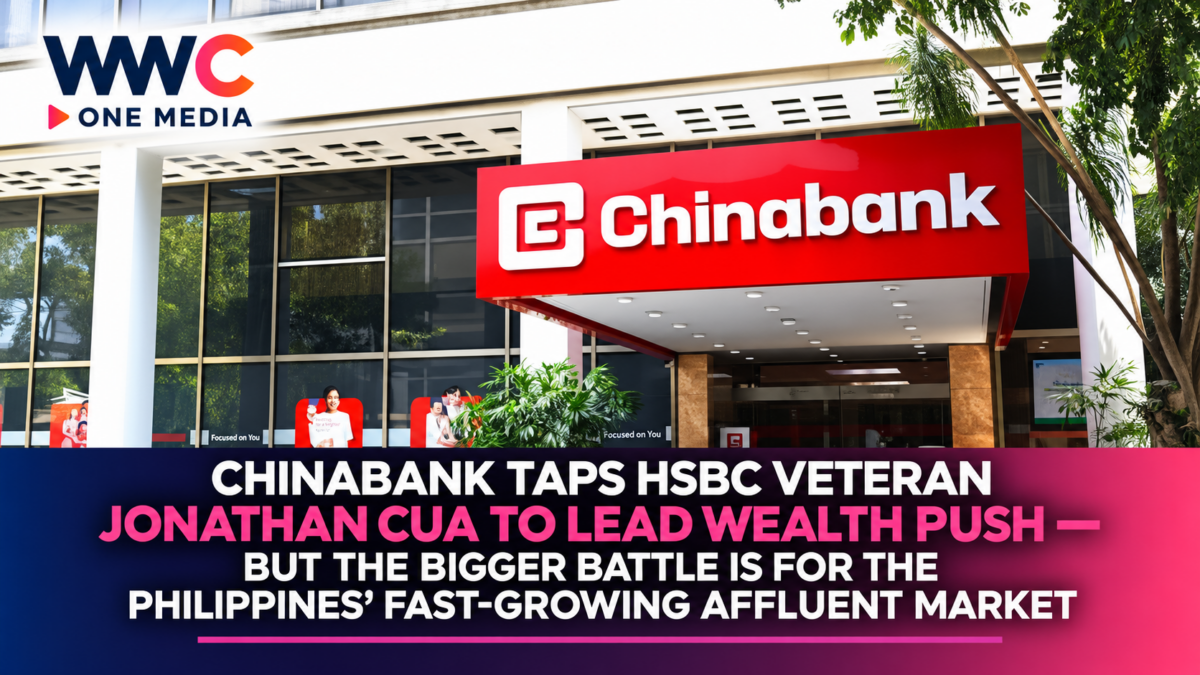
MANILA — Chinabank is strengthening its wealth-management business with the appointment of veteran banker Jonathan Cua, a move that signals the lender wants a much bigger share of the Philippines’ growing market for affluent and high-net-worth clients.
Cua brings decades of experience from:
HSBC
and other major financial institutions.
His mandate is straightforward but ambitious:
Expand Chinabank Wealth Management
and deepen relationships with clients whose needs now extend far beyond ordinary:
Savings accounts
Time deposits
and
Loans.
The timing matters.
Across the Philippines, banks are competing aggressively for a new generation of wealthy clients.
These include:
Entrepreneurs
Family-business owners
Corporate executives
Professionals
and
Next-generation heirs
who increasingly want access to more sophisticated financial services.
That makes Cua’s appointment more than a routine personnel move.
It is part of a larger race to control the financial lives of the country’s wealthiest households.
JONATHAN CUA BRINGS DEEP PRIVATE-BANKING EXPERIENCE
Cua spent years working in wealth and private banking, including senior roles at:
HSBC.
That matters because wealth management is fundamentally different from traditional commercial banking.
A typical bank customer may need:
Deposits
Credit cards
Mortgages
or
Business loans.
A high-net-worth client may need all of those plus:
Portfolio management
Estate planning
Trust structures
Global investments
Tax coordination
Succession planning
and
Family governance.
The adviser therefore needs to understand not just banking.
They need to understand the client’s entire balance sheet.
CHINABANK IS TRYING TO MOVE FURTHER UP THE VALUE CHAIN
Traditional banking can be highly profitable.
But wealth management offers a different type of economics.
Instead of earning mainly from:
Interest spreads,
banks can earn recurring fees from:
Assets under management
Trust products
Investment advisory
Fund distribution
and
Portfolio services.
That can produce:
Higher-margin
and
Less capital-intensive revenue.
For banks, that makes wealth management particularly attractive.
The more money clients place into managed investments, the more recurring fee income the bank can generate.
THE PHILIPPINES IS CREATING MORE WEALTH
The broader opportunity is being driven by economic growth.
The Philippines has seen continued expansion across sectors including:
Property
Consumer goods
Technology
Healthcare
Professional services
and
Family-owned enterprises.
Over time, that creates more:
Millionaires
Business owners
and
Families with investable assets.
Many of these clients do not simply want to preserve money in deposits.
They want to grow it.
That creates demand for professional wealth management.
THE RISE OF THE NEXT GENERATION CHANGES EVERYTHING
One of the biggest forces reshaping private banking is:
generational wealth transfer.
Many of the Philippines’ established business families are now transferring assets from founders to:
Children
and
Grandchildren.
The next generation often has different expectations.
They may want:
International diversification
Digital access
Sustainable investments
Private-market exposure
and
More professional governance.
That forces banks to evolve.
Relationships that were once built around personal loyalty increasingly need to be supported by stronger investment capabilities.
SUCCESSION PLANNING IS BECOMING A BIGGER BUSINESS
Family businesses also face another question:
What happens when the founder retires or dies?
This is not simply a legal issue.
It affects:
Ownership
Voting rights
Dividends
Control
and
Tax planning.
Private banks increasingly help clients design structures involving:
Trusts
Holding companies
Insurance
Estate plans
and
Investment portfolios.
That creates long-term relationships.
A client may remain with the same wealth manager for decades.
CHINABANK ALREADY HAS A STRONG ENTREPRENEURIAL CLIENT BASE
Chinabank has historically had strong relationships with:
Chinese-Filipino entrepreneurs
Family businesses
and
SMEs.
That gives it a natural advantage.
Many business owners who first used Chinabank for:
Working-capital loans
Trade finance
or
Corporate deposits
eventually accumulate significant personal wealth.
The bank can then try to convert those commercial relationships into:
Private-banking relationships.
That is a valuable source of clients.
THIS CROSS-SELLING OPPORTUNITY IS HUGE
Imagine a business owner who already uses Chinabank for:
Company payroll
Loans
Treasury services
and
Foreign exchange.
That same individual may personally own:
Real estate
Stocks
Bonds
Insurance policies
and
Offshore investments.
If Chinabank can manage both:
the business relationship
and
the owner’s personal wealth,
the lifetime value of that client becomes much larger.
This is one reason banks invest heavily in wealth-management teams.
HSBC EXPERIENCE COULD HELP CHINABANK GO MORE GLOBAL
Cua’s HSBC background could be particularly important.
HSBC has long specialized in:
Cross-border banking
Global investments
and
International wealth management.
Filipino high-net-worth clients increasingly want access to opportunities outside the Philippines.
That may include:
U.S. bonds
Global equities
Asian funds
Private credit
and
Offshore deposits.
A banker with international experience can help bridge that demand.
PHILIPPINE INVESTORS ARE BECOMING MORE GLOBAL
Historically, many wealthy Filipinos concentrated assets in:
Local property
Philippine equities
and
Bank deposits.
That is gradually changing.
Investors are increasingly seeking exposure to:
U.S. technology stocks
Global bonds
Asian markets
and
Alternative assets.
Why?
Because diversification can reduce dependence on one:
Country
Currency
or
Asset class.
That trend benefits banks with strong global product access.
HIGH INTEREST RATES HAVE CHANGED CLIENT BEHAVIOR
The current interest-rate environment has also transformed wealth management.
When interest rates were extremely low, investors had to take more risk to generate income.
Today, clients can earn meaningful yields from:
Government bonds
Corporate bonds
Money-market funds
and
Time deposits.
That creates new asset-allocation questions.
Should a client stay in cash?
Buy bonds?
Buy equities?
Invest overseas?
Private bankers are increasingly paid to answer those questions.
BONDS HAVE BECOME MORE ATTRACTIVE
Philippine government bonds and U.S. Treasuries have offered relatively high yields.
That can appeal to wealthy investors seeking:
Income
and
Capital preservation.
But bond investing is not risk-free.
Clients must understand:
Interest-rate risk
Currency risk
and
Credit risk.
That creates demand for professional advice.
EQUITIES STILL MATTER FOR LONG-TERM GROWTH
At the same time, affluent investors still need:
Growth assets.
Stocks remain one of the most important ways to build wealth over long periods.
But volatility can be uncomfortable.
Private banks therefore increasingly construct diversified portfolios combining:
Fixed income
Equities
Cash
and
Alternatives.
The exact mix depends on each client’s risk profile.
ALTERNATIVE INVESTMENTS ARE BECOMING MORE POPULAR
Sophisticated investors increasingly want access to:
Private equity
Private credit
Real estate funds
Structured products
and
Hedge-fund strategies.
These products can provide:
Higher return potential
or
Diversification.
But they can also be:
Less liquid
More complicated
and
More expensive.
That makes due diligence critical.
Private banks can differentiate themselves by selecting strong products rather than simply offering everything.
WEALTH MANAGEMENT IS ALSO A TECHNOLOGY BUSINESS NOW
Clients no longer want to wait for:
Monthly statements
or
Phone calls.
They expect:
Real-time portfolio access
Mobile dashboards
Digital onboarding
and
Instant reporting.
The next generation of wealthy investors may judge a private bank partly by its:
App
and
Digital experience.
That puts pressure on traditional banks to invest in technology.
BUT RELATIONSHIPS STILL MATTER
Despite digitalization, wealth management remains deeply personal.
High-net-worth clients often want:
A trusted adviser
who understands:
Family dynamics
Business interests
Risk tolerance
and
Long-term goals.
Technology can support that relationship.
It cannot fully replace it.
That is why senior relationship managers remain highly valuable.
COMPETITION IS GETTING INTENSE
Chinabank is not alone.
Major Philippine banks including:
BDO
BPI
Metrobank
Security Bank
and
UnionBank
have all expanded wealth-management capabilities.
Foreign banks also compete for affluent Filipino clients.
That includes institutions with strong international private-banking platforms.
The result is a crowded market.
Clients have more choices than ever.
BDO HAS SCALE
BDO benefits from:
Massive branch reach
Corporate relationships
and
One of the country’s largest balance sheets.
That gives it strong cross-selling opportunities.
A wealthy entrepreneur may already use BDO for:
Business banking
Trade finance
and
Investments.
Scale can be a major advantage in wealth management.
BPI HAS A STRONG AFFLUENT FRANCHISE
BPI also has a strong premium banking business.
Its longstanding presence among:
Corporate executives
Professionals
and
Upper-income households
gives it a deep client base.
BPI has also invested heavily in:
Digital wealth tools
and
Asset management.
That makes it another major competitor.
METROBANK ALSO TARGETS HIGH-NET-WORTH CLIENTS
Metrobank has built strong relationships with:
Family businesses
and
Large corporates.
Its investment-banking and treasury capabilities provide another route into wealth management.
Clients increasingly want one bank capable of handling both:
Corporate finance
and
Personal investments.
That creates opportunities for integrated banking groups.
FOREIGN BANKS BRING GLOBAL PRODUCT ACCESS
Foreign banks can compete differently.
They often have access to:
International research
Global funds
Offshore structures
and
Cross-border networks.
For wealthy Filipinos with:
Children studying abroad
International businesses
or
Assets in multiple countries,
that can be particularly attractive.
Chinabank therefore needs to combine:
Local relationships
with
Global capabilities.
Cua’s background may help with exactly that.
CHINABANK’S BRAND IS STRONG AMONG FAMILY BUSINESSES
One of Chinabank’s biggest assets is trust built over decades.
The bank was founded in:
1920.
It has served generations of entrepreneurs.
That heritage creates strong emotional ties.
But wealth management increasingly requires more than heritage.
Clients also compare:
Performance
Fees
Product selection
and
Technology.
That is where the next phase of competition will be fought.
THE BANK IS ALSO GOING THROUGH LEADERSHIP TRANSITION
Cua’s appointment comes during a broader period of transition at Chinabank.
Long-time chairman:
Gilbert Dee
recently stepped back from the board and became:
Chairman Emeritus.
Dee played a major role in shaping the institution over decades.
His transition marks the end of an era.
At the same time, the bank is bringing in executives with broader outside experience.
That suggests Chinabank is preparing for its next phase.
PROFESSIONALIZATION IS BECOMING MORE IMPORTANT
Many Asian financial institutions are moving toward:
More institutional management
and
Stronger succession planning.
That includes hiring executives from global banks.
Outside hires can bring:
New systems
Risk controls
Products
and
International relationships.
But they must also understand the local culture.
That balance is especially important in relationship-driven markets like the Philippines.
CHINABANK HAS BEEN GROWING RAPIDLY
Chinabank has posted strong growth across:
Loans
Deposits
and
Profitability.
The bank has benefited from strong corporate borrowing and consumer demand.
That financial strength gives it resources to invest in:
Technology
Branches
and
Talent.
Wealth management becomes a natural next growth pillar.
FEE INCOME CAN REDUCE DEPENDENCE ON INTEREST MARGINS
Banks earn much of their money from the spread between:
What they pay depositors
and
What they charge borrowers.
That spread is called the:
net interest margin.
But margins can fluctuate with interest rates.
Wealth-management fees provide another source of revenue.
That helps diversify earnings.
For investors, diversified revenue can make a bank’s profitability more resilient.
THIS IS WHY EVERY BIG BANK WANTS WEALTH CLIENTS
A wealthy client can generate revenue from multiple sources.
They may use:
Deposits
Loans
Investments
Insurance
Foreign exchange
and
Trust services.
One relationship can therefore produce significant recurring income.
And high-net-worth clients are often less sensitive to minor price differences than mass-market customers.
They care more about:
Trust
Service
and
Access.
THE BIGGEST CHALLENGE IS KEEPING CLIENT MONEY INSIDE THE BANK
Wealthy customers typically have relationships with multiple institutions.
They may keep:
Deposits at one bank
Investments at another
and
Offshore assets somewhere else.
The real goal of wealth management is to capture a larger percentage of the client’s:
“wallet share.”
That means convincing the client to consolidate more assets under one bank.
This is where stronger advisory capabilities matter.
FAMILY OFFICES ARE ALSO EXPANDING
Another emerging trend is the growth of:
Family offices.
These organizations manage wealth for:
Ultra-high-net-worth families.
They may handle:
Investments
Taxes
Philanthropy
Governance
and
Succession.
As Philippine family fortunes become larger and more sophisticated, family offices will become more important.
Banks want to serve them.
That creates another opportunity for Chinabank.
THE PHILIPPINES COULD BECOME A BIGGER REGIONAL WEALTH MARKET
Singapore and Hong Kong dominate Asian private banking.
But the Philippines is generating more wealth domestically.
That creates opportunities for local institutions.
Clients may still use offshore centers.
But local banks can manage:
Peso assets
Domestic businesses
and
Family relationships
more efficiently.
The winning model may therefore combine local banking with international investment access.
CUA’S JOB WILL BE TO BUILD THAT BRIDGE
This is where Jonathan Cua’s appointment becomes strategically important.
Chinabank already has:
Local relationships.
What it wants to expand is:
Global-style wealth management.
Cua’s experience could help strengthen:
Investment advisory
Product architecture
Relationship management
and
Cross-border capabilities.
The goal is not simply to sell more financial products.
It is to become the primary financial adviser to wealthy families.
THE BIGGER STORY: CHINABANK IS FIGHTING FOR THE CLIENT BEFORE THE WEALTH LEAVES THE COUNTRY
The Philippines is creating more:
Entrepreneurs
Professionals
and
High-net-worth families.
But wealthy clients have more options than ever.
They can move money to:
Singapore
Hong Kong
The United States
or
Global digital investment platforms.
That means Philippine banks face a simple but urgent question:
Can they provide enough:
Investment sophistication
Global access
and
Service quality
to keep that wealth inside their ecosystem?
Chinabank’s decision to bring in an HSBC veteran suggests it understands the stakes.
Jonathan Cua is not being hired simply to manage another banking division.
He is being asked to help Chinabank compete for a larger share of one of the most valuable customer segments in Philippine finance.
And that battle will become more intense as trillions of pesos in family wealth pass from one generation to the next.
Chinabank has spent more than a century building relationships with Filipino businesses — but the next test is whether it can turn those relationships into a modern wealth-management franchise before the country’s richest clients take more of their money elsewhere.