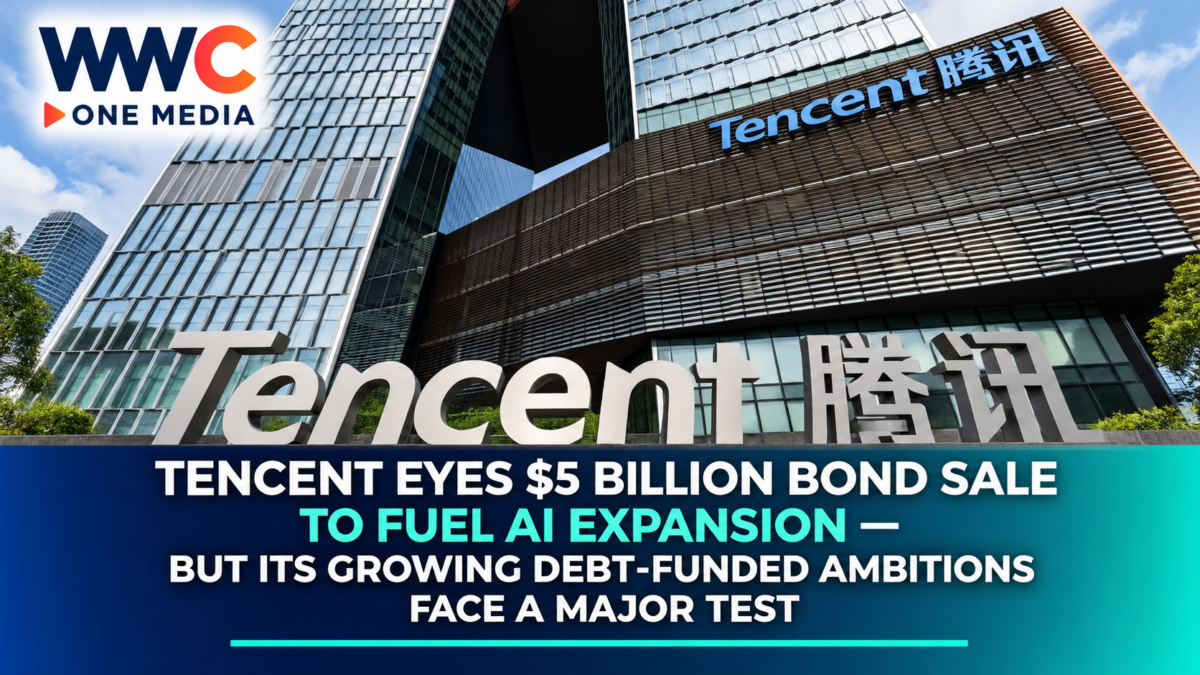
HONG KONG — Chinese technology powerhouse Tencent Holdings is reportedly considering a bond offering of approximately $5 billion, signaling that the company may increasingly turn to debt markets as it accelerates its multibillion-dollar push into artificial intelligence.
According to an October 8 report by Bloomberg, Tencent is weighing the potential fundraising as its AI expansion gains momentum. The possible transaction comes at a critical moment for China’s technology industry, where competition for advanced computing infrastructure, AI models and cloud customers is driving increasingly expensive investment decisions.
The proposed financing remains under consideration. Its final size, structure and timing have not been independently confirmed, and the report does not establish that Tencent has completed a new $5 billion issuance.
But the implications extend beyond a single bond sale.
Tencent is competing in an AI arms race where access to capital, computing power and advanced chips may prove as important as developing the technology itself.
Tencent’s AI spending is growing rapidly
Tencent, the company behind WeChat, one of China’s most influential digital platforms, has been expanding its AI strategy to defend its position against domestic technology rivals, including Alibaba and ByteDance.
The company has pledged to at least double its AI investments to more than 36 billion yuan, equivalent to approximately $5.3 billion, in 2026, according to earlier Bloomberg reporting.
Its spending ambitions reflect the enormous resources needed to develop large language models, build intelligent applications and secure computing infrastructure capable of processing increasingly complex AI workloads.
Tencent is particularly focused on integrating advanced AI capabilities into its existing ecosystem, which spans messaging, gaming, advertising, financial technology and cloud services.
That strategy could give Tencent a competitive advantage: rather than building an AI audience entirely from scratch, it can introduce new technology to customers already using its digital products.
However, AI development requires sustained investment, and monetization may take time to catch up with spending.
Tencent’s earlier $4.5 billion bond plan adds context
This would not be Tencent’s first major financing initiative of 2026.
In June, Bloomberg reported that the Chinese technology giant was marketing dollar- and yuan-denominated bonds in a transaction that could raise as much as $4.5 billion.
The earlier proposed securities included 10-year and 20-year dollar bonds, alongside offshore yuan bonds with maturities of 10 and 30 years.
The reported objectives included refinancing obligations and supporting general corporate needs, including AI development.
Bloomberg also reported that Tencent had approximately $3.5 billion in debt and bilateral loans maturing in 2026, with another $2.8 billion scheduled for 2027.
The earlier transaction illustrates Tencent’s willingness to use international capital markets as it balances debt repayments with expanding technology investment.
It is important, however, to distinguish the June financing plan from the newly reported October proposal. The available reporting does not establish whether the contemplated $5 billion sale would be an entirely separate issuance, a replacement financing or part of a broader funding strategy.
A $7 billion Oracle chip deal reveals the scale of Tencent’s ambitions
Tencent’s reported financing plans become more significant when viewed alongside its growing demand for advanced AI chips.
The Financial Times reported in early October that Tencent had agreed to lease access to approximately 100,000 advanced AI chips through Oracle’s data centers in Southeast Asia.
The arrangement was reportedly valued at around $7 billion, with a substantial upfront payment.
The FT also reported that Tencent’s second-quarter capital expenditure surged 176% year-on-year to approximately 53 billion yuan, or $7.9 billion, as it expanded AI computing capacity.
For Tencent, accessing advanced processors has become strategically important as US export restrictions complicate the purchase of certain high-performance chips by Chinese companies.
Overseas computing arrangements could provide an alternative route for some AI workloads, subject to applicable export controls and regulatory restrictions.
The development also highlights Southeast Asia’s growing strategic relevance in the global AI infrastructure race.
Singapore and neighboring markets may increasingly become important locations for cloud computing, data-center development and access to high-performance processing capacity.
DeepSeek investment could strengthen Tencent’s AI position
Tencent is also positioning itself through investments in China’s emerging AI companies.
Reuters reported on October 6 that Chinese AI developer DeepSeek was pursuing a funding round worth at least 80 billion yuan, approximately $12 billion, potentially reaching 100 billion yuan.
Tencent and battery manufacturer CATL were identified among the major investors backing the financing.
The reported fundraising, which remained subject to completion, could support DeepSeek’s expansion and preparations for a potential public listing.
Tencent’s involvement could strengthen its position across several parts of the AI industry, from cloud infrastructure to models and consumer applications.
Rather than relying entirely on internal development, Tencent appears to be pursuing a broader strategy combining its own research, partnerships and investments.
That approach could help the company respond to competition from Alibaba, ByteDance and emerging Chinese AI developers.
The global AI borrowing boom is raising concerns
Tencent’s contemplated bond sale also comes amid a worldwide financing surge tied to artificial intelligence.
In an October 8 report, Reuters highlighted how technology companies’ large financing requirements are placing increasing pressure on global capital markets.
Broadcom, Oracle and SpaceX were among the companies pursuing substantial funding arrangements for AI-related hardware and infrastructure.
The growing wave of corporate borrowing has raised questions about interest rates, credit risk and whether expected AI revenues will ultimately justify the enormous capital commitments.
There are also signs that investors are becoming more selective.
Reuters reported on September 29 that credit-market concerns surrounding major AI infrastructure projects were increasing, even as companies continued expanding their investments.
For Tencent, that creates a complicated financing environment.
Issuing bonds could allow the company to access substantial funding without immediately diluting existing shareholders. But borrowing also creates interest expenses and future repayment obligations.
If AI-related revenues grow more slowly than infrastructure costs, those obligations could constrain financial flexibility.
Can Tencent turn its AI investment into profit?
The central challenge facing Tencent is not simply how much money it can raise.
It is whether the company can convert its growing AI infrastructure into profitable products and services.
Tencent already operates an enormous digital ecosystem that could support AI commercialization in several areas, including intelligent advertising tools, AI-assisted customer service, gaming development, enterprise software and cloud computing.
These existing businesses offer potential opportunities to generate revenue from AI improvements without requiring customers to adopt entirely unfamiliar platforms.
However, converting those opportunities into sustainable earnings will depend on customer demand, pricing, operating costs and the quality of Tencent’s AI services.
The company’s extensive digital reach does not automatically guarantee that expensive AI investments will generate adequate financial returns.
The bigger picture
Tencent’s reported $5 billion bond proposal reflects a broader transformation of the global technology industry.
Companies that once competed primarily through software, digital platforms and consumer engagement are increasingly competing through access to electricity, data centers, specialized semiconductors and long-term financing.
For Chinese technology groups, the challenge is particularly complicated because of semiconductor restrictions, international trade tensions and intense domestic competition.
Tencent has several advantages, including an established consumer ecosystem, significant operating businesses and relationships across China’s technology sector.
But AI development is becoming more capital-intensive, and competitors are moving aggressively.
The question is no longer just whether Tencent can afford to compete in artificial intelligence. It is whether the company can generate enough financial returns to justify the cost of staying in the race.
And as its borrowing ambitions grow, investors will be watching closely to see whether AI eventually becomes a major profit engine—or an increasingly expensive commitment.