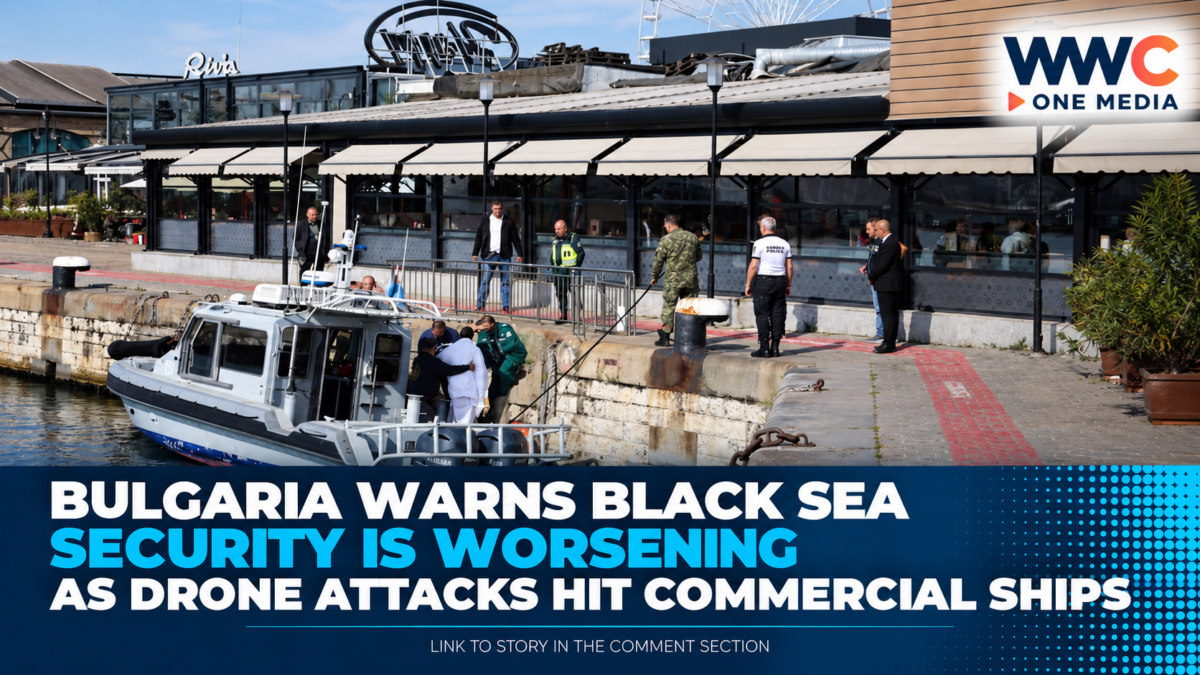
SOFIA, Bulgaria — Bulgarian President Iliana Yotova has warned that Russia’s war in Ukraine has significantly worsened the security situation in the Black Sea after drone attacks struck two commercial vessels inside Bulgaria’s exclusive economic zone.
Speaking after an emergency meeting of Bulgaria’s Consultative Council on National Security on Wednesday (Oct. 7), Yotova said the conflict was increasingly threatening commercial shipping, freedom of navigation and critical infrastructure in the region. She stopped short of directly blaming Russia for the attacks, saying Bulgarian authorities were still investigating who was responsible.
The warning came a day after two merchant ships were attacked roughly 128km off Bulgaria’s coast, in what Bulgarian officials described as the first such attack on commercial shipping in the country’s Black Sea economic zone.
Two ships attacked off Bulgaria
The attacks occurred early Tuesday (Oct. 6), when sea and aerial drones struck the vessels in waters about 80 miles off Bulgaria.
The Togo-flagged Alfa Watan suffered severe structural damage and sank at the scene. Its crew remained missing after Bulgarian authorities suspended search operations on Wednesday.
A second vessel, the Palau-flagged Able, caught fire following the attack. All 18 crew members were evacuated, although at least one person was injured.
The incident has heightened concerns over the safety of commercial shipping in the western Black Sea, particularly as the conflict between Russia and Ukraine continues to generate risks far beyond the immediate battlefield.
Ukraine has blamed Russia for the attack, while Russia has not been established as responsible. Bulgarian authorities have said the perpetrators must be identified through an investigation before responsibility is assigned.
Yotova links worsening risks to Ukraine war
Yotova said the attacks were part of a broader deterioration in maritime security.
“Russia’s war against Ukraine has led to a significant deterioration of the security environment in the Black Sea region,” she said.
She pointed to a growing pattern of maritime and aerial drone attacks against commercial vessels, saying such incidents have resulted in ships being damaged or sunk and lives being lost.
She also warned that increasingly sophisticated and longer-range unmanned systems were creating new threats to Bulgaria’s critical infrastructure.
The Bulgarian security council said the attacks could restrict freedom of navigation, reduce shipping traffic, increase insurance costs and create environmental risks if vessels carrying potentially hazardous cargo are damaged or sunk.
Bulgaria says there is no immediate national security threat
Despite the seriousness of the attacks, Bulgarian Prime Minister Rumen Radev said there was no immediate threat to Bulgaria’s national security.
He acknowledged that the country faces risks because the war is being fought relatively close to Bulgarian territory, but said the government did not consider the latest incident a direct threat to the country at this stage.
The distinction is significant because Bulgaria is both a NATO and European Union member, meaning attacks or incidents affecting its territory or economic zone could have broader implications for European security.
However, the government has so far focused on strengthening surveillance and maritime protection rather than invoking NATO’s collective-defence mechanism.
Bulgaria seeks stronger NATO and EU protection
Following the emergency security meeting, Yotova said Bulgaria should make greater use of its position within NATO and the EU to strengthen security in the Black Sea.
The council recommended seeking increased allied contributions to regional security, including air and maritime surveillance, coastal defence and counter-drone capabilities. Bulgaria could also seek additional support through NATO’s enhanced vigilance activity known as Eastern Sentry.
The government also plans to strengthen Bulgaria’s maritime situational awareness through unmanned surveillance systems and accelerate the modernisation of its armed forces.
Yotova said these measures were intended to protect Bulgaria’s security, economic interests and environment without violating the Montreux Convention, which governs access to the Turkish Straits and the Black Sea.
Call for safe navigation and a Black Sea moratorium
Bulgaria also wants the European Union to develop a framework for maintaining free and safe navigation in the Black Sea.
Yotova said Bulgaria should work with the other Black Sea countries — Russia, Ukraine, Romania, Georgia and Turkiye — to seek common measures to protect merchant shipping.
She also proposed discussions on a possible moratorium on military hostilities in the Black Sea, with the longer-term goal of transforming the region into a zone of shared security.
Bulgaria plans to raise the issue at upcoming European discussions, including the European Council meeting scheduled for Oct. 15 and 16.
The country also intends to consult Romania and Turkiye on coordinated measures to protect commercial vessels.
Growing concern over attacks on civilian shipping
The attacks off Bulgaria come amid a wider series of incidents involving commercial shipping in the Black Sea.
The latest episode has prompted concern in Europe because civilian vessels are operating in waters increasingly affected by military activity, drones and other unmanned systems.
European Commission President Ursula von der Leyen condemned attacks on civilian shipping in the Black Sea as unacceptable, warning of the danger posed to crews and commercial trade.
The European Commission is also assisting with the investigation into the Bulgarian attacks, including through satellite imagery.
The incidents have raised particular concern for the region’s food and energy supply chains because Black Sea shipping routes are important for the movement of agricultural commodities and other goods.
Bulgaria had already warned about Black Sea risks
Yotova’s latest warning follows an address she delivered to the United Nations General Assembly in September, when she argued that the war in Ukraine had transformed the Black Sea from a regional security issue into a broader international concern.
She called for the Black Sea to become a zone of safety and free movement for transport, energy and trade, warning that the effects of the war were extending beyond the territorial waters of the countries directly involved in the conflict.
The latest attacks have added urgency to those concerns.
Investigation remains critical
Although Ukraine has accused Russia of carrying out the attacks, Bulgarian authorities have not yet publicly established who launched the drones.
That distinction is important as investigators examine the evidence and determine whether the attacks were connected to the wider Russia-Ukraine conflict or another actor.
For Bulgaria, the immediate priority is protecting commercial shipping and critical infrastructure while avoiding an escalation that could draw the NATO member more directly into the conflict.
The sinking of the Alfa Watan and the attack on the Able have nevertheless demonstrated how the risks associated with the war are increasingly reaching international shipping routes beyond Ukraine’s immediate coastline.
With investigations continuing and regional tensions remaining high, Bulgaria is now pushing for stronger surveillance, counter-drone capabilities and international measures aimed at keeping the Black Sea open to civilian navigation.