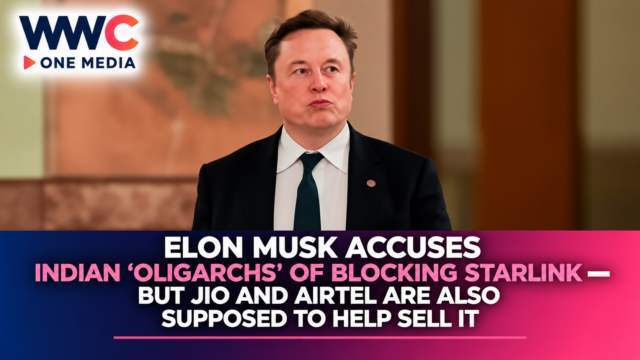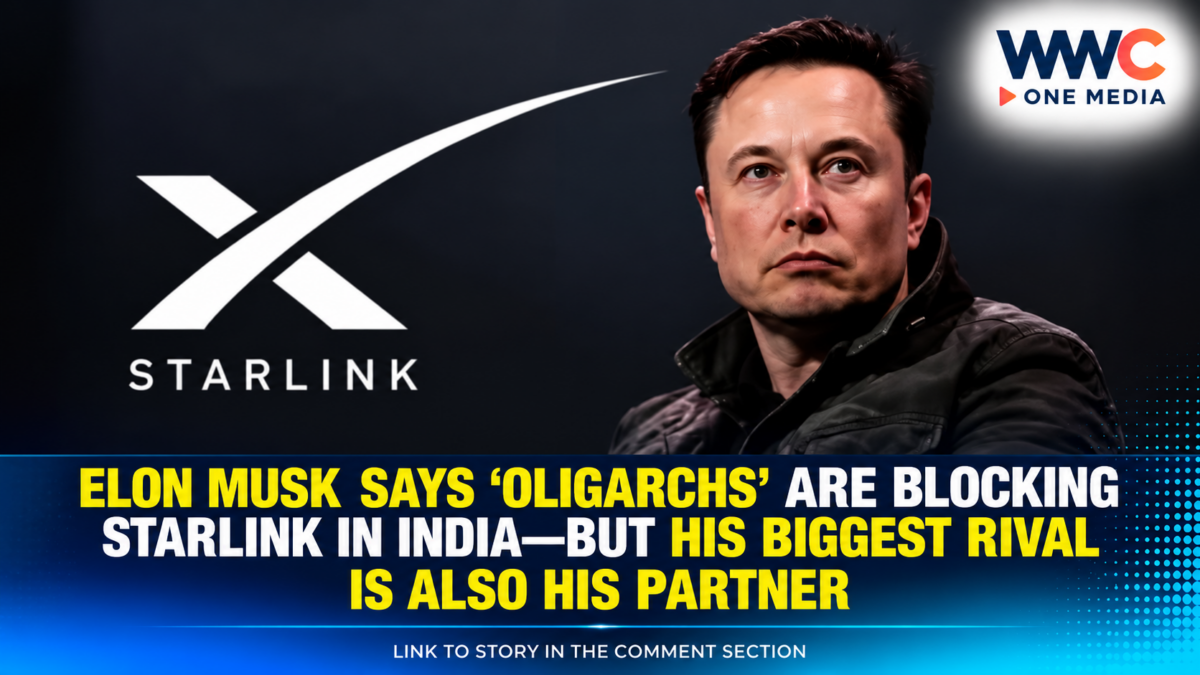
NEW DELHI — Elon Musk has dramatically escalated his fight over Starlink’s long-delayed entry into India, accusing unnamed Indian “oligarchs” of trying to protect a “monopolistic chokehold” on consumers.
But there is a major twist: the billionaires widely seen as the targets of Musk’s remarks—Mukesh Ambani and Sunil Bharti Mittal—have companies that are not simply rivals to Starlink. Both Reliance Jio and Bharti Airtel have signed agreements with SpaceX to help bring Starlink to India.
And India’s government is pushing back on the suggestion that Starlink is being singled out.
The result is a rapidly intensifying battle over one of the world’s most important emerging satellite-internet markets.
Musk’s explosive accusation
Musk made the accusation on X after responding to a post arguing that Starlink could help provide fast internet to Indians in areas where conventional mobile towers and fiber networks are difficult or expensive to deploy.
“Unfortunately, we are being blocked by certain oligarchs,” Musk said, alleging that they were trying to maintain their “monopolistic chokehold on the Indian people.”
He then added: “You can guess who they are…”
Musk called the situation “a crime against the people of India.”
He did not identify anyone by name.
However, Bloomberg and several Indian outlets interpreted the comments as an apparent swipe at the powerful telecom interests of Reliance Industries chairman Mukesh Ambani and Bharti Enterprises founder Sunil Bharti Mittal. Their companies, Reliance Jio and Bharti Airtel, dominate India’s telecom market.
That interpretation should not be treated as a confirmed accusation against either billionaire.
There is no public evidence establishing that Ambani, Mittal, Jio or Airtel is responsible for the regulatory delay.
India says the rules apply to everyone
The Indian government has rejected claims that Starlink is facing discriminatory treatment.
According to government officials cited by Indian media, satellite operators must undergo the same security vetting before receiving the approvals necessary to begin commercial service.
That distinction matters.
Starlink already holds an Indian licence for satellite communications. But having a licence does not automatically mean Starlink can switch on commercial consumer service.
The company still faces additional regulatory, security and spectrum requirements.
India has also licensed Eutelsat OneWeb and Jio Satellite Communications, meaning Starlink is competing in a broader satellite-internet race rather than operating in isolation.
Starlink says it is ready to go
The timing of Musk’s attack is significant.
Just hours before his comments, Starlink executive Lauren Dreyer told the India Mobile Congress that the company had already built much of the infrastructure required for an Indian launch.
Starlink says it has established 20 gateway sites containing hundreds of antennas and has designed its Indian operations around the country’s security requirements.
The company also says Indian user data will remain inside India.
Dreyer said Starlink had spent about five years working with Indian regulators, telecom operators and industry stakeholders.
Her message was blunt: Starlink says it is ready to serve India once India gives the final authorization.
That makes the remaining regulatory hurdles even more politically sensitive.
The real roadblock: security and spectrum
Starlink’s delay is not entirely new.
Earlier in 2026, Bloomberg reported that Indian security agencies had withheld final clearances amid concerns over Starlink’s ability to comply with India’s security requirements.
Those concerns were reportedly heightened by reports involving Starlink terminals in the Middle East conflict, including allegations that terminals were used in Iran even though Starlink was not licensed there.
Indian authorities have therefore been focused on a fundamental question:
Can a foreign-controlled satellite network guarantee that India can monitor, regulate and control its communications infrastructure when national-security concerns arise?
Starlink has responded by emphasizing that it has built an India-specific operating structure and security controls.
The company says it is keeping Indian user data within the country and has built the necessary ground infrastructure.
Then comes the Ambani twist
Here’s where the story becomes much more complicated.
Musk’s apparent targets are not simply trying to keep Starlink out of India.
Reliance Jio has already partnered with SpaceX.
In March 2025, Jio Platforms announced an agreement with SpaceX to explore offering Starlink services in India. Jio also planned to distribute Starlink equipment through its retail network and support installation and customer service.
Bharti Airtel made a similar agreement with SpaceX.
So while Jio and Airtel are enormous competitors to Starlink in India’s connectivity market, both have also positioned themselves as potential distribution and infrastructure partners.
That makes Musk’s “oligarchs” accusation particularly difficult to interpret as a straightforward corporate blockade.
Jio and Airtel still have enormous power
The reason Ambani and Mittal are nevertheless central to the story is simple: their companies control an enormous share of India’s telecom ecosystem.
Reliance Jio and Bharti Airtel together account for roughly 910 million broadband subscribers, representing more than 80% of India’s market, according to government data cited by the South China Morning Post.
That gives the two groups extraordinary influence over India’s connectivity market.
But it also creates a strange competitive relationship.
They can potentially benefit from Starlink entering India while simultaneously competing against it.
For rural connectivity, enterprise customers and hard-to-reach locations, Starlink could complement terrestrial networks.
For mainstream broadband, however, Starlink could eventually become another competitor.
India’s satellite-internet race is getting crowded
Starlink is also not the only company waiting at the starting line.
India has granted satellite-communications licences to:
- Starlink
- Jio Satellite Communications
- Eutelsat OneWeb
All three have been preparing for commercial service, but regulatory and security requirements remain critical hurdles.
Amazon’s satellite internet ambitions are also part of the longer-term competitive landscape, although its Indian application has followed a different regulatory path.
This is becoming much bigger than a fight between Musk and India’s telecom billionaires.
It is effectively a contest over who controls India’s next layer of connectivity infrastructure.
Why India matters so much to Starlink
India is an enormous potential market.
Traditional fiber and mobile networks have expanded dramatically, but the economics of reaching every remote village, island, mountain region and border area remain difficult.
That is precisely where low-Earth-orbit satellite broadband can have an advantage.
India’s own communications ministry has said satellite services could help connect rural, underserved and geographically difficult areas that are hard to reach through fiber, microwave and conventional terrestrial infrastructure.
For Starlink, India offers something potentially even more valuable: scale.
For India, satellite broadband could provide another tool for closing the remaining connectivity gaps.
But Starlink cannot simply turn the satellites on
This is the crucial point behind the controversy.
Starlink’s licence is not the same thing as final permission to launch consumer services.
India has been developing a regulatory framework for satellite spectrum that includes administrative assignment rather than traditional spectrum auctions.
TRAI’s recommendations have also addressed spectrum pricing, gateway coordination, interference management and security requirements.
More recent Indian rules have added another layer of scrutiny before satellite networks can connect to public telecommunications networks and offer consumer-facing services.
That means the final delay cannot simply be reduced to “Indian telecom companies blocked Musk.”
The regulatory picture is considerably more complicated.
Musk’s accusation could raise the pressure
Nevertheless, Musk’s intervention changes the political temperature.
Until now, Starlink’s Indian launch delays could largely be described as a regulatory and national-security issue.
Musk has now turned the dispute into something much more explosive:
an allegation that powerful private interests are protecting their market dominance.
If India continues delaying Starlink, Musk is likely to face questions about whether the remaining obstacles are genuinely regulatory—or whether commercial interests are influencing the process.
But if the government clears Starlink under the same framework applied to other operators, Musk’s allegation could lose some of its force.
Either way, the confrontation puts India’s satellite-internet policy under an international spotlight.
The bigger battle is over India’s digital future
India is trying to expand connectivity while protecting national security, domestic telecom interests and control over critical communications infrastructure.
Starlink wants rapid access to one of the world’s biggest markets.
Jio and Airtel want to maintain their dominant positions while also potentially benefiting from satellite technology.
And the Indian government has to decide how much room it is willing to give foreign-controlled satellite networks.
That makes Musk’s “oligarch” attack more than a social-media outburst.
It is a sign that the fight over India’s satellite-internet market is entering a much more confrontational phase.
Bottom line
Musk has accused unnamed Indian “oligarchs” of blocking Starlink, but the evidence does not establish that Ambani, Mittal, Jio or Airtel caused the delay. In fact, both Jio and Airtel have partnerships with SpaceX.
The more firmly established explanation is that Starlink remains subject to India’s security clearances, spectrum allocation and other regulatory requirements, while the government says satellite operators are being treated under the same framework.
But with Starlink already claiming it has built 20 Indian gateway sites and completed much of its local security infrastructure, the question now becomes unavoidable:
If Starlink is truly ready to launch, what exactly is India still waiting for?