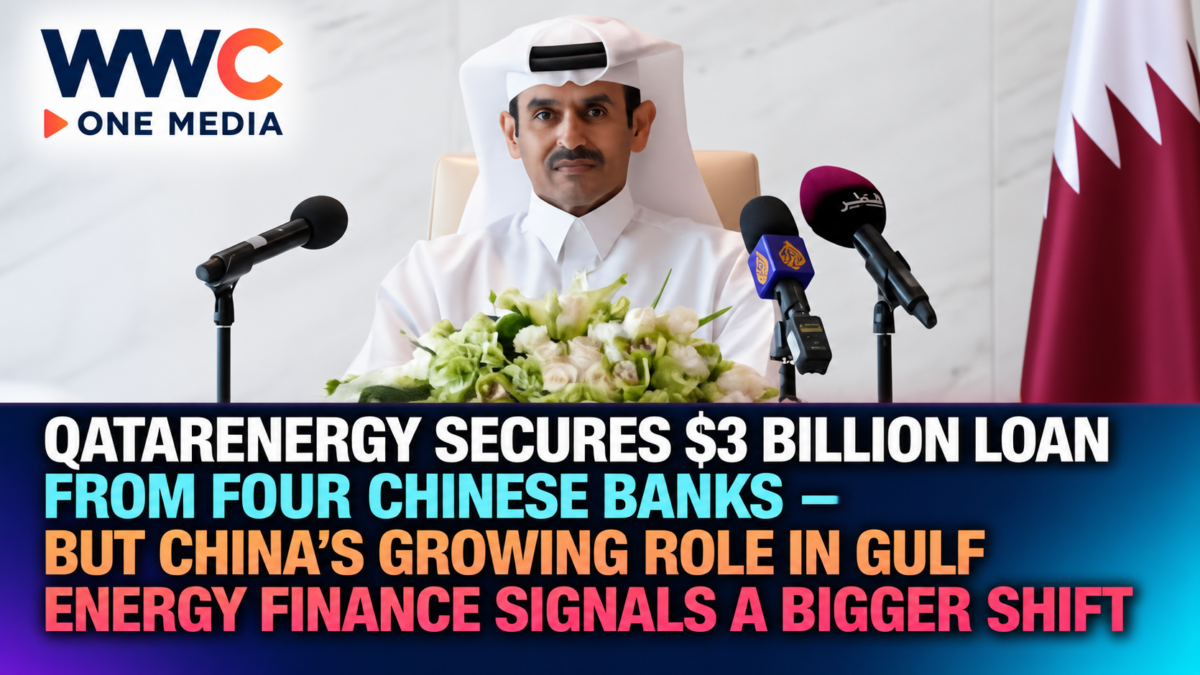
DOHA — QatarEnergy has reportedly secured $3 billion in financing from four Chinese banks, marking another major development in the deepening financial relationship between China and the energy-rich Gulf states.
The financing, reported by Bloomberg on October 7, 2026, comes at a critical moment for Qatar’s energy industry.
The state-owned company is pursuing one of the world’s largest liquefied natural gas expansion programs while confronting operational disruptions, damaged infrastructure and uncertainty surrounding shipping routes in the Middle East.
The involvement of Chinese lenders highlights a broader transformation in international finance.
China is no longer simply one of the biggest customers for Gulf energy. Its banks are becoming increasingly important providers of the capital supporting the region’s energy industry.
That shift could have significant implications for global banking competition, LNG investment and the economic relationship between Beijing and Doha.
But the latest financing also raises an important question.
As Chinese banks take a bigger role in funding Gulf energy companies, will their growing financial influence reshape a market historically dominated by Western and international lenders?
A $3 Billion Deal at a Critical Time
According to Bloomberg’s October 7 report, QatarEnergy secured a $3 billion loan involving four Chinese banks.
The financing underscores the continued availability of substantial Chinese banking capital for major Gulf energy businesses.
However, the reported headline does not establish the loan’s precise maturity, pricing, collateral arrangements or designated use.
Those details matter because QatarEnergy has several potential financing requirements.
The company is developing new LNG production capacity, supporting energy infrastructure, investing in shipping and maintaining existing operations.
It is also managing disruption caused by the wider Middle East conflict.
The latest loan therefore arrives during a period when access to diversified financing sources could be particularly valuable.
For lenders, the transaction reflects the scale of the Gulf’s energy-financing market.
For QatarEnergy, it demonstrates the potential importance of maintaining relationships with financial institutions across several major economies.
China’s Banks Are Becoming Major Gulf Lenders
The financing is part of a much larger regional trend.
Bloomberg reported in January that Chinese banks increased lending to Gulf borrowers nearly threefold in 2025.
Chinese financial institutions provided approximately $15.7 billion in regional loans, excluding bilateral transactions, according to Bloomberg-compiled data.
That compared with around $4.6 billion from banks based in the United States, United Kingdom and eurozone combined.
Saudi Arabia and the United Arab Emirates attracted much of the Chinese lending activity.
The figures show how rapidly the balance of international lending has been changing.
Western banks remain important providers of capital across the Middle East.
But Chinese financial institutions are increasingly competing for major transactions involving governments, energy companies and infrastructure developers.
QatarEnergy’s reported $3 billion loan adds another example to that broader trend.
China Is Moving Beyond Buying Oil and Gas
For years, China’s relationship with the Gulf was primarily associated with energy imports.
China needed oil and gas to support manufacturing, electricity generation and economic growth.
Gulf producers needed large, reliable customers.
That relationship has gradually expanded.
Chinese companies now participate in energy infrastructure, petrochemicals, shipping and industrial projects across the region.
Chinese banks are also financing companies and assets connected to those industries.
The result is a more integrated economic relationship.
Rather than merely purchasing energy produced in the Middle East, Chinese businesses and financial institutions are becoming increasingly involved in the systems that support its production and transportation.
This could deepen commercial ties even during periods of geopolitical instability.
QatarEnergy’s LNG Expansion Requires Enormous Capital
QatarEnergy is undertaking one of the world’s largest natural gas development programs.
Its North Field expansion is intended to substantially increase Qatar’s LNG production capacity.
Before the disruptions associated with the Middle East conflict, Qatar planned to raise its annual LNG capacity from approximately 77 million tonnes to 126 million tonnes through major development phases.
The investment involves new liquefaction facilities, offshore infrastructure, processing plants, pipelines and export facilities.
It also requires a large fleet of specialized LNG carriers.
These are complex projects with long construction periods and substantial capital requirements.
Even a financially powerful state-owned energy company benefits from access to multiple funding sources when managing investments of that scale.
Middle East Conflict Has Complicated Qatar’s Energy Plans
The latest financing comes against a difficult operational backdrop.
Reuters reported in September that QatarEnergy was facing potential delays to its North Field expansion because of disruptions around the Strait of Hormuz and difficulties transporting equipment.
QatarEnergy Chief Executive and Qatar’s Minister of State for Energy Affairs, Saad Sherida al-Kaabi, said the first North Field East production train remained targeted for early 2027.
However, later development phases faced greater uncertainty.
The conflict has complicated the movement of construction materials and equipment through a region critical to international energy shipping.
For QatarEnergy, that creates a complicated financial environment.
The company must maintain existing operations while investing in new capacity and managing the consequences of damaged infrastructure.
Additional financing could strengthen its flexibility, although the precise purpose of the reported Chinese-bank loan has not been independently established.
Iranian Attacks Damaged Qatar’s LNG Infrastructure
The scale of QatarEnergy’s operational difficulties became clear earlier this year.
In March, Reuters reported that Iranian attacks had damaged facilities at Qatar’s Ras Laffan energy complex.
According to al-Kaabi, the attacks affected approximately 17% of Qatar’s LNG export capacity.
The damage involved two LNG production trains and a gas-to-liquids facility.
QatarEnergy estimated that the disruption could reduce annual revenue by approximately $20 billion.
Some affected facilities were expected to require extensive repairs lasting several years.
Those losses illustrate why energy producers need substantial financial resilience.
Even companies with large resource reserves can face extraordinary costs when war damages production infrastructure.
The financial consequences extend beyond repairs.
Reduced production can affect export contracts, shipping schedules and future investment plans.
LNG Shipments Are Moving Again, but Risks Remain
There have been signs of improvement.
Reuters reported on October 5 that more LNG cargoes from Qatar were moving through the Strait of Hormuz despite continuing security threats.
Several shipments from the Ras Laffan export terminal had successfully passed through the strategically important waterway.
That suggested some recovery in export activity.
However, the route remains vulnerable to renewed attacks and shipping disruptions.
This distinction is important.
Improving tanker movements do not automatically mean that damaged LNG production capacity has been restored.
Production, transportation and export operations are separate parts of the energy supply chain.
QatarEnergy must manage all three.
China’s Financial Commitment Comes With Geopolitical Risk
For Chinese banks, financing Gulf energy businesses offers opportunities alongside significant risks.
The region contains some of the world’s most important hydrocarbon reserves and energy infrastructure.
Many major borrowers are state-owned or closely connected to governments.
Those relationships can make Gulf borrowers attractive to international banks.
But the Middle East conflict has demonstrated that even strategically important energy assets can experience severe disruption.
In March, Bloomberg reported that the growing exposure of Asian banks to Gulf lending had become a concern as hostilities involving Iran escalated.
That means Chinese lenders must evaluate more than a borrower’s financial strength.
They also need to consider geopolitical instability, operational disruption, insurance costs and the potential effect of prolonged shipping restrictions.
Chinese Banks Have Financed QatarEnergy Projects Before
The reported transaction is not the first example of Chinese financial institutions supporting projects connected to QatarEnergy.
Independent financing records show that Chinese banks participated in earlier loans for major Qatari energy developments.
One example is the Ras Laffan Petrochemicals Complex, a project involving QatarEnergy and Chevron Phillips Chemical.
In 2023, the development secured a syndicated financing package of approximately $4.39 billion.
The lending group included major Chinese institutions alongside banks from other countries.
Chinese participants included Agricultural Bank of China, Bank of China, China Construction Bank and Industrial and Commercial Bank of China.
That earlier financing demonstrates that Chinese banks already have experience participating in complex Qatari energy transactions.
However, it should not be assumed that the same four institutions provided the newly reported $3 billion loan.
The lenders in the October 2026 transaction require separate confirmation.
LNG Shipping Is Another Major Area of Cooperation
The financial relationship also extends into LNG transportation.
QatarEnergy has ordered large numbers of LNG carriers to support its expanding export business.
Chinese shipyards have secured important contracts within that program.
Financing records from earlier transactions show Chinese banks supporting LNG carrier acquisitions connected to QatarEnergy.
For example, Chinese development and export-credit institutions participated in financing arrangements associated with four LNG vessels ordered from Chinese shipbuilders.
These relationships illustrate how energy trade creates opportunities across several industries.
A long-term LNG supply agreement can support demand for shipping.
Shipping requirements create orders for shipbuilders.
And shipbuilding contracts create opportunities for banks to arrange financing.
The result is a network of commercial relationships linking China’s financial and industrial sectors with Qatar’s energy industry.
Qatar and China Have Deep Long-Term LNG Relationships
Energy sales remain an essential part of the partnership.
China is an important market for Qatari LNG.
Chinese energy companies have entered long-term purchase agreements linked to Qatar’s gas expansion.
These contracts help provide revenue visibility for expensive production projects.
For buyers, long-term agreements can support energy security by securing access to future supplies.
For QatarEnergy, they can help justify investment in facilities that may operate for decades.
The relationship therefore benefits both sides.
China gains access to LNG.
Qatar gains major customers and long-term commercial relationships.
The involvement of Chinese banks adds a financial dimension to those established energy ties.
But China’s Future LNG Demand Is Becoming Less Certain
There is a potentially important complication.
China’s LNG demand outlook is changing.
Reuters reported in July that analysts had reduced their forecasts for Chinese LNG imports in the early 2030s.
The revisions reflected China’s increasing domestic gas production, pipeline imports and renewable-energy development.
Several analysts lowered their expectations by approximately 14 million to 22 million tonnes.
At the same time, global LNG export capacity is expected to expand significantly through the end of the decade, led by projects in the United States and Qatar.
That creates a potential longer-term challenge.
QatarEnergy is investing to supply a global market that may become more competitive.
China remains an important LNG customer.
But future demand growth is not guaranteed.
The ability to secure customers across Asia and Europe will therefore remain critical.
Qatar Is Also Strengthening Energy Relationships Across Asia
China is not QatarEnergy’s only important Asian partner.
In February 2026, Malaysia’s state-owned Petronas signed a 20-year LNG supply agreement with QatarEnergy.
The agreement covers approximately 2 million tonnes of LNG annually.
The deal reflects Malaysia’s efforts to diversify energy supply as domestic gas production faces pressure and electricity demand rises.
It also demonstrates QatarEnergy’s broader effort to establish long-term relationships across Asian markets.
These partnerships matter because Asian countries remain among the world’s largest LNG importers.
Japan, South Korea, China and several Southeast Asian economies rely on imported gas for electricity, industry or both.
QatarEnergy’s long-term growth plans depend partly on maintaining access to those markets.
Why the $3 Billion Loan Matters Beyond Qatar
The financing also reflects a larger change in international capital flows.
Chinese banks have increasingly demonstrated their ability to participate in multibillion-dollar transactions outside China.
For Gulf companies, that provides another major source of financing.
For Chinese lenders, it creates opportunities to diversify international business and deepen relationships with strategically important industries.
The development could also increase competition among global banks.
A Gulf energy company seeking financing may be able to approach lenders from China, Europe, the United States, Japan and the Middle East.
Greater competition can provide borrowers with more options.
However, the availability and cost of financing still depend on credit conditions, geopolitical risk and market sentiment.
Does Chinese Financing Mean Western Banks Are Losing Influence?
Not necessarily.
Western banks remain deeply involved in energy financing across the Gulf.
Many major transactions involve syndicates combining banks from several countries.
International financial institutions also provide services beyond loans, including hedging, trade finance and capital-markets advisory work.
The rise of Chinese lending therefore does not automatically mean Western institutions are being displaced.
But it does suggest that their relative dominance may be weakening in some segments.
For QatarEnergy, greater diversity among lenders could be beneficial.
For Chinese banks, successful transactions could strengthen their position in future regional financings.
The competition is likely to intensify as Middle Eastern governments and energy companies continue investing in infrastructure.
The Financing Terms Will Be Important
The next major question concerns the structure of QatarEnergy’s reported $3 billion loan.
Several details remain important for evaluating its financial significance.
The interest rate will help determine how expensive the financing is.
The maturity will indicate how long QatarEnergy has before repayment becomes due.
The currency and repayment structure will affect financial flexibility.
And the designated use of proceeds will clarify whether the loan supports investment, refinancing, operating requirements or another purpose.
Until those terms are confirmed, it would be premature to describe the financing as a specific emergency rescue package or to assign it to a particular LNG project.
The reported transaction establishes a major financing development.
Its full financial implications will depend on the underlying agreement.
The Bigger Story Is China’s Expanding Financial Reach
China’s involvement in Gulf energy has been growing for years.
The relationship began primarily with demand for crude oil and natural gas.
It has expanded into investment, infrastructure, shipping, petrochemicals and banking.
The latest reported loan to QatarEnergy reinforces that trajectory.
Chinese banks are increasingly competing for the business of some of the world’s most strategically important energy companies.
For Qatar, those relationships provide access to additional sources of capital at a time when its energy sector faces extraordinary operational and investment challenges.
For China, lending strengthens its commercial presence in a region central to global energy security.
QatarEnergy’s reported $3 billion financing agreement is significant on its own.
But the bigger story is how China is steadily expanding its role from a major buyer of Gulf energy into a major financier of the infrastructure and companies supplying it.
The unanswered question is whether that growing financial relationship will give Chinese banks a lasting advantage in the Middle East—or expose them to greater risks as geopolitical instability continues to threaten the region’s most valuable energy assets.