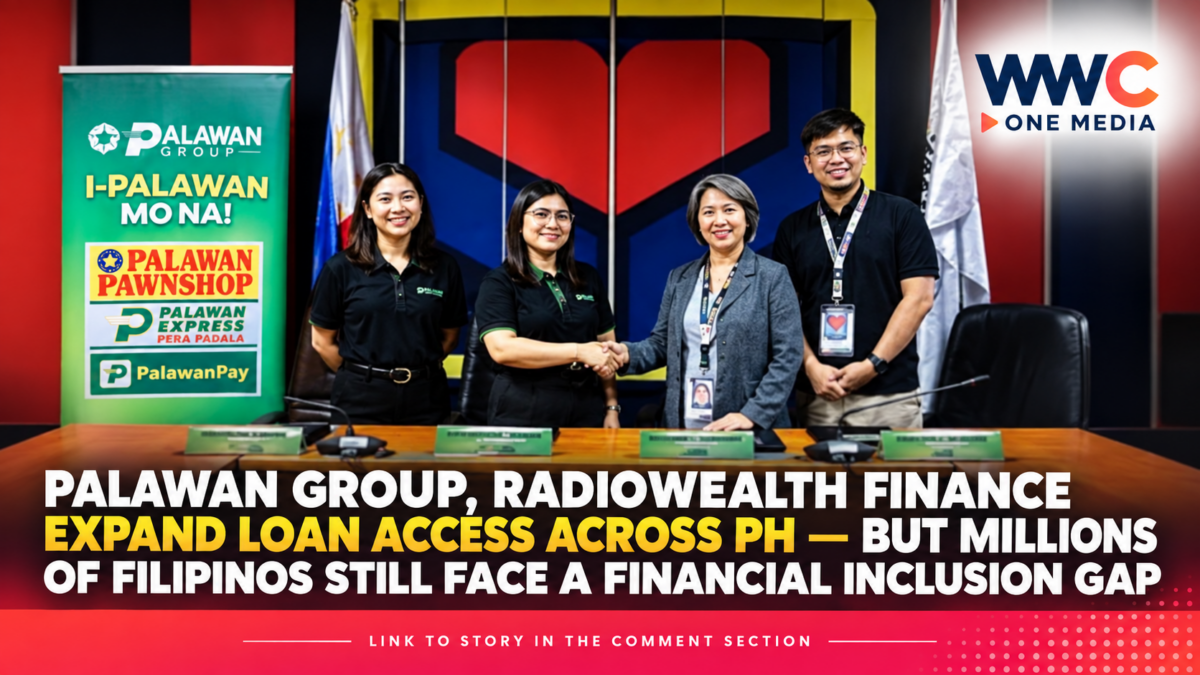
MANILA, Philippines — Palawan Group of Companies and Radiowealth Finance Company are expanding their partnership to make receiving and repaying loans easier across the Philippines, combining one of the country’s widest physical financial-service networks with a growing digital payments ecosystem.
The tie-up gives Radiowealth Finance Company, or RFC, borrowers additional options to receive loan proceeds and settle monthly amortizations through Palawan Group’s nationwide channels, while PalawanPay is being integrated as a payment option for RFC customers for the first time.
The move targets a persistent problem in Philippine consumer finance: obtaining a loan is only one part of financial access.
For borrowers in provinces and communities where banks and traditional financial institutions may be less convenient to reach, simply receiving funds or making monthly repayments can involve additional travel, time and expense.
By connecting RFC’s lending operations with Palawan’s physical and digital channels, the companies are betting that convenience could help close that gap.
More than 70,000 physical and digital access points
Palawan Group says its broader network now includes more than 70,000 branches, Pera Padala outlets and PalawanPay Money Shops nationwide, although the figure includes different types of physical and partner locations rather than 70,000 conventional branches.
Palawan Pawnshop itself operates thousands of branches, while the wider network includes agents and digital cash-in and cash-out locations.
Under the expanded partnership, RFC customers can use Palawan’s over-the-counter network for loan-related transactions while also gaining access to digital payment options through PalawanPay.
The companies said they also plan closer coordination covering operations, finance, marketing and customer service.
That combination of physical locations and app-based financial services reflects a broader strategy increasingly being used by Philippine financial companies: do not force customers to choose between cash and digital finance—offer both.
Palawan Group describes that model as a “bricktech” strategy, combining brick-and-mortar access with technology. The group has steadily expanded beyond its traditional pawnshop and remittance businesses into payments, insurance, lending and other financial services.
Why the partnership matters beyond convenience
The bigger issue is financial inclusion.
Despite years of rapid growth in e-wallets and digital banking, millions of Filipinos still do not individually hold a formal financial account.
The Bangko Sentral ng Pilipinas’ 2025 Consumer Finance and Inclusion Survey found that only 50% of Filipino adults individually owned a formal financial account in 2025, down from 56% in 2021.
E-money accounts were the most common, owned by about 36% of adults, while bank-account ownership stood at roughly 23%.
The BSP also found substantial differences based on income, education and location, with higher-income and better-educated Filipinos more likely to hold accounts and more urbanized regions generally reporting stronger access than predominantly rural areas.
That makes networks extending beyond major commercial centers particularly important.
Palawan Group Chief Business Development Officer Lisa Castro-Sabado said the partnership was intended to respond more quickly to customers while expanding financial access to underserved Filipinos.
Radiowealth Finance Chairman Jun Famatigan similarly described the agreement as more than a commercial expansion, saying the companies want to create additional opportunities for Filipinos who have limited access to financial services.
Digital payments are booming even as account ownership remains uneven
The partnership comes during one of the biggest shifts in Philippine financial behavior in decades.
According to the BSP, digital transactions represented 57.4% of the volume of monthly retail payments in 2024, up from 52.8% in 2023.
Digital transactions accounted for 59% of retail payment value, with merchant payments, person-to-person transfers and business-to-business supplier payments responsible for most digital activity.
Digital adoption has continued expanding.
BSP data showed that 62% of Filipino households used electronic devices for online financial transactions in 2025, compared with 53% a year earlier.
Meanwhile, household-level financial access is considerably higher than individual ownership: the BSP said 85% of households had at least one financial account in 2025, indicating that many families share access even when individual household members remain outside the formal financial system.
That creates a potentially large market for financial companies capable of bridging cash-heavy communities with digital platforms.
Radiowealth brings six decades of lending operations
Radiowealth Finance traces its history to 1964 and focuses heavily on financing for Filipino consumers and entrepreneurs.
The company offers financing products including business loans and secured financing involving vehicle documents and real-estate titles, subject to its lending requirements.
Importantly, RFC is not an unregistered online lending operation.
The Securities and Exchange Commission lists Radiowealth Finance Company Inc. as a financing company with Certificate of Authority No. 173.
The SEC also lists RFC’s online loan-application portal among recorded online lending platforms.
That distinction matters as regulators continue warning Filipinos to verify whether digital lenders and lending platforms are properly authorized before providing personal information or borrowing money.
Palawan is increasingly becoming financial infrastructure, not just a remittance company
The RFC deal is also part of a much wider expansion by Palawan Group.
The company has been building partnerships that use its physical network as financial infrastructure for institutions that need to disburse or collect money across the country.
In 2025, for example, Palawan Group partnered with the Department of Agriculture’s Agricultural Credit Policy Council to make loan disbursement and repayment more convenient for farmers and fisherfolk—groups that have traditionally faced significant barriers to formal financing.
More recently, the company has expanded international remittance access and continued integrating digital transactions through PalawanPay.
PalawanPay has around 22 million users, according to company figures, while Palawan Group continues adding payment, insurance, remittance and other financial services around that ecosystem.
The strategic logic is straightforward.
A financial company does not necessarily need to build thousands of its own branches if it can connect customers to an existing national payment and cash-handling network.
But easier repayment does not automatically mean easier or cheaper borrowing
For consumers, however, one distinction is crucial.
The Palawan-RFC partnership expands transaction channels. It does not mean every customer will automatically qualify for a loan, nor does it by itself reduce interest rates, fees or borrowing requirements.
Loan approval, interest charges, repayment periods, collateral requirements and other conditions remain governed by RFC’s applicable products and borrower assessments.
That means consumers should still compare the effective cost of borrowing, not simply whether obtaining and repaying a loan has become more convenient.
Accessibility and affordability are not the same thing.
A loan that can be received digitally or paid through a nearby outlet may reduce transaction friction, but borrowers still need to understand the total amount they will repay and whether installments fit comfortably within their household or business cash flow.
The bigger battle is bringing formal finance closer to everyday Filipinos
The Palawan-Radiowealth partnership may appear at first to be another corporate payment integration.
But it highlights a much larger competition unfolding across Philippine finance.
Banks, e-wallet operators, financing companies, remittance networks and fintech firms are racing to reach consumers who historically relied heavily on cash, informal borrowing or financial institutions located far from their communities.
Digital finance is accelerating that transition—but the BSP’s latest numbers show the job is far from finished.
Only half of Filipino adults individually held a formal financial account in 2025, even as digital transactions increasingly dominate the country’s retail-payment system.
That gap explains why Palawan Group’s physical network still matters even in an increasingly app-driven economy.
For RFC, the partnership means more locations and another digital channel through which customers can manage loans.
For Palawan, it strengthens its ambition to become much more than a pawnshop and remittance network.
And for millions of Filipinos still outside—or only partially connected to—the formal financial system, the real test will be whether easier access eventually translates into safer, more affordable and more useful credit.