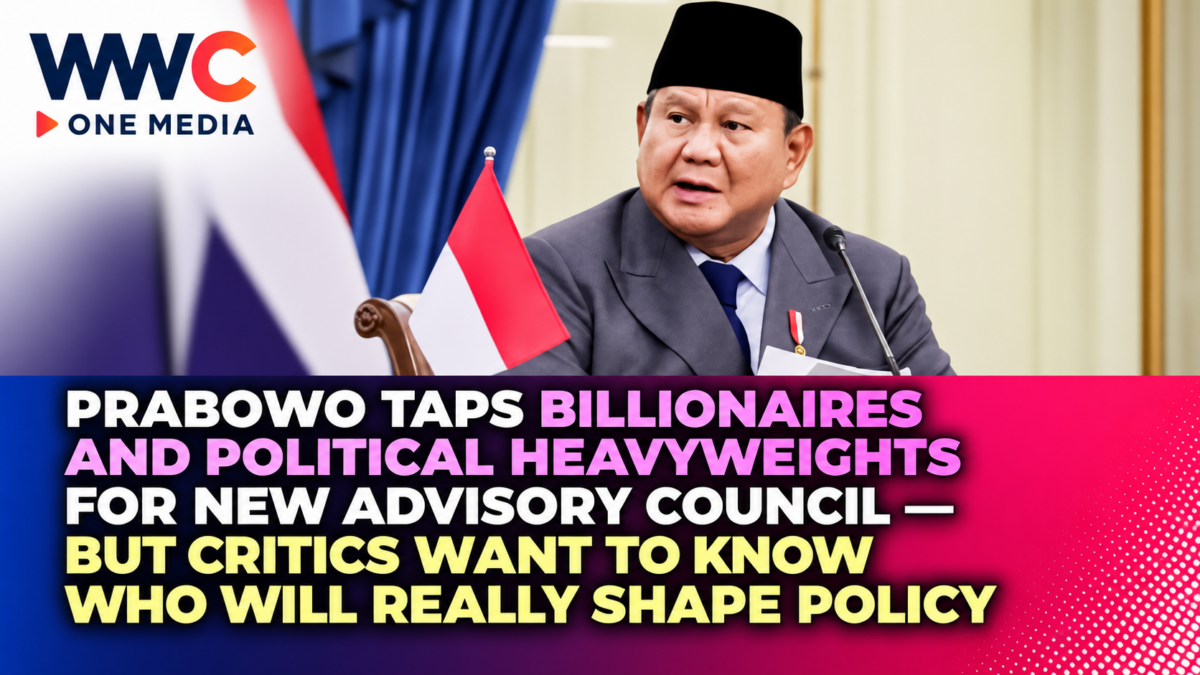
JAKARTA — Indonesian President Prabowo Subianto has assembled one of the broadest power circles of his presidency, appointing 26 billionaires, veteran politicians, former ministers, religious leaders, retired officials and public intellectuals to the country’s Presidential Advisory Council.
The new lineup, sworn in at the State Palace on October 2, places some of Indonesia’s most influential business and political figures within direct advisory reach of the president at a time when Prabowo is reshuffling his government, trying to stabilize investor confidence and facing growing scrutiny over the direction of policy in Southeast Asia’s largest economy.
At the center of the new council are two of Indonesia’s best-known billionaires:
Dato’ Sri Tahir, founder of Mayapada Group,
and
Chairul Tanjung, founder of CT Corp.
They will sit alongside former senior ministers, ex-security officials, Islamic leaders, academics and political veterans.
The lineup gives Prabowo access to a huge range of experience.
But it also raises an important question:
Will Wantimpres become a serious policy brain trust—or another layer of influential insiders surrounding the president?
The Council Has 26 Members
Prabowo formally appointed the members under Presidential Decree No. 107/P of 2026.
Former senior minister Pratikno was named chairman.
Former coordinating economic minister Hatta Rajasa became deputy chairman.
Former government communications chief Muhammad Qodari was appointed secretary.
The full council also includes figures such as:
Sinta Nuriyah Wahid,
Quraish Shihab,
Agum Gumelar,
Chairul Tanjung,
Said Aqil Siradj,
Anwar Iskandar,
Yahya Cholil Staquf,
Jusuf Wanandi,
Budi Gunawan,
Bambang Soesatyo,
Salim Segaf Al-Jufri,
Soekarwo,
Dato’ Sri Tahir,
Rocky Gerung,
Jusuf Hamka,
Anwar Usman,
and former transportation minister Ignasius Jonan.
That is an unusually broad mix of business, politics, religion, security and civil society.
The Council Is Advisory — Not a Shadow Cabinet
Wantimpres is not designed to run ministries.
Under Indonesian law, its role is to provide advice and considerations to the president in exercising executive power.
The council is directly under and accountable to the president.
Its members may advise Prabowo:
individually,
or collectively.
They can also be asked to attend cabinet meetings, working visits or state visits.
But they do not automatically have authority over:
budgets,
ministries,
regulators,
or state-owned companies.
That distinction matters because the presence of several powerful tycoons may create an impression that business leaders are entering government.
Formally, they are advisers.
Their Advice Is Supposed to Stay Confidential
Another important legal detail is that Wantimpres members are generally not supposed to publicly disclose the contents of the advice they give the president.
The institution’s own rules say members are not permitted to reveal or disseminate their advice and considerations to outside parties.
That means the public may not always know:
what Tahir recommended,
what Chairul Tanjung argued,
or whether political figures disagreed with Prabowo behind closed doors.
This confidentiality can make the council useful for candid discussions.
It can also make its real influence difficult to measure.
Pratikno Brings Deep Experience From the Jokowi Era
Pratikno’s appointment as chairman is politically significant.
He served for a decade as state secretary under former President Joko Widodo, making him one of Jokowi’s closest and most experienced administrative figures.
Prabowo then kept him inside government as coordinating minister for human development and culture before moving him to Wantimpres during this week’s reshuffle.
That gives Pratikno a rare combination of:
bureaucratic knowledge,
political relationships,
and experience working under two presidents.
His selection also shows that Prabowo is not relying only on figures from his own long-standing political circle.
He is incorporating people closely associated with the previous administration.
Hatta Rajasa Adds Another Political Network
Deputy chairman Hatta Rajasa is another veteran of multiple governments.
He served as coordinating minister for economic affairs under President Susilo Bambang Yudhoyono and previously held cabinet roles under both Yudhoyono and Megawati Soekarnoputri.
Hatta is also a former chairman of the National Mandate Party, or PAN.
His daughter is married into the Yudhoyono family.
That places him at the intersection of:
business,
party politics,
and one of Indonesia’s most influential political families.
For Prabowo, that kind of network can be valuable.
It broadens the range of political channels available outside the formal cabinet.
Then There Are the Billionaires
The most eye-catching appointments are Tahir and Chairul Tanjung.
According to Forbes’ 2025 Indonesia rich list, Tahir and family were worth about $9.8 billion, while Chairul Tanjung was worth roughly $4.4 billion.
Forbes’ real-time tracker placed Tahir’s family fortune around $9.5 billion to $10.3 billion in September 2026, depending on market movements.
That makes the council not merely politically influential.
It is also financially powerful.
Tahir Built Mayapada Into a Diversified Empire
Tahir is the founder of Mayapada Group.
His interests span:
banking,
healthcare,
media,
property,
and investments.
His family has stakes in Bank Mayapada and property businesses and owns assets in Indonesia and Singapore.
He is also well known for philanthropy.
Putting a business figure of that scale on the council could give Prabowo direct access to the perspective of one of Indonesia’s most experienced private-sector investors.
That may be especially useful as the government seeks investment for:
infrastructure,
healthcare,
industrial development,
and new growth sectors.
Chairul Tanjung Brings Media, Retail and Finance Experience
Chairul Tanjung built CT Corp., one of Indonesia’s largest diversified private groups.
His businesses span:
financial services,
television and media,
retail,
entertainment,
hospitality,
and consumer services.
His portfolio gives him something different from Tahir.
He understands both high finance and mass-market consumer behavior.
He has also served in government before.
Chairul was briefly coordinating minister for economic affairs under President Yudhoyono.
So he enters Wantimpres as both a billionaire entrepreneur and a former senior policymaker.
Why Would Prabowo Want Billionaires Around Him?
There are several possible reasons.
First:
business leaders can provide real-time information about investment sentiment.
Second:
they understand why companies delay or accelerate spending.
Third:
they can flag regulatory problems before they become larger economic issues.
Fourth:
they may help Prabowo communicate with domestic and international investors.
That could matter now.
Indonesia is trying to attract enormous capital into:
mining downstreaming,
electric vehicles,
batteries,
digital infrastructure,
food production,
housing,
and energy.
Business advice can be valuable when investment policy becomes increasingly complicated.
But Their Presence Also Raises Conflict-of-Interest Questions
The same advantage creates a risk.
Billionaires own companies that can be affected by:
tax policy,
banking regulation,
public procurement,
land policy,
trade rules,
and state investment decisions.
That means the public will want confidence that advice to the president serves national interests rather than private commercial ones.
There is no evidence in the appointment itself that Tahir or Chairul will improperly influence policy.
But the potential for perceived conflict is obvious.
That makes transparency around government decisions even more important.
Wantimpres Does Not Make Those Decisions Itself
Again, the legal structure matters.
Wantimpres can advise.
It does not itself issue regulations or allocate government contracts.
That means accountability remains with:
the president,
the cabinet,
ministries,
and relevant government agencies.
If a policy happens to benefit an adviser’s business interests, the important question will be how the government decision was made.
The existence of a billionaire on the council alone does not prove improper influence.
The Council Also Includes Powerful Islamic Leaders
Prabowo did not build Wantimpres solely around business and politics.
Several prominent Islamic leaders were appointed.
They include:
Yahya Cholil Staquf,
Said Aqil Siradj,
and
Anwar Iskandar.
These figures have deep links to Nahdlatul Ulama, Indonesia’s largest Muslim organization.
That gives the council direct access to leaders with enormous social and religious reach.
In Indonesia, that matters politically.
Religious organizations influence:
education,
local communities,
elections,
social policy,
and public opinion.
Quraish Shihab Adds Religious Scholarship
The council also includes respected Quranic scholar and former religious affairs minister Quraish Shihab.
His presence gives Prabowo access to a different kind of authority.
Where billionaires advise on markets and investment, religious scholars can provide perspective on:
social cohesion,
religious affairs,
education,
and public ethics.
Pratikno said after the swearing-in that the council was intentionally composed of national figures from varied religions, professions and backgrounds.
The diversity appears deliberate.
Sinta Nuriyah Wahid Carries Another Symbolic Weight
Sinta Nuriyah Wahid, widow of former President Abdurrahman Wahid, is another notable member.
Gus Dur, as her husband was widely known, remains an important symbol of pluralism and moderate Islam in Indonesia.
Sinta’s appointment therefore brings moral and historical weight beyond ordinary party politics.
It also strengthens the council’s connection to Indonesia’s civil-society and interfaith traditions.
Budi Gunawan Brings Security and Political Influence
The council includes retired police general Budi Gunawan.
He previously served as head of Indonesia’s State Intelligence Agency and later as coordinating political and security minister under Prabowo.
Budi is widely regarded as an influential political figure and has longstanding connections with former President Megawati Soekarnoputri.
That makes him useful to Prabowo in another way.
Wantimpres can function as a bridge to political networks that do not necessarily sit inside the president’s core coalition.
Anwar Usman Is the Most Controversial Name
One of the most scrutinized appointments is former Constitutional Court chief justice Anwar Usman.
Anwar is also Vice President Gibran Rakabuming Raka’s uncle.
In 2023, an ethics panel found Anwar guilty of serious ethical violations connected to a Constitutional Court decision that changed eligibility rules for presidential and vice-presidential candidates.
That ruling helped allow Gibran to run in the 2024 election despite being below the normal age requirement.
Anwar was subsequently removed from the court’s top leadership post.
His appointment to Wantimpres will therefore attract renewed attention.
His Presence Reopens the Gibran Controversy
The 2023 Constitutional Court episode remains one of the most politically sensitive events surrounding Prabowo and Gibran’s rise to power.
Critics argued that the ruling created a path specifically benefiting Gibran.
Anwar’s family relationship intensified those concerns.
His inclusion in the presidential advisory council does not change the old ethics ruling.
But it does return him to a prominent national role.
That may reinforce criticism that politically connected figures continue to circulate through Indonesia’s elite institutions.
Rocky Gerung Adds a Completely Different Voice
Political commentator and academic Rocky Gerung is another interesting choice.
Gerung has often been an outspoken critic of Indonesian governments.
His inclusion suggests Prabowo is willing—at least institutionally—to bring more independent or critical voices into the advisory structure.
Whether those critical voices genuinely influence policy is another question.
But the appointment gives Wantimpres a broader ideological profile than a council made entirely of loyalists.
Jusuf Wanandi Brings Establishment Policy Experience
The council also includes Jusuf Wanandi, co-founder of Indonesia’s Centre for Strategic and International Studies.
Wanandi has spent decades at the intersection of:
business,
foreign policy,
politics,
and strategic affairs.
His experience could be especially relevant as Indonesia balances relationships with:
China,
the United States,
ASEAN,
BRICS,
and other global blocs.
Prabowo has pursued an unusually active foreign policy.
Having experienced strategic thinkers outside the Foreign Ministry may appeal to him.
Ignasius Jonan Adds Infrastructure Expertise
Former transportation and energy minister Ignasius Jonan was also appointed.
Jonan is widely associated with management reform at Indonesia’s state railway company before entering cabinet.
His experience spans:
transport,
energy,
state-owned enterprises,
and infrastructure.
That fits directly with several of Prabowo’s economic priorities.
Indonesia needs vast investment in:
transport networks,
power,
housing,
industrial zones,
and resource processing.
Jonan gives the council another highly practical operational voice.
The Council Arrives Immediately After a Major Cabinet Reshuffle
Timing is one of the most important parts of the story.
Prabowo appointed Wantimpres just one day after reshuffling several major cabinet positions.
Veteran diplomat Arrmanatha Nasir became foreign minister.
Former foreign minister Sugiono moved into a coordinating role.
Pratikno left the cabinet and moved to the advisory council.
That sequence suggests Prabowo is reorganizing not only his formal government but also the structure around it.
The cabinet runs departments.
Wantimpres gives him another channel of advice.
Finance Has Also Been in Turmoil
The political backdrop includes repeated changes at the Finance Ministry.
Prabowo recently replaced Purbaya Yudhi Sadewa with veteran technocrat Suahasil Nazara, making Suahasil the third finance minister of Prabowo’s presidency in less than two years.
Reuters reported that the previous dismissal followed internal clashes over personnel and policy, adding to investor concern about the stability of economic management.
That makes the appointment of senior business figures to Wantimpres even more noteworthy.
Prabowo may want more private-sector voices around him while the government tries to rebuild economic confidence.
Indonesia’s Economy Is Huge — and the Policy Stakes Are High
Indonesia is Southeast Asia’s largest economy.
It is also a G20 member with:
more than 280 million people,
enormous natural resources,
a rapidly expanding consumer market,
and growing geopolitical importance.
Prabowo wants faster growth.
The government’s 2027 budget is built around an official 6% growth target.
State spending is planned at more than 4.1 quadrillion rupiah, roughly $228 billion to $231 billion depending on exchange rates.
That means decisions on:
taxation,
subsidies,
industrial policy,
food security,
defense,
and social programs
carry enormous consequences.
A president facing that complexity has obvious reasons to seek broader advice.
But Investors Are Watching Fiscal Discipline
Prabowo’s economic agenda is expensive.
He has pushed programs involving:
free school meals,
defense spending,
food security,
housing,
infrastructure,
and industrial development.
Investors have repeatedly questioned whether the government can expand those programs without weakening Indonesia’s long-standing fiscal discipline.
The new 2027 budget keeps the deficit below the legal 3% ceiling at about 2.4% of GDP.
That helps reassure markets.
But the concern has not disappeared.
The Billionaires May Be Expected to Offer Market Discipline
This is where Tahir and Chairul Tanjung could become especially influential.
Business leaders understand how markets react to:
deficits,
currency weakness,
regulatory uncertainty,
and unpredictable policymaking.
They also know what makes investors postpone projects.
Prabowo may use them as a reality check.
If government policy begins worrying banks or major employers, advisers from the private sector can potentially flag that problem early.
Whether the president listens is another matter.
That Is the Core Question Raised by Critics
The Jakarta Post noted that the new council was broadly welcomed but also prompted one basic criticism:
Prabowo has to be willing to listen.
An advisory council can contain the smartest people in the country.
It has little value if advice is ignored.
That is why political analyst Arya Fernandes of CSIS said the challenge will be ensuring the body contributes meaningfully to strategic policy rather than simply expanding the president’s circle of advisers.
That may become the main test of Wantimpres.
A 26-Member Council Can Also Become Unwieldy
There is another practical issue.
Twenty-six advisers are a lot of advisers.
They represent competing interests.
Business leaders may prioritize investment.
Religious figures may focus on social policy.
Former generals may emphasize security.
Political veterans may care about coalition stability.
Academics may recommend reforms that politicians dislike.
That diversity can generate better decisions.
It can also generate conflicting advice.
Pratikno’s job will partly involve turning those perspectives into something the president can actually use.
The Expansion Is Historically Significant
The traditional Wantimpres structure was much smaller.
Under the original 2006 framework, the council consisted of a chairman and eight members.
Indonesia later amended the law in 2024, opening the way for a broader structure.
Prabowo has now filled the institution with 26 figures.
That turns Wantimpres into a much larger national advisory platform than earlier versions.
Prabowo Waited Nearly Two Years to Fill It
Another unusual feature is timing.
Prabowo had governed for nearly two years without appointing the council.
Reuters noted that Wantimpres had remained vacant under him until now.
So why activate it now?
The official answer is that the president wants broader experience and advice.
Politically, the timing also coincides with:
cabinet reshuffles,
investor unease,
economic pressure,
and signs of weakening public approval.
That makes it reasonable to view the council as part of a wider effort to stabilize the presidency.
Approval Ratings Matter
Reuters described Prabowo as facing declining approval ratings as the council was announced.
A broad advisory body can help politically in several ways.
It gives prominent figures a stake in the administration.
It creates channels to religious organizations.
It strengthens links with business.
It connects Prabowo to former ministers and political families.
And it can signal that the president is listening more broadly.
That does not necessarily mean the appointments are purely political.
But politics is clearly part of the institutional environment.
This Is Also Coalition Management
Indonesia’s presidential system often depends on extremely broad political coalitions.
Prabowo already controls a large parliamentary alliance.
Wantimpres gives him another mechanism for keeping influential individuals close.
A former minister outside cabinet can still have access.
A political elder can still offer input.
A tycoon can remain engaged without taking a formal ministerial post.
A religious leader can communicate concerns directly.
That can reduce the number of powerful figures operating entirely outside the administration.
But ‘Keeping Everyone Close’ Has a Cost
The danger is elite congestion.
If too many influential people receive positions or privileged access, government can begin looking less like a streamlined executive and more like a network of overlapping power centers.
That can make accountability harder.
Who recommended the policy?
Which adviser influenced the president?
Did ministers disagree?
Was a decision driven by economics, politics or coalition management?
Because Wantimpres advice is confidential, the public may rarely know.
That opacity could become one of the council’s biggest criticisms.
Prabowo’s Leadership Style Is Already Under Scrutiny
Recent personnel changes have increased debate about Prabowo’s management style.
Reuters reported concerns that loyalty and personal networks may sometimes compete with technocratic independence inside the administration.
The appointment of a diverse advisory council could partly counter that criticism.
Prabowo is bringing in:
experienced technocrats,
business leaders,
religious figures,
and some independent thinkers.
But again, representation is only one step.
Influence is what matters.
The New Council Could Be Most Valuable During Crises
Advisory bodies become particularly useful when problems cross ministerial boundaries.
Consider:
a financial-market shock,
food-price crisis,
regional security dispute,
or major social unrest.
No single ministry owns the whole problem.
A council containing:
former economic ministers,
security officials,
religious leaders,
businesspeople,
and strategists
can provide a more integrated view.
That is probably where Wantimpres could deliver the most value.
Indonesia Faces Several Such Risks Already
The government is managing:
high food prices,
energy costs,
pressure on the rupiah,
large social spending commitments,
regional geopolitical tensions,
and investor concern about fiscal policy.
Rice prices, for example, have remained near records, while forecasts warn El Niño could reduce the 2027 harvest.
At the same time, borrowing costs and global energy prices are putting pressure on many economies.
These are exactly the kinds of cross-cutting problems a broad advisory council may be asked to examine.
Business Leaders May Focus on Confidence
For investors, confidence can disappear quickly.
Policy surprises.
Sudden tax changes.
Cabinet instability.
Regulatory disputes.
All can trigger capital outflows.
Indonesia has spent decades building a reputation for relatively disciplined macroeconomic management.
Prabowo wants faster growth without losing that credibility.
Advisers such as Tahir, Chairul Tanjung and Hatta Rajasa may be particularly useful in warning when policy begins to cross that line.
Religious Leaders May Focus on Social Stability
Economic reform can create winners and losers.
Fuel subsidies.
Food prices.
Labor rules.
Tax changes.
All can trigger social anger.
Indonesia’s large Islamic organizations often have strong grassroots visibility that the central government lacks.
Their leaders can tell the president what communities are actually feeling.
That kind of information can be politically valuable before dissatisfaction becomes protest.
Former Security Officials Add Another Layer
Figures such as Budi Gunawan and Agum Gumelar bring experience from security institutions.
That can help with:
political stability,
intelligence,
regional security,
and crisis management.
But it also means a significant portion of Prabowo’s advisory environment remains connected to military, police and intelligence networks.
That will reinforce debate about the role of security figures in civilian governance.
Prabowo himself is a former general.
Business and Security Are Becoming Increasingly Connected
Indonesia’s strategic industries often sit at the intersection of economics and national security.
Nickel.
Energy.
Ports.
Telecommunications.
Semiconductors.
Digital infrastructure.
Critical minerals.
Chinese investment.
Western investment.
These are not purely commercial issues anymore.
A diverse council may help Prabowo evaluate those decisions from multiple angles.
China Will Be One of the Biggest Strategic Questions
China is one of Indonesia’s largest trading and investment partners.
Chinese money has helped finance:
nickel processing,
industrial parks,
transport infrastructure,
and the Jakarta-Bandung high-speed railway.
But Indonesia also guards its own maritime interests in the South China Sea.
Prabowo therefore needs to balance:
economic cooperation,
strategic autonomy,
and national sovereignty.
Advisers with business and foreign-policy backgrounds could play an important role in that balance.
The U.S. Relationship Matters Too
Indonesia also wants stronger economic, defense and technology ties with the United States.
That gives Prabowo another balancing act.
He wants investment from China.
He wants access to Western technology.
He wants ASEAN centrality.
And he wants Indonesia to remain strategically independent.
That is a complicated foreign-policy environment.
The presence of experienced diplomats and strategic thinkers outside the formal Foreign Ministry may reflect that reality.
Prabowo Has Been Centralizing Foreign Policy
Reuters has reported that Prabowo personally dominates much of Indonesia’s foreign-policy agenda.
The appointment of veteran diplomat Arrmanatha Nasir as foreign minister may give the ministry more professional weight.
At the same time, Wantimpres adds even more voices.
That could improve policy quality.
Or it could make decision-making more diffuse.
Again, the effectiveness will depend on who the president actually listens to.
The Council Includes One Woman Among 26 Members
The Jakarta Post noted that Sinta Nuriyah Wahid is the only woman on the council.
That imbalance may attract criticism.
Indonesia has prominent women in:
business,
academia,
government,
law,
civil society,
and politics.
A 26-member advisory council with only one woman provides limited gender representation.
That does not determine the quality of the council’s advice.
But it does weaken the claim that the body fully reflects the country’s diversity.
The Business Representation Is Much Stronger
By comparison, economic and political elites are well represented.
The council includes:
billionaires,
former cabinet ministers,
business founders,
senior policy figures,
and politically connected personalities.
This reflects Prabowo’s priorities.
Economic growth and political stability remain central to his presidency.
The composition appears built to give him access to both.
The Wealth Inside the Room Is Extraordinary
Tahir alone is worth roughly $10 billion.
Chairul Tanjung around $4.4 billion based on Forbes’ most recent annual ranking.
Add politically connected entrepreneurs and former senior officials, and the council represents an enormous concentration of:
capital,
networks,
institutional knowledge,
and influence.
That is what makes Wantimpres potentially powerful even without formal executive authority.
Advice from people like these can matter simply because they have access.
Access Is a Form of Power
Formal authority is not the only way policy is shaped.
Someone who can privately tell the president:
“investors will react badly,”
“religious leaders are concerned,”
“this policy will hurt the banks,”
or
“the security risks are higher than ministers think”
can have enormous influence.
That is the power Wantimpres may possess.
Not the ability to sign laws.
The ability to shape the thinking of the person who does.
That Is Why Accountability Will Matter
A strong advisory council could improve government.
It could also create a hidden channel of influence.
The difference depends on governance.
If Prabowo uses Wantimpres to challenge his assumptions and test policy, it could become valuable.
If it becomes a reward for allies or a place where private interests gain privileged access, criticism will grow quickly.
The public will have limited visibility because the advice itself is confidential.
So outcomes become the main evidence.
Watch What Happens to Economic Policy Next
The most useful way to judge the council will not be speeches at the inauguration.
It will be what changes afterward.
Does economic policy become more predictable?
Does Prabowo reduce policy surprises?
Does investor confidence improve?
Does fiscal discipline hold?
Do business regulations become clearer?
Does the government manage food inflation better?
If those areas improve, Wantimpres may deserve some credit.
If not, the council risks becoming another elite institution with an impressive membership list but limited practical effect.
The Bigger Story Is About Prabowo Expanding His Inner Circle
The billionaire names naturally attract attention.
But the deeper political story is broader.
Prabowo has created a 26-person advisory network linking:
business,
religion,
security,
academia,
former governments,
and multiple political factions.
That gives him one of the widest informal power bases of his presidency.
At a time of cabinet changes and economic uncertainty, that may help stabilize his administration.
It may also concentrate even more influence around the presidency.
The Council Is Powerful Only If Prabowo Uses It
That may ultimately be the simplest test.
Wantimpres has no independent executive power.
It cannot force the president to accept its recommendations.
It cannot overrule ministers.
Its influence comes from one thing:
access to Prabowo.
The council contains billionaires worth billions of dollars.
Veteran politicians who have served multiple presidents.
Religious leaders representing millions of Indonesians.
Former security chiefs.
Economists.
Public intellectuals.
That is an extraordinary amount of experience in one institution.
But experience is useful only if the president wants to hear uncomfortable advice.
And that is why the biggest question about Indonesia’s newest power circle is not who got appointed.
It is whether any of them will be willing—and able—to tell Prabowo something he does not want to hear.