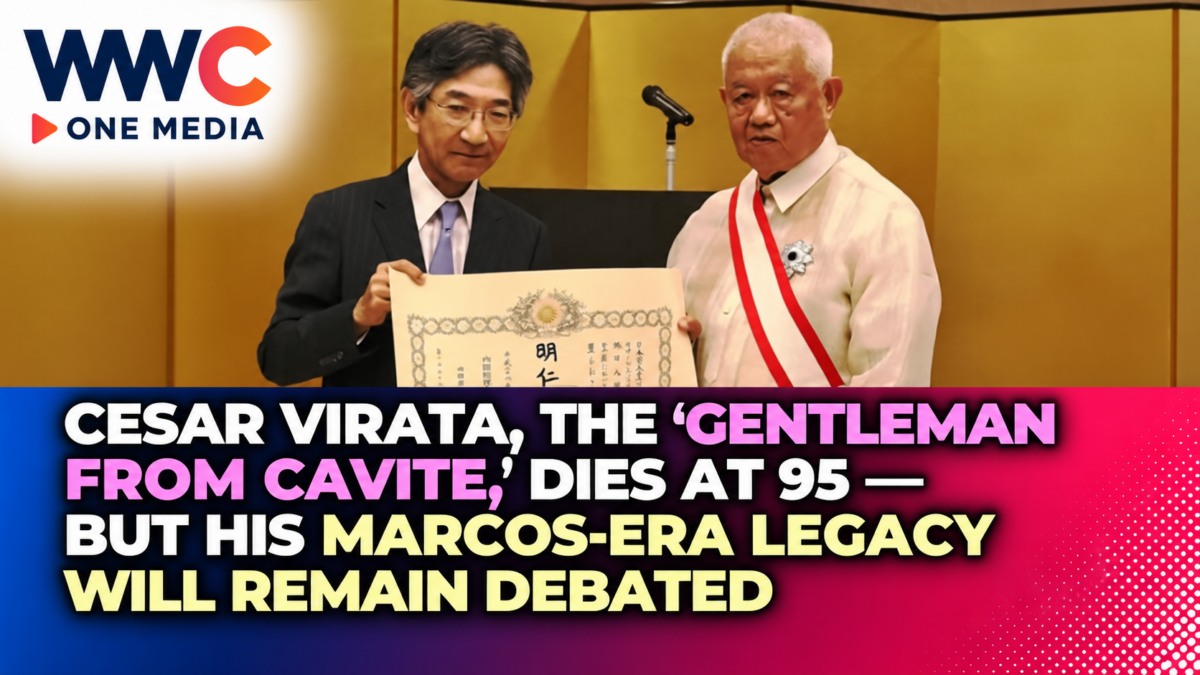
MANILA — Cesar E.A. Virata, the economist, educator and technocrat who spent 16 years running Philippine finances and later became prime minister during the final years of Ferdinand Marcos Sr.’s rule, has died at 95—closing the life of a public servant praised for personal integrity and technical competence but whose place in history remains inseparable from one of the country’s most controversial political and economic eras.
Virata died on Friday, October 2, 2026, according to Rizal Commercial Banking Corp., where he remained corporate vice chairperson and a director until his death.
The Department of Finance also mourned its former chief, honoring his service to the country.
For former Finance Assistant Secretary Ma. Teresa S. Habitan, however, Virata was more than a figure in an economic history book.
He was her first boss.
In an InsiderPH column titled “The Gentleman from Cavite,” Habitan recalled joining the then-Ministry of Finance in June 1977 as a young government employee and working in an unusually small, flat organization where even junior staff interacted directly with the minister.
Her portrait is deeply personal:
a quiet technocrat,
a boss who knew junior employees by name,
a demanding but measured public servant,
and a man she remembered as living with dignity, humility and restraint.
But Virata’s death also reopens a much larger Philippine debate.
Was Cesar Virata principally the disciplined technocrat who tried to keep the economy functioning inside an increasingly unstable political system—or was he also part of the machinery that allowed that system to endure?
Both questions are central to understanding his legacy.
Why He Was Called the ‘Gentleman From Cavite’
Virata was born in Kawit, Cavite, on December 12, 1930.
He later entered electoral politics during the Marcos-era parliamentary experiment and represented Cavite in the Batasang Pambansa.
Habitan recalled that his campaign slogan was:
“Kabitenyong Maginoo.”
Or, roughly:
“The Gentleman from Cavite.”
The description reflected his public personality.
Virata was not known for fiery speeches.
He was soft-spoken.
Methodical.
Reserved.
More comfortable discussing fiscal policy, investment and international finance than engaging in theatrical politics.
That style distinguished him sharply from many of the more flamboyant figures surrounding the Marcos government.
Virata Was an Academic Before He Became a Powerful Government Official
Long before entering Malacañang’s economic establishment, Virata built his reputation in academia and business.
He studied at the University of the Philippines, earning degrees in mechanical engineering and business administration and graduating cum laude.
He later earned an MBA in industrial management from the Wharton School of the University of Pennsylvania.
Virata joined the UP faculty and eventually became dean of the College of Business Administration from 1960 to 1967.
GMA News credits him with helping introduce UP’s MBA program.
He also worked with SyCip Gorres Velayo & Co., or SGV, where he helped build its management-services practice.
That combination of:
engineering,
business education,
consulting,
and academia
made him exactly the kind of specialist the Philippine government was increasingly recruiting as the country pursued industrialization.
Marcos Put Virata in Charge of Finance in 1970
President Ferdinand Marcos Sr. appointed Virata finance secretary in 1970.
He would remain the country’s finance chief until 1986—first as secretary and later as minister—giving him one of the longest tenures ever in the position.
Those 16 years covered extraordinary events.
Oil shocks.
Inflation.
Large infrastructure programs.
Rapid foreign borrowing.
Martial law.
International lending booms.
The assassination of Benigno Aquino Jr.
A foreign-exchange crisis.
Debt restructuring.
And eventually the collapse of the Marcos government.
Virata was at the center of the economic decision-making machinery through almost all of it.
He Became Prime Minister in 1981
Virata’s power expanded further when he became Prime Minister of the Philippines in 1981.
He held that office until the political upheaval of February 1986.
He simultaneously remained finance minister.
For a period he also headed national economic planning.
A 1982 Central Bank report lists Virata simultaneously as:
Prime Minister,
Minister of Finance,
and later Director-General of the National Economic and Development Authority.
Few Philippine economic officials have ever concentrated that degree of formal responsibility.
But the title “prime minister” needs historical context.
Marcos remained president and retained immense political authority.
Virata was powerful in economic administration but was never the ultimate political decision-maker.
That distinction would become central to later assessments of his career.
Virata Became the Face of Philippine Technocracy
Researchers have frequently described him as the Marcos government’s “chief technocrat.”
UP political scientist Teresa Encarnacion Tadem wrote that Virata’s rise reflected both his technical expertise and support from Marcos as well as international institutions such as the IMF and World Bank, which broadly shared the development approach pursued by technocrats in government.
The technocrats favored policies built around:
investment,
exports,
international borrowing,
fiscal management,
and engagement with global financial institutions.
For much of the 1970s, that model generated infrastructure investment and periods of rapid economic expansion.
But the weaknesses became increasingly visible as debt accumulated.
Virata Was Deeply Connected to the World Bank and IMF
Virata’s influence extended well beyond Manila.
He represented the Philippines in major international financial institutions, including the World Bank and Asian Development Bank.
He also chaired important governing bodies associated with the World Bank, IMF and ADB.
That made him internationally recognizable at a time when the Philippines depended increasingly heavily on foreign financing.
To supporters, these relationships gave Manila a respected negotiator who understood how international finance operated.
To critics, they also tied the Philippines closely to an economic model dependent on substantial external borrowing.
Both interpretations are part of his historical record.
Then the Debt Machine Began to Break
The Philippines entered a severe financial crisis in the early 1980s.
An IMF historical account describes a domestic investment boom beginning around 1979, followed by a financial crisis that peaked in 1983 and continued until the change of government in 1986.
Virata was directly involved in repeated negotiations with:
the IMF,
commercial banks,
foreign governments,
and international creditors.
By 1982, international bank lending was already tightening.
Then came the August 1983 assassination of opposition leader Benigno Aquino Jr.
Political confidence collapsed.
Capital fled.
Foreign lenders became increasingly reluctant to extend financing.
The country’s financial vulnerabilities turned into a full-blown crisis.
The Central Bank’s Reserves Were Found to Be Overstated
One of the most serious developments during the crisis involved the country’s foreign-exchange position.
The IMF’s historical account says investigators determined that the Central Bank’s reserves had been substantially overstated.
That revelation badly damaged creditor confidence.
By October 1983, Virata was negotiating a standstill on principal payments with commercial banks as the government struggled to manage its foreign obligations.
The peso was devalued.
Economic activity contracted sharply.
Public spending was cut.
The country entered one of the deepest downturns in its modern history.
That crisis remains impossible to separate from Virata’s time as the government’s most prominent economic technocrat.
His Defenders Say He Was Trying to Contain a Crisis He Did Not Fully Control
Those who worked closely with Virata often describe a man attempting to impose professional economic discipline inside a political environment where powerful interests operated outside normal technocratic constraints.
That is partly the tone of Habitan’s tribute.
She remembered a leader who understood the limitations of his position and behaved pragmatically within them.
This interpretation distinguishes between:
the professional technocrats who managed official economic policy,
and
the political and business interests close to Marcos that benefited from patronage and preferential treatment.
Some colleagues and academics have therefore described Virata as a technocrat rather than a crony.
But that defense leads directly to the harder historical question.
Critics Ask Why the Technocrats Stayed
Competence does not automatically settle questions of political responsibility.
Virata remained one of the government’s most senior officials throughout the Martial Law period.
He continued serving after:
democratic institutions had been curtailed,
political opposition had been suppressed,
human-rights abuses had been documented,
and economic patronage had become deeply embedded in the system.
Academic assessments of his career therefore ask not only what Virata personally did, but what capable technocrats enabled by continuing to serve an authoritarian government.
This is what makes his legacy difficult to reduce to either heroism or guilt.
The Economic Collapse Also Happened on His Watch
The later Marcos economy became defined by:
external debt,
financial instability,
capital flight,
falling investment,
and severe recession.
Virata was not solely responsible for those outcomes.
Global interest rates, oil shocks, recession, political instability and the Aquino assassination all played roles.
So did decisions by Marcos and the wider political establishment.
But Virata was finance minister.
And eventually prime minister.
The economic record therefore belongs partly to him too.
That is why Habitan herself wrote that pundits will continue debating what Virata could have done, what he failed to do, and what was realistically possible under the circumstances.
That may be the most balanced way to frame the argument.
His Government Career Ended With EDSA
The political system Virata served collapsed during the People Power Revolution of February 1986.
Marcos left the Philippines.
Corazon Aquino took power.
Virata’s tenure as prime minister ended.
Salvador Laurel briefly succeeded him before the office itself disappeared under the new constitutional order.
Unlike some other leading Marcos-era figures, however, Virata remained highly visible in Philippine corporate and economic life afterward.
He Returned to the Private Sector
After government, Virata established a management consulting business and became deeply involved in Philippine corporations.
His most enduring corporate relationship was with Rizal Commercial Banking Corp.
RCBC said Virata joined its board in 1995, became corporate vice chairperson in 2000, and remained connected with the bank for more than three decades.
PSE records still listed him as RCBC corporate vice chairperson in 2026.
That longevity is remarkable.
Virata’s professional career essentially stretched from the postwar rebuilding era into the age of digital banking and artificial intelligence.
SEC Says He Helped Build the Modern Philippine Capital Market
Securities and Exchange Commission Chair Francis Ed. Lim credited Virata after his death with helping create institutions that still underpin Philippine capital markets.
Lim described him as an architect of the country’s modern capital-market infrastructure.
Virata was an incorporator of the Philippine Stock Exchange and helped promote the development of the country’s fixed-income trading infrastructure.
That is a substantial part of his post-government legacy.
The modern financial architecture that investors now take for granted did not appear overnight.
It was built gradually through institutions, regulation and market infrastructure.
Virata remained involved in that process for decades.
UP Eventually Named Its Business School After Him
In 2013, the University of the Philippines Board of Regents renamed its College of Business Administration the Cesar E.A. Virata School of Business.
The decision was not without controversy.
UP records show there were motions and discussions seeking to reconsider or revoke the renaming.
Ultimately, the Board of Regents sustained the decision in 2014.
That episode itself reflects Virata’s complicated standing.
For many alumni and economists, he represented:
academic excellence,
professionalism,
institution building,
and public service.
For critics, honoring a senior official who served throughout the Marcos authoritarian period raised unresolved questions.
The university ultimately kept his name.
Virata Was Still Working in His 90s
Virata never entirely retired from professional life.
RCBC still listed him among its senior board leadership.
Other corporations continued to seek his advice.
He remained interested in economics, governance and historical preservation.
InsiderPH reported that he served across institutions in:
banking,
insurance,
property,
education,
publishing,
and infrastructure.
That extraordinary longevity helped turn him into a link between several generations of Philippine economic leadership.
Habitan Last Celebrated His Birthday With Him in December 2025
One of the most personal details in Habitan’s tribute comes from near the end of Virata’s life.
She wrote that the young UP economics graduates who once formed the core of his Finance Ministry technical staff continued gathering for Virata’s birthday long after their government careers had moved in different directions.
Their most recent gathering came in December 2025, when they celebrated his 95th birthday.
It is a small detail.
But it says something about the loyalty he inspired among people who worked directly for him.
Political reputations are built publicly.
Leadership reputations are often built privately.
He Was Known for a Surprisingly Flat Management Style
Habitan recalled that the Ministry of Finance was much smaller and less layered than today’s large bureaucracies.
Junior employees could communicate directly with other agencies under Virata’s authority.
Staff members attended his birthday and Christmas gatherings.
And Virata apparently knew even relatively junior employees by name.
For someone who eventually accumulated immense formal responsibility, the management style described is strikingly understated.
It helps explain the enduring personal loyalty behind many of the tributes following his death.
But Personal Integrity and Historical Responsibility Are Different Questions
This is perhaps the central point in evaluating Virata.
A person can be:
personally modest,
professionally competent,
and individually honest
while still serving a government responsible for policies and abuses that historians judge severely.
Those claims are not mutually exclusive.
That is why reducing Virata to either:
“Marcos technocrat”
or
“great statesman”
fails to capture the complexity.
His life sits precisely at the intersection between technocratic professionalism and political power.
He Was Not Marcos
But he worked for Marcos for 16 years.
He was not principally known as one of the regime’s business cronies.
But he administered an economy in which crony capitalism became a major problem.
He did not hold the ultimate political authority.
But he occupied some of the most senior government posts in the country.
He negotiated with creditors during the debt crisis.
But he also belonged to the government under which that crisis developed.
That tension will define serious histories of Virata for years.
The Debt Crisis Reshaped an Entire Generation
It is difficult for younger Filipinos to understand how damaging the early-1980s crisis became.
The economy contracted.
Businesses failed.
Investment disappeared.
Poverty increased.
The peso weakened.
Debt-service pressures consumed public resources.
The effects lasted long after Marcos left office.
Virata’s role during the crisis therefore cannot be treated as an obscure technical matter.
It shaped the economic lives of millions of Filipinos.
Yet the Institutions He Helped Build Also Outlived the Regime
This is the counterweight.
Economic institutions associated with Virata did not disappear in 1986.
Capital-market structures developed further.
Professional economic management survived.
The Philippine relationship with multilateral lenders continued.
The business school that bears his name trained new generations of managers.
His work in finance and corporate governance continued for decades.
History rarely provides perfectly clean categories.
Virata is a clear example.
Even His Reputation Among Economists Was Unusual
Many officials associated with authoritarian governments become professionally isolated after regime change.
Virata did not.
He continued receiving:
board appointments,
academic recognition,
corporate roles,
international honors,
and invitations to policy discussions.
Japan awarded him the Grand Cordon of the Order of the Rising Sun in 2016, recognizing his contributions to Philippine-Japanese economic relations.
That enduring respect suggests that many in the economic and business community separated his technocratic record from the wider political excesses of the Marcos regime.
Not everyone agrees with that separation.
His Death Comes as the Philippines Again Debates Technocracy and Politics
Virata’s story remains relevant because the underlying tension has never disappeared.
Every Philippine administration needs highly skilled professionals.
Economists.
Engineers.
Lawyers.
Bankers.
Policy specialists.
But technocrats operate inside political systems.
They make choices about:
when to compromise,
when to resist,
when to resign,
and when technical competence risks becoming political legitimacy.
Virata spent his career navigating precisely that boundary.
The ‘Gentleman From Cavite’ Was Also a Product of His Time
Habitan’s title captures the man she knew.
Quiet.
Courteous.
Disciplined.
Reserved.
But the Philippines Virata helped govern was anything but quiet.
His career passed through:
Martial Law,
constitutional restructuring,
foreign-debt expansion,
financial crisis,
political assassination,
mass protest,
and revolution.
That contrast is striking.
The calm technocrat stood near the center of an increasingly turbulent state.
He Also Represented an Older Idea of Public Service
Virata belonged to a generation that placed enormous value on technical expertise.
His career path ran through:
UP,
Wharton,
SGV,
government,
international financial institutions,
and major corporations.
The underlying belief was that national development could be engineered by highly trained specialists using disciplined economic policy.
That worldview shaped much of Asian development policy after World War II.
It also contained a weakness.
Economic management cannot be isolated permanently from politics, governance and institutional accountability.
The Philippine experience of the 1980s demonstrated that forcefully.
His Former Staff Remember the Man, Historians Will Judge the System
That is why Habitan’s tribute and a broader historical assessment can both be valid.
A former employee can genuinely remember a kind, humble and principled boss.
An economist can acknowledge his technical sophistication.
A market regulator can credit him with institution building.
And a historian can still scrutinize his role in an authoritarian government and debt crisis.
None of those perspectives automatically cancels the others.
Together, they create a fuller portrait.
Virata’s Longest Legacy May Be Institutional
Political titles disappear quickly.
Virata’s office of prime minister itself disappeared shortly after he left it.
Institutions last longer.
The UP business school.
The capital market.
Financial institutions.
Corporate-governance practices.
Economic-policy networks.
Those may ultimately prove more durable than the title “Prime Minister.”
SEC Chair Lim’s tribute focused precisely on that institutional legacy.
Yet the Marcos Question Will Never Completely Leave His Biography
Virata served Ferdinand Marcos Sr. from 1970 until the regime fell in 1986.
No serious biography can treat that as incidental.
The Marcos years included significant infrastructure construction and periods of economic expansion.
They also included authoritarian rule, documented human-rights abuses, cronyism, growing foreign debt and ultimately a devastating economic crisis.
Virata’s precise personal responsibility for every part of that record is debatable.
His proximity to it is not.
That Is Why His Legacy Resists Simple Headlines
It would be easy to write:
“Great technocrat dies at 95.”
It would also be easy to write:
“Marcos official dies at 95.”
Neither is sufficient.
Cesar Virata was:
an educator,
an economist,
a finance minister,
a prime minister,
an international negotiator,
a banker,
an institution builder,
and a senior official inside an authoritarian political system.
All of those identities belong in the same story.
The Bigger Question Is How History Will Remember Him
Habitan closed her tribute with affection for the man she had first known as a young Finance Ministry employee in 1977.
Her judgment was personal.
History’s judgment will be broader.
Virata unquestionably possessed extraordinary technical expertise.
He served the government longer than almost any Philippine finance chief.
He earned substantial respect inside business, academia and international finance.
And people who worked closely with him repeatedly describe unusual modesty and professionalism.
But he also served at the highest levels of government during an authoritarian era that culminated in political and economic crisis.
That contradiction will remain.
And perhaps that is the most accurate legacy of the “Gentleman from Cavite.”
He represented the promise of Philippine technocracy—and also its greatest dilemma: how far can expertise remain separate from the political system it helps to sustain?