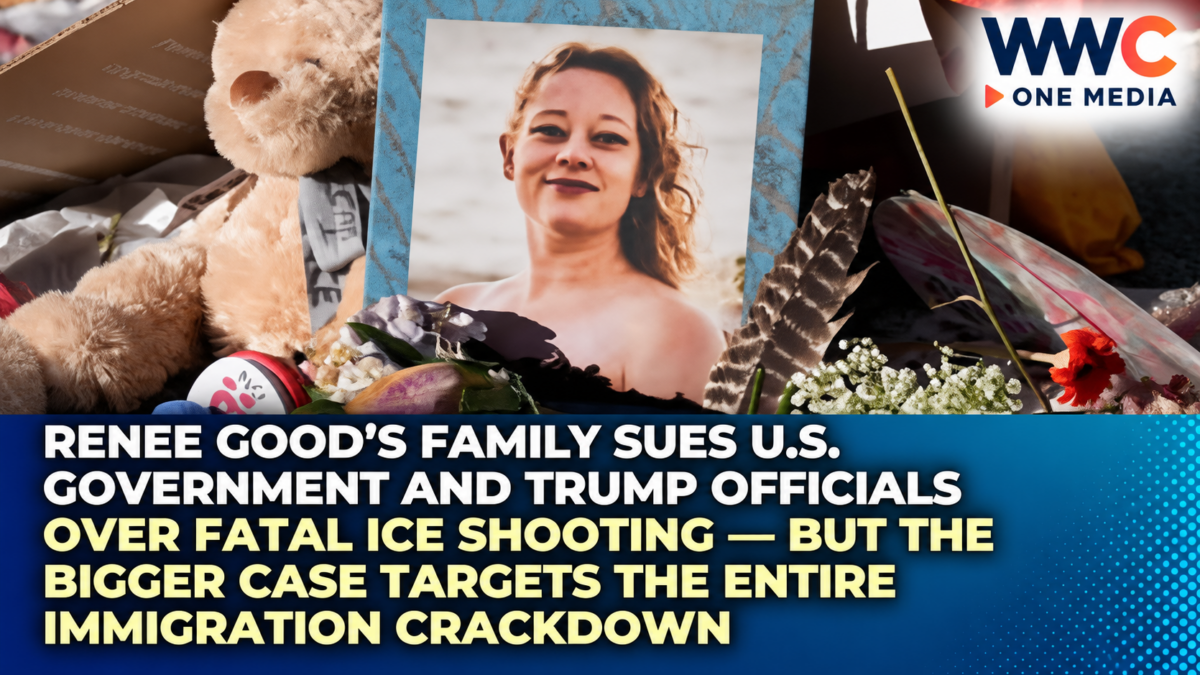
MINNEAPOLIS — The family of Renee Good, the 37-year-old U.S. citizen fatally shot by an Immigration and Customs Enforcement agent during a federal immigration operation in Minneapolis, has launched a sweeping legal challenge against the U.S. government, the officer who fired the shots and senior Trump administration officials.
Good’s partner, Becca Good, and her brother Brent Ganger, acting on behalf of the family, filed two federal lawsuits on October 1 seeking damages and a jury trial over Good’s January 7 killing.
One lawsuit names the United States and alleges wrongful death under Minnesota law, along with claims including battery, assault, false imprisonment, intentional infliction of emotional distress and negligence.
The second goes much further.
It names ICE officer Jonathan Ross and senior federal officials and alleges that Good’s death was part of a broader unconstitutional campaign during Operation Metro Surge, the Trump administration’s large-scale immigration enforcement push in Minnesota.
That means the case is no longer only about whether Ross was legally justified in firing his weapon.
Good’s family is now asking a federal court to examine whether the policies, tactics and leadership behind the entire Minneapolis immigration crackdown helped create the conditions that led to her death.
Renee Good Was Killed While Sitting in Her SUV
Good was shot on January 7, 2026, during federal immigration enforcement activity in south Minneapolis.
She and her partner had joined neighborhood residents monitoring and protesting the presence of heavily armed federal immigration agents.
Good was inside her Honda Pilot when ICE officer Jonathan Ross approached.
Video from the incident shows Good speaking with officers before beginning to move the vehicle.
Ross then fired three shots.
Good was struck and later died.
The most important factual dispute remains what happened in the seconds before the shooting.
Federal officials say Ross fired because Good accelerated the SUV toward him and posed an immediate threat.
Good’s family and attorneys argue she was attempting to leave and that Ross was not in imminent danger when he fired.
The available video has been analyzed extensively, but it does not eliminate every factual dispute.
That will likely be central to the litigation.
The Trump Administration Called It Self-Defense
Federal officials defended Ross almost immediately.
The Department of Homeland Security said the officer acted in self-defense and portrayed Good’s vehicle as a weapon.
Administration officials also used extremely strong language after the shooting, with some describing Good’s conduct as comparable to domestic terrorism.
Good’s family strongly rejects that characterization.
Their lawsuits argue that she was unarmed, was not the target of an immigration investigation and did not pose the kind of immediate deadly threat necessary to justify lethal force.
That creates the central legal question:
Was Ross facing a genuine threat to his life, or did he use excessive force against a civilian trying to drive away?
Her Family Says the Killing Was ‘Not an Accident’
The lawsuits do not treat Good’s death as an isolated encounter.
Attorneys for the family argue that it was the foreseeable result of a broader enforcement strategy that placed aggressive federal operations into residential communities while encouraging confrontational tactics against protesters and immigration observers.
They describe Operation Metro Surge as a campaign designed to intimidate immigrant communities and people who opposed the federal crackdown.
The complaint alleges that senior federal officials helped create, authorize or tolerate those conditions.
The administration denies those allegations.
That means the case could eventually require a court to examine not only Ross’ split-second decision, but also what orders, policies and expectations came from Washington.
The Lawsuit Invokes a Law Written to Fight the Ku Klux Klan
One of the most unusual elements is the legal theory used in the second lawsuit.
Good’s family invokes an 1871 federal civil-rights law commonly associated with the Ku Klux Klan Act, arguing that federal officials conspired to interfere with constitutional rights.
The law was originally adopted after the Civil War to combat organized violence and conspiracies aimed at suppressing civil rights.
Using it in a modern immigration-enforcement case is legally ambitious.
The family argues that the federal operation involved coordinated actions against communities and protesters that crossed constitutional lines.
Whether a court accepts that theory will be one of the most closely watched parts of the case.
The Defendants Include Some of Trump’s Most Powerful Immigration Officials
The civil-rights case names several prominent officials associated with the administration’s immigration crackdown.
Public reporting identifies defendants including senior White House adviser Stephen Miller, former Homeland Security Secretary Kristi Noem, former Border Patrol commander Gregory Bovino, and other federal officials.
The theory is that policy flowed downward.
Good’s lawyers argue that frontline officers did not operate in a vacuum and that aggressive tactics were encouraged by senior political leadership.
The government is expected to argue that high-level officials cannot automatically be held personally liable for a shooting simply because they designed or promoted broader immigration policies.
That could make immunity and causation major legal battlegrounds.
Holding Federal Officers Personally Liable Is Difficult
Good’s family faces a challenging legal path.
U.S. courts have significantly narrowed the circumstances in which people can sue federal officers personally for constitutional violations.
Recent Supreme Court decisions have been skeptical of extending implied damages claims into new law-enforcement contexts.
That means lawyers for Ross and other officials are likely to argue that federal law does not permit some or all of the claims against them.
The family’s use of the Ku Klux Klan Act appears designed in part to navigate around those restrictions.
The case could therefore become important well beyond Minneapolis.
It could test how much legal accountability is available when federal immigration officers are accused of excessive force.
The Wrongful-Death Claim May Be More Straightforward
The first lawsuit follows a more traditional route.
It uses the Federal Tort Claims Act, which allows certain lawsuits against the United States for wrongful acts committed by federal employees.
Good’s family alleges that the federal government is legally responsible for conduct including:
wrongful death,
assault,
battery,
false imprisonment,
negligence,
and intentional infliction of emotional distress.
The government will likely dispute both liability and causation.
But this claim does not depend as heavily on creating a new constitutional damages remedy against individual officers.
That could make it one of the more important legal avenues for the family.
Local Prosecutors Are Still Investigating the Shooting
The civil lawsuits are unfolding while Minnesota authorities continue a separate criminal investigation.
The Hennepin County Attorney’s Office, working with the Minnesota Bureau of Criminal Apprehension and the state attorney general, has been examining whether Good’s killing violated Minnesota criminal law.
Possible offenses under review have included:
murder,
manslaughter,
and failure to render aid.
That does not mean Ross has been charged.
He has not.
It means prosecutors are still evaluating whether the evidence supports any criminal case.
That distinction is essential.
Minnesota Investigators Initially Said Federal Officials Withheld Evidence
The investigation became controversial almost immediately.
State authorities said federal agencies initially prevented them from accessing some evidence connected to the shooting.
The Hennepin County Attorney’s Office later issued formal demands seeking federal records, physical evidence and other material needed for its investigation.
That created an unusual dispute between state and federal law-enforcement agencies investigating the same death.
Minnesota officials argued that they could not conduct a credible independent review without access to the full evidence file.
The Evidence-Sharing Fight Lasted for Months
The situation improved later.
In July, Hennepin County announced that state investigators had obtained hard drives containing previously withheld evidence connected to the shootings of Good, Alex Pretti and Julio Sosa-Celis.
Good’s vehicle was also transferred into BCA custody.
State officials said they immediately began analyzing the material.
The BCA also shared its own files with the U.S. Attorney’s Office, creating two-way evidence sharing.
That means the current investigation has access to a much broader evidentiary record than it did earlier in the year.
The Federal Civil-Rights Investigation Was Brief and Controversial
Another major controversy involved the Justice Department.
The Washington Post reported that FBI personnel initially opened a civil-rights investigation into Ross’ actions after determining there were sufficient grounds to review the shooting.
But Justice Department leadership later said there was no ongoing federal civil-rights investigation.
That decision drew criticism from former civil-rights prosecutors and Good’s supporters.
The federal government has argued that Ross’ conduct was justified.
Good’s family says the lack of a meaningful federal accountability process is one reason civil litigation became necessary.
The Video Is Likely to Be the Most Important Evidence
The shooting was captured from multiple angles.
That makes video evidence unusually important.
Ross also recorded part of the encounter on his own cellphone.
The footage shows Good speaking calmly before the SUV begins moving.
Ross is positioned near the front and side of the vehicle.
He fires three times as the SUV moves.
At least two shots appear to have been fired from the side as the vehicle passed, according to frame-by-frame analysis reported by The Washington Post.
Whether Ross reasonably believed he was about to be struck remains disputed.
That question will likely determine much of the case.
Self-Defense Depends on What Ross Reasonably Perceived
The law does not require an officer to wait until a vehicle physically hits him before defending himself.
The central issue is whether a reasonable officer in the same situation would have believed deadly force was necessary to prevent death or serious injury.
That means both sides will focus intensely on:
Ross’ position,
the SUV’s direction,
its speed,
the timing of the shots,
the distance between Ross and the vehicle,
and whether escape routes were available.
The case may ultimately turn on fractions of seconds.
Good Was a U.S. Citizen, Not an Immigration Target
This fact has made the shooting especially politically significant.
Good was a U.S. citizen.
She was not someone ICE was attempting to deport.
She was not the subject of an immigration arrest warrant.
She was present as a neighborhood resident and protester during the enforcement activity.
That transformed the controversy from a dispute over immigration enforcement into a broader question about what authority federal agents have when dealing with American citizens who observe or protest immigration operations.
Her Death Became a National Flashpoint
Good’s killing sparked protests across Minnesota and nationally.
Her death occurred during a period of unusually aggressive federal immigration activity under Operation Metro Surge.
The operation involved large deployments of federal agents into communities around Minneapolis and elsewhere in Minnesota.
Critics argued that masked and armed federal teams were creating fear and escalating confrontations.
The administration said the operation was necessary to enforce immigration law and remove people who were unlawfully in the country.
Good’s death became one of the most visible symbols of that conflict.
She Was Not the Only U.S. Citizen Shot During the Operation
The lawsuits also point toward a wider pattern of violent encounters during the Minnesota operation.
Another U.S. citizen, Alex Pretti, was also fatally shot by federal immigration agents during the January crackdown.
Julio Sosa-Celis survived another shooting involving federal officers.
State investigators have reviewed all three incidents.
The accumulation of cases intensified demands for outside oversight and raised broader questions about use-of-force standards among federal immigration teams.
Operation Metro Surge Eventually Ended
The large Minnesota enforcement operation ended in February after weeks of controversy and confrontation.
But its legal consequences are still unfolding.
Civil lawsuits remain active.
State prosecutors continue reviewing shootings.
Churches and community groups have filed separate cases challenging federal surveillance and enforcement practices.
That means Operation Metro Surge may ultimately be examined more thoroughly in federal court than it ever was while the operation itself was underway.
Good’s Family Is Also Challenging the Government’s Public Narrative
The lawsuits do not focus only on the shooting.
Good’s family also accuses federal officials of spreading false or inflammatory descriptions of her after her death.
Officials publicly described her conduct in extremely severe terms.
Her family argues those statements damaged her reputation and helped justify the shooting before any independent investigation had been completed.
That could become important in discovery.
Lawyers may seek internal communications showing what officials knew before making public statements.
Discovery Could Become Politically Explosive
If the lawsuits survive early attempts to dismiss them, the discovery process could become one of the most consequential parts of the litigation.
Good’s lawyers may seek:
emails,
text messages,
operational directives,
use-of-force policies,
training materials,
communications between senior officials,
and internal discussions after the shooting.
That could expose how Operation Metro Surge was designed and what commanders were told about dealing with protesters.
For the administration, preventing broad discovery may therefore become almost as important as defeating the claims themselves.
Senior Officials Will Likely Fight to Stay Out of the Case
Officials such as Miller and Noem are likely to argue that they were too far removed from the specific shooting to be personally liable.
They may also invoke immunity defenses.
The family, meanwhile, will argue that their policies directly shaped the operation and created a foreseeable risk of excessive force.
That creates a difficult legal question.
How far up the chain of command can responsibility travel?
If a frontline officer allegedly commits an unconstitutional act, can policymakers who designed the enforcement strategy also be held responsible?
Federal courts have historically been cautious about answering yes.
The Lawsuits Demand a Jury Trial
Good’s family is not simply seeking a declaration.
They are demanding damages and a jury trial.
That matters because a jury could eventually be asked to decide whether the government’s use of force was justified and whether officials violated Good’s rights.
Before that happens, however, both lawsuits will likely face extensive motions to dismiss.
The government will almost certainly challenge jurisdiction, legal theories and individual liability.
So the road to an actual trial could be long.
This Is Not Yet a Finding of Government Wrongdoing
The allegations are serious.
But they remain allegations.
No court has yet ruled that Ross used unlawful force.
No court has ruled that Miller, Noem or other officials conspired to violate Good’s rights.
And no criminal charges have been filed against Ross.
The government continues to defend the shooting as self-defense.
That legal presumption matters.
The lawsuits begin the accountability process.
They do not decide it.
But the Case Could Force Answers the Family Says It Never Received
That may be the most important practical consequence.
For months, Good’s family has argued that federal institutions failed to provide a credible, independent review.
Civil litigation gives them another mechanism.
Through subpoenas and court-ordered discovery, they may gain access to evidence they could not otherwise obtain.
That could include internal material revealing:
what Ross reported,
what commanders knew,
what federal officials said privately,
and whether the public explanation changed over time.
Even if the family ultimately loses some claims, the litigation could still produce substantial new information.
The Bigger Fight Is About Federal Law-Enforcement Accountability
Good’s death sits at the intersection of several major national debates:
immigration,
protest rights,
police use of force,
federal immunity,
and executive power.
ICE was created primarily to enforce immigration law.
But when agents operate on American streets, they inevitably interact with citizens, protesters and bystanders.
The question becomes:
Who investigates them when something goes wrong?
State authorities?
The FBI?
The Justice Department?
Federal inspectors general?
Civil courts?
The months-long evidence dispute after Good’s death exposed how unclear and politically contested those accountability mechanisms can become.
The Lawsuit Could Outlast the Immigration Crackdown It Challenges
Operation Metro Surge has ended.
The lawsuits may continue for years.
If Good’s family survives the government’s early dismissal efforts, the cases could become a major test of whether senior federal officials can be held responsible for the consequences of aggressive immigration-enforcement strategies.
The wrongful-death case focuses directly on Renee Good.
The civil-rights case aims much higher.
It argues that her death cannot be separated from the operation that put heavily armed federal officers into Minneapolis neighborhoods under policies designed in Washington.
That is why the October 1 filings matter far beyond one shooting.
Renee Good’s family is not only asking who fired the bullets.
They are asking whether the people who designed the operation that put Jonathan Ross on that street should also answer for what happened next.