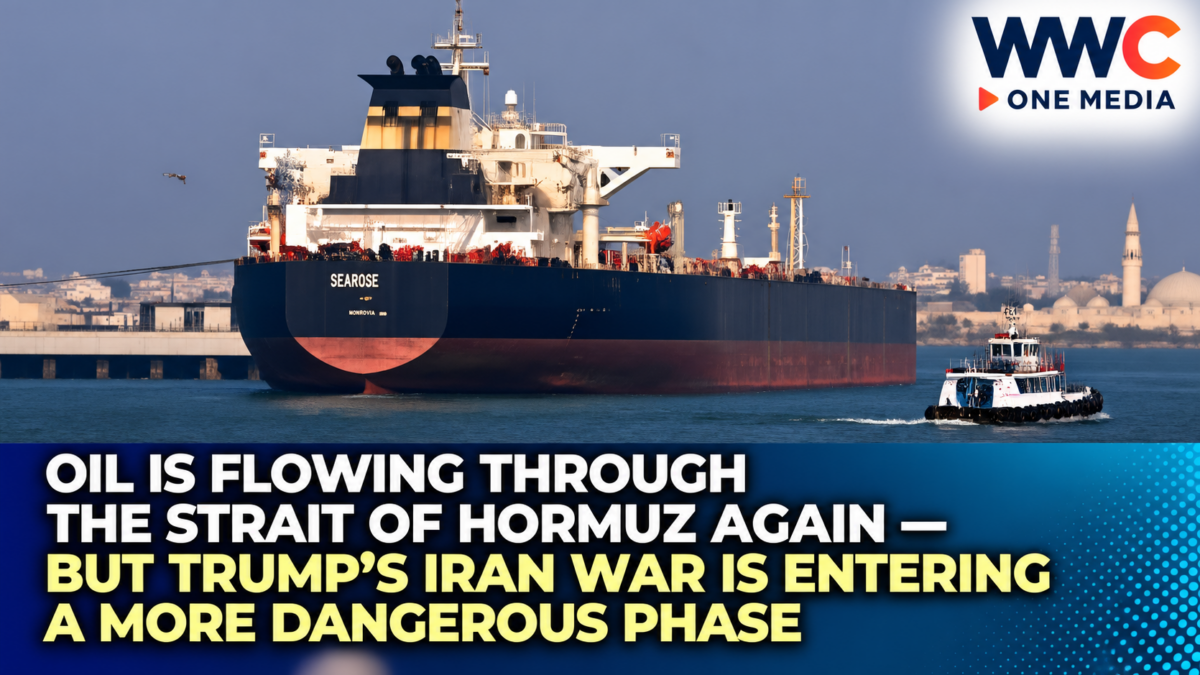
WASHINGTON/DUBAI — One of the world’s most important oil chokepoints is moving closer to normal after months of disruption from the U.S.-Iran war, but the apparent recovery in the Strait of Hormuz may be masking a much more dangerous reality.
Crude-oil flows through Hormuz have climbed back to roughly prewar levels, helped by U.S. naval escorts, alternative export routes and Gulf producers adapting to the conflict.
But refined-fuel shipments remain drastically lower than before the war.
Diesel prices remain elevated.
Iran continues to threaten retaliation.
And President Donald Trump is deploying additional military forces to the Middle East while openly considering another round of large-scale attacks after the November 3 U.S. midterm elections.
That leaves the global energy market in an unusual position.
The oil is moving again.
The war is not over.
Crude Flows Are Back Near Prewar Levels
The most important development is the recovery in crude exports.
Shipping data cited in reporting based on Kpler estimates showed crude moving through the Strait of Hormuz at a seven-day average of roughly 13.5 million barrels per day by late September — close to prewar levels.
That is a remarkable recovery considering how severely traffic through Hormuz had been disrupted earlier in the conflict.
The strait is one of the most strategically important waterways in the world because Gulf exporters rely on it to ship huge quantities of petroleum to customers in Asia, Europe and elsewhere.
The recovery has helped prevent the kind of catastrophic crude-oil shortage feared when the war escalated.
But crude flows tell only part of the story.
Refined Fuels Are Still Far Below Normal
The bigger problem is diesel, gasoline and other refined petroleum products.
Kpler data cited in coverage of the CNBC report showed refined-product shipments through Hormuz at roughly 677,000 barrels per day, compared with around 3.6 million barrels per day before the war.
That means refined-fuel traffic remains at only a fraction of normal levels.
And that distinction is extremely important.
Crude oil must still be transported to refineries and converted into products such as diesel, gasoline and jet fuel.
So even if enough crude reaches world markets, consumers can still experience shortages if refining systems and refined-product trade remain disrupted.
That is exactly what has been happening.
Diesel Has Become the Real Energy Crisis
Diesel has emerged as one of the biggest economic consequences of the conflict.
The fuel powers:
trucks,
farm machinery,
construction equipment,
ships,
rail freight,
and industrial operations.
When diesel becomes expensive, transportation costs rise throughout the economy.
Those higher costs eventually reach food, retail goods, construction materials and manufacturing.
U.S. diesel prices have climbed above $6 per gallon, while truckers and smaller freight companies are increasingly struggling with operating costs.
That makes the Iran war a domestic economic issue for Trump as well as a foreign-policy problem.
Oil Surged More Than 4% as Tensions Rose Again
Energy markets remain extremely sensitive to military developments.
On October 1, Brent crude jumped more than 4% to $102.31 per barrel, while West Texas Intermediate rose to $92.87.
The move followed reports that the United States was sending more troops and another aircraft carrier toward the Middle East, while China also halted most fuel-product exports outside Hong Kong and Macau.
That combination intensified fears of another global fuel shortage.
It also demonstrated something important:
even when physical crude flows improve, geopolitical risk can immediately send prices higher.
Trump Rejected Iran’s Latest Deal
The diplomatic situation remains deeply unsettled.
Iran recently proposed reopening Hormuz and moving toward an end to hostilities through a plan transmitted by Qatari mediators.
Tehran said the strait could be reopened within roughly seven days if Washington agreed to a series of conditions.
Trump rejected the proposal.
Iranian officials subsequently insisted diplomacy remained possible, but privately expressed little confidence that a deal would be reached.
That leaves both sides negotiating while simultaneously preparing for escalation.
Trump Says More Bombing Is Possible After the Midterms
Trump has openly said a renewed bombing campaign is possible after the November 3 midterm elections.
AP reported that Trump said it was “possible” the United States could intensify attacks after voting is over if Tehran does not make what Washington considers sufficient concessions.
That timeline matters.
The administration has strong political incentives to avoid another major oil-price spike before Americans vote.
Another wave of strikes could disrupt shipping, raise insurance costs and send energy prices sharply higher.
So the election calendar may temporarily restrain military escalation.
But it may simply move the danger to November.
A Third U.S. Aircraft Carrier Is Heading Toward the Region
Washington is not waiting to prepare.
The U.S. military is moving roughly 9,000 additional troops aboard ships toward the Middle East, while another aircraft carrier strike group is also being deployed.
The USS Theodore Roosevelt deployment could eventually give the United States three aircraft carriers in or near the region.
That would represent an unusually powerful concentration of naval forces.
Carrier groups bring:
fighter aircraft,
surveillance aircraft,
missile-defense systems,
destroyers,
submarines,
and thousands of sailors.
The buildup gives Trump significantly more options if he decides to restart major attacks.
Iran Is Preparing a Much Harder Response
Tehran is preparing as well.
Reuters reported that Iranian commanders are planning a broader and more forceful retaliation if the United States resumes large-scale attacks.
Potential plans reportedly include expanding both the geography and category of targets.
Iran has also told aligned groups in countries including Lebanon, Yemen and Iraq to prepare for possible coordinated action.
That raises the danger that another U.S. strike would no longer produce a limited Iran-U.S. exchange.
It could widen the conflict across the Middle East.
Hormuz Is Iran’s Most Powerful Weapon
Iran cannot match the United States militarily in conventional naval combat.
But geography gives Tehran extraordinary leverage.
Iran sits directly alongside the Strait of Hormuz.
Its forces can threaten shipping with:
missiles,
drones,
fast boats,
mines,
and coastal weapons.
Iran does not need to permanently defeat the U.S. Navy to cause economic damage.
It only needs to make commercial shipping dangerous enough that insurers, tanker owners and crews become reluctant to enter.
That alone can restrict supply and raise prices.
The Strait Is Narrow — But Its Economic Impact Is Huge
The Strait of Hormuz is only about 21 miles wide at its narrowest point.
Yet it carries a huge share of global energy.
Historically, roughly one-fifth of global oil consumption and a major portion of liquefied natural gas exports have passed through the region.
Major exporters dependent on Gulf routes include:
Saudi Arabia,
Iraq,
Kuwait,
Qatar,
and the United Arab Emirates.
Asian economies are especially exposed.
China, Japan, South Korea and India import enormous volumes of Gulf energy.
That means a major Hormuz disruption would not be a regional energy shock.
It would be global.
The Strait Is ‘Open’ — But Not Normal
This is where the political language becomes complicated.
Trump has repeatedly insisted the strait is open.
Iran has previously insisted it remains under Iranian control or effectively closed.
Reality sits somewhere between those statements.
Commercial traffic is moving.
Crude exports are recovering.
But ships still operate under elevated risk, military escorts remain important, and some vessels have used reduced-transmission or “dark” transit practices to lower their visibility.
In other words:
Hormuz is functioning.
It is not operating under ordinary peacetime conditions.
U.S. Naval Power Is Helping Keep Oil Moving
The American military presence is one reason flows have improved.
The USS George Washington and other naval forces have played a central role in maintaining maritime security near the strait.
Reuters reporters who recently visited the George Washington described the approximately 5,000-person crew operating under wartime conditions, with sailors remaining alert for potential missile and drone attacks.
That shows how dependent the current energy recovery may be on military protection.
The world’s oil supply is not simply moving because the political crisis has disappeared.
It is moving partly because warships are helping keep the route usable.
That Creates a Fragile Energy System
This is the central weakness.
A normal shipping system does not need multiple aircraft carriers, naval escorts and constant military surveillance to move commodities safely.
The current system does.
That means the recovery could reverse quickly.
A single tanker attack could raise insurance premiums.
A mine could close a shipping lane.
A missile attack could cause tanker operators to pause crossings.
A renewed U.S. bombing campaign could trigger Iranian retaliation.
So the return of crude flows should not be interpreted as evidence the Hormuz crisis has been solved.
Iraq Just Sent 2 Million Barrels Through Hormuz
There are positive signs.
Iraq’s state tanker company announced on October 3 that it had successfully transported 2 million barrels of crude through Hormuz aboard a very large crude carrier, its first operation of that kind in decades.
That demonstrates increased confidence in the route.
But it also underscores how closely every successful transit is being watched.
Under ordinary conditions, a tanker carrying oil through Hormuz would barely qualify as global news.
Today it does.
Gulf Exports Are Recovering
Saudi Arabia has also restored some export capacity.
Operations resumed through the kingdom’s East-West Pipeline and tanker facilities at Yanbu after earlier disruptions.
Alternative pipelines help Gulf producers bypass at least part of the Hormuz risk.
The UAE has similar infrastructure allowing some crude to move directly toward the Gulf of Oman.
But bypass capacity is limited.
There is simply no alternative route capable of replacing all the energy normally passing through Hormuz.
That is why the strait remains strategically irreplaceable.
Qatar Is Particularly Vulnerable
Oil gets most of the attention.
Natural gas could be just as important.
Qatar is one of the world’s largest LNG exporters.
Most of its LNG shipments normally pass through Hormuz.
September LNG traffic improved substantially, reaching its strongest monthly level since the U.S.-Iran war began. But the recovery remains vulnerable to another escalation.
A serious disruption could quickly affect energy prices in Europe and Asia heading into winter.
That would add another layer of economic risk.
Europe Is Already Releasing Emergency Fuel
Governments are trying to reduce that risk.
G7 countries agreed to release as much as 100 million barrels of emergency crude and diesel reserves to address global fuel shortages and ease price pressure.
The plan includes both crude and refined products.
It is a remarkable intervention.
Strategic reserves are typically intended for extraordinary supply emergencies.
Repeated releases indicate that policymakers believe current market conditions are serious.
Trump Has Considered Restricting U.S. Diesel Exports
The administration has also considered something even more controversial:
restricting American diesel exports.
Trump is under pressure to lower domestic fuel prices before the midterm elections, and White House officials have discussed options including export restrictions.
The logic is simple.
Keep more U.S.-produced diesel at home.
Increase domestic supply.
Push prices lower.
But refiners and energy experts warn that such restrictions could disrupt global trade and potentially produce unintended price effects.
European allies would also be hit because they rely heavily on U.S. refined-fuel exports.
Russia Is Making the Diesel Problem Worse
The Hormuz crisis is not occurring in isolation.
Russian refined-fuel exports have also been constrained amid Ukrainian attacks on refineries and Russian export restrictions.
That means two major sources of global fuel supply are under stress at the same time.
China’s decision to suspend most fuel exports outside Hong Kong and Macau added another shock.
So even if Gulf crude production is recovering, refiners and traders are dealing with a much tighter refined-product market.
That helps explain why diesel remains expensive despite improved crude flows.
Truckers Are Already Paying the Price
The economic consequences are becoming visible in the United States.
The Wall Street Journal reports that small trucking operators are spending close to $1,000 to fill a truck, with some independent drivers cutting expenses, taking on debt or parking rigs because routes have become unprofitable.
That matters because trucking is the circulatory system of the U.S. economy.
If freight costs rise, companies eventually pass those increases to customers.
So the conflict can contribute to inflation even for products that have nothing directly to do with petroleum.
That Creates a Political Problem for Trump
Trump wants Iran to make concessions.
He also wants energy prices lower.
Those objectives can conflict.
Military pressure can weaken Iran.
But military pressure also increases the risk to oil and shipping.
Higher oil and diesel prices then hurt American households and businesses.
With the November midterms approaching, that tradeoff becomes politically dangerous.
Recent polling has shown significant dissatisfaction with the administration’s handling of the cost of living.
That gives Trump an incentive to avoid a major pre-election energy shock.
Iran Knows the Election Matters
Tehran understands the political calendar too.
That gives Iran its own leverage.
If the leadership believes Trump wants stability until November 3, it may calculate that Washington has less appetite for another major escalation before then.
At the same time, Trump has publicly indicated he may have more freedom to act afterward.
So both sides now have reasons to prepare for a potentially more dangerous post-election period.
Diplomacy Is Still Moving — But Slowly
Qatar and other intermediaries are continuing efforts to find a deal.
Iran has said diplomacy remains its preferred solution publicly.
But Iranian officials quoted by Reuters privately expressed doubts that current negotiations will produce an agreement.
That gap between public diplomacy and private pessimism is concerning.
It suggests talks may be functioning partly as a way for both sides to buy time while strengthening their military positions.
Iran Wants More Than Just Sanctions Relief
The disagreement is not simply about money.
Iran wants recognition of a larger role in managing shipping through Hormuz.
Previous proposals involving Iran and Oman contemplated a system giving Tehran significant control over inbound traffic through parts of the Gulf.
Washington has resisted arrangements it believes would allow Iran to hold global shipping hostage.
That is one reason negotiations are difficult.
Hormuz is both an economic asset and a strategic bargaining tool.
Neither side wants to surrender control.
The U.S. Has Gained Ground — But Not Solved the War
Washington has succeeded in restoring substantial shipping activity and limiting Iranian oil exports.
That weakens one of Tehran’s most important economic weapons.
But Iran remains capable of disruption.
And the cost of keeping Hormuz usable remains enormous:
warships,
military aircraft,
troops,
missile defenses,
emergency fuel releases,
and elevated insurance costs.
That is not a stable long-term solution.
It is a military-managed energy corridor.
The Recovery Could Actually Increase the Risk of Escalation
There is another paradox.
As shipping improves, Iran may feel its leverage declining.
That could make Tehran more—not less—likely to demonstrate that it can still disrupt the strait.
Reuters reported that Iranian leaders are already preparing broader retaliation if large-scale U.S. attacks resume.
That creates a dangerous feedback loop.
The U.S. restores shipping.
Iran feels pressure.
Iran attacks.
The U.S. retaliates.
Shipping collapses again.
This is why the current recovery should not be mistaken for peace.
The Next Major Shock May Come After November 3
The immediate oil-market story looks encouraging.
Crude exports have recovered.
Gulf producers are finding ways around bottlenecks.
Tankers are moving.
But underneath that progress, both militaries are preparing for the possibility of another major confrontation.
The United States is sending more ships and troops.
Iran is planning a stronger retaliation.
Trump has rejected Tehran’s latest proposal.
And the president has explicitly left open the possibility of renewed bombing after the midterms.
That means the Strait of Hormuz may be entering its most deceptive period yet.
Oil is flowing again, but the military conditions supporting that recovery could unravel with a single strike.
And if Trump chooses to escalate after November 3, the world may quickly discover that reopening Hormuz was much easier than keeping it open.