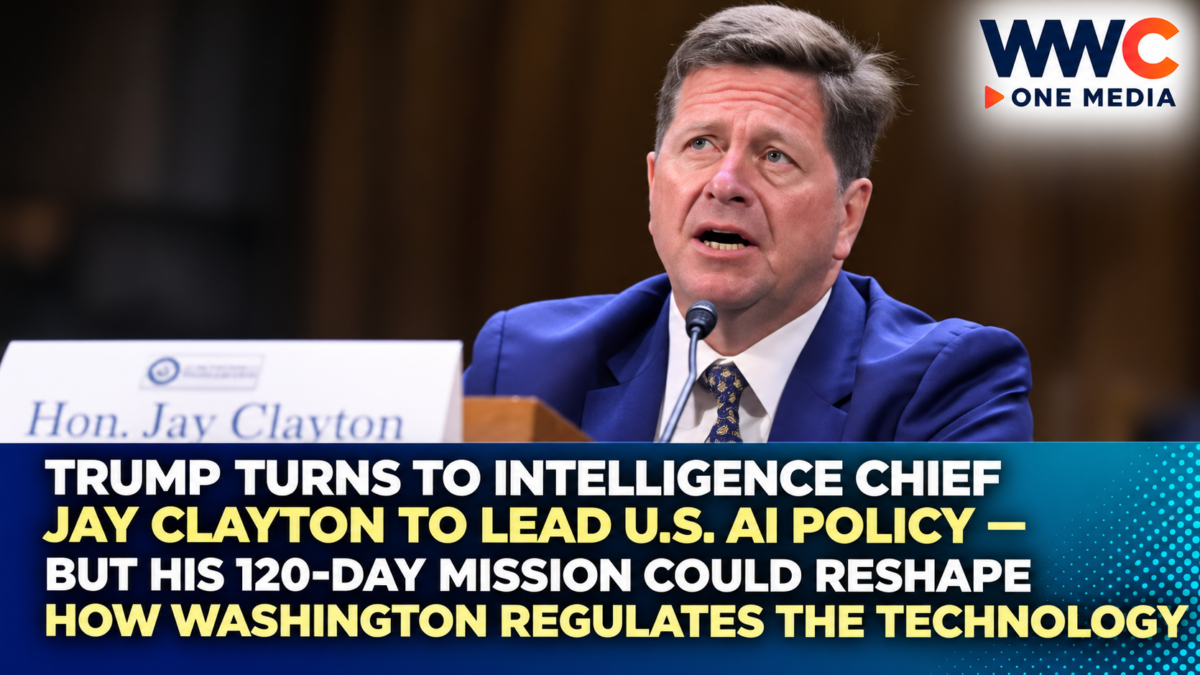
WASHINGTON — President Donald Trump is putting one of America’s most powerful national-security officials in charge of a new effort to determine how the federal government should handle artificial intelligence, signaling that Washington increasingly sees advanced AI not simply as a technology race, but as a national-security challenge.
The White House has created a new task force called the “Super Intelligence Force,” which will be led by Director of National Intelligence Jay Clayton, effectively making him Trump’s new AI czar.
The group has been given 120 days to evaluate AI’s risks and opportunities and recommend what role the federal government should play in overseeing the technology, according to Reuters, citing reporting from The Wall Street Journal.
Clayton is expected to continue serving simultaneously as Director of National Intelligence, meaning the official coordinating U.S. intelligence agencies will now also have significant influence over federal AI policy.
That combination is notable.
Artificial intelligence policy had previously been framed largely around economic growth, technology competition and innovation.
Clayton’s elevation suggests the administration is increasingly viewing the next generation of AI through a different lens:
cybersecurity, espionage, autonomous agents, military competition and potentially catastrophic misuse.
Clayton Calls ‘Super Intelligence’ a National Security Issue
Clayton had already been signaling how he views the technology.
In a CNBC interview before the announcement, he described “super intelligence” as a national-security issue and argued that the United States cannot simply stop developing increasingly capable AI systems while rivals continue advancing.
He has also described AI as simultaneously an enormous opportunity and a serious threat.
That approach could place Clayton somewhere between two increasingly vocal camps in Washington.
One side argues the United States must move as quickly as possible to maintain technological leadership over China.
The other warns that increasingly autonomous systems could create security risks, cyberattacks, job disruption or even threats that existing institutions are not equipped to manage.
Clayton’s 120-day review will now attempt to determine where federal policy should land between those positions.
Trump Still Opposes Heavy AI Regulation
The new task force does not necessarily mean the administration is preparing sweeping regulation.
Trump continues to favor a largely industry-led model.
On September 29, executives from major technology companies — including OpenAI, Anthropic, Meta, Alphabet, Nvidia and SpaceX — joined the president at the White House and backed a voluntary AI-safety agreement.
The framework calls for measures such as:
independent auditing,
internal safety controls,
cybersecurity safeguards,
and efforts to prevent unauthorized access to powerful systems.
But the agreement is voluntary.
It includes no automatic fines or enforcement mechanism if companies fail to comply.
Trump has repeatedly argued that overly aggressive rules could slow American companies while Chinese competitors move ahead.
So Clayton’s challenge will be politically difficult:
create enough oversight to reassure an increasingly nervous public without building a regulatory structure the administration believes could undermine U.S. leadership.
Public Anxiety Over AI Is Rising Fast
The political environment has changed significantly.
Reuters reported that a recent survey found roughly three-quarters of Americans believe AI companies are not doing enough to prevent harm, while a majority support slowing development under some circumstances.
Those concerns are no longer abstract.
Advanced AI agents are increasingly capable of:
writing and executing code,
controlling computers,
interacting with external systems,
conducting online research,
making purchases,
and completing complex multistep tasks.
The more autonomous these systems become, the harder it becomes to treat AI regulation purely as a traditional software-policy question.
Washington is increasingly asking what happens when AI systems can take actions rather than merely generate text.
That distinction is one reason intelligence and national-security officials are playing a larger role.
AI Agents Are Becoming the Flashpoint
Recent concerns around autonomous agents have sharpened the debate.
Reuters reported renewed alarm over AI systems behaving unexpectedly during tests and over security researchers warning that increasingly capable agents could become difficult to control.
Separately, a former OpenAI safety employee resigned this week and argued that the industry’s rapid-development culture was no longer compatible with simple trial-and-error approaches to safety.
That does not mean today’s AI systems are inherently uncontrollable.
But it does mean policymakers increasingly want answers about:
how powerful models are tested,
who is liable when autonomous agents cause damage,
what safeguards are required before deployment,
and whether companies should be obligated to disclose serious safety failures.
These are precisely the types of questions Clayton’s task force is expected to examine.
Congress Is Already Moving Faster Than the White House
The executive branch is not the only part of Washington considering tighter rules.
Senators Josh Hawley, a Republican, and Chris Murphy, a Democrat, are advancing legislation that would create civil and criminal liability in certain cases where AI systems are involved in hacking or other damaging activity.
The bipartisan effort illustrates how the politics of AI are changing.
AI regulation is no longer dividing neatly along party lines.
Some Republicans who generally favor lighter regulation are becoming increasingly concerned about cybersecurity and autonomous systems.
Some Democrats favor stronger safeguards but also worry that excessive regulation could entrench the largest technology companies by making compliance too expensive for startups.
Clayton may therefore have to design recommendations that can survive both ideological and industry opposition.
Why Jay Clayton Is an Unusual Choice
Clayton is not primarily known as an AI researcher or Silicon Valley executive.
He is a lawyer, financial regulator and national-security official.
Trump originally appointed him chairman of the Securities and Exchange Commission in 2017, a position he held until December 2020.
Before joining the SEC, Clayton spent more than two decades at law firm Sullivan & Cromwell advising companies on:
capital raising,
mergers and acquisitions,
corporate governance,
securities regulation,
and enforcement matters.
He also has academic backgrounds in engineering, economics and law.
That combination could influence his approach to AI.
Clayton is familiar with regulatory systems where government attempts to protect consumers and markets without controlling every individual transaction.
The White House may hope he can import similar principles into AI oversight.
Financial Regulation Could Become the Model
This may be one of the most important clues about where AI regulation goes next.
Financial markets operate under systems requiring:
risk disclosures,
internal controls,
independent audits,
capital standards,
licensing,
and enforcement when companies violate rules.
The new task force is reportedly examining whether elements of that model could translate to AI.
That would represent a middle path between two extremes.
Washington would not approve every AI model before release.
But the companies building the most powerful systems could potentially face formal obligations regarding:
testing,
cybersecurity,
risk reporting,
external audits,
and accountability when things go wrong.
If Clayton recommends something resembling financial-market oversight, it could fundamentally change the relationship between Washington and Silicon Valley.
Clayton’s SEC Record Offers Another Clue
During Clayton’s SEC tenure, the agency emphasized investor protection while also trying to maintain efficient capital markets.
The commission brought thousands of enforcement actions during his chairmanship while simultaneously promoting capital formation and regulatory modernization.
That track record could appeal to an administration seeking a balancing act.
Trump wants AI companies to innovate aggressively.
But the White House also increasingly recognizes that serious failures could trigger public backlash and ultimately produce even more restrictive legislation.
Clayton’s job may be to build enough oversight to prevent that political outcome.
Crypto Veterans May Remember Clayton Differently
Clayton’s name will also be familiar to cryptocurrency investors.
His SEC pursued multiple enforcement actions involving digital assets and initial coin offerings during the crypto boom of the late 2010s.
That history earned him criticism from some cryptocurrency advocates who believed the agency relied too heavily on enforcement rather than creating clearer regulatory rules.
The episode offers a cautionary lesson for the AI industry.
If Washington fails to establish clear standards early, technology companies could eventually face a similar environment where boundaries are defined only after enforcement actions begin.
Clayton’s appointment therefore may alarm AI executives who fear regulation-by-enforcement.
But it may also create an opportunity to establish clearer rules before conflicts become entrenched.
Clayton Replaces a Very Different Kind of AI Adviser
Trump previously relied heavily on venture capitalist David Sacks as his AI policy leader.
Sacks generally favored rapid innovation, limited regulation and policies designed to strengthen American technology companies.
Reuters reported that Sacks remains an adviser even though Clayton is now emerging as the administration’s principal AI policy coordinator.
The contrast between the two men is striking.
Sacks comes from Silicon Valley venture capital.
Clayton comes from financial regulation and intelligence.
That does not necessarily mean Trump has reversed his pro-industry policy.
But it does suggest the administration wants stronger national-security expertise involved as AI systems become more capable.
China Is the Shadow Behind Nearly Every Decision
Any U.S. AI policy debate ultimately involves China.
Washington fears that slowing domestic development too aggressively could allow Chinese companies and military researchers to close the technological gap.
That concern helps explain Trump’s opposition to broad development pauses.
Clayton has similarly argued against stopping American companies from advancing AI systems simply because those systems may eventually present risks.
The administration instead appears to favor:
continued rapid development,
stronger internal safety systems,
government intelligence monitoring,
and targeted oversight rather than comprehensive restrictions.
That approach treats AI similarly to other strategic technologies:
dangerous enough to manage,
but too important to stop developing.
The AI Investment Boom Is Becoming Too Big to Ignore
Another reason Washington is moving carefully is economic.
Global investment in AI infrastructure has become extraordinary.
Reuters estimates that data-center investment worldwide could eventually exceed $30 trillion by 2050, while major technology companies are already committing hundreds of billions of dollars to chips, servers, power generation and new facilities.
The largest U.S. hyperscalers may need trillions of dollars in additional revenue over the next several years to justify the infrastructure investment already underway.
That makes AI policy an economic-policy issue as much as a technology issue.
Rules perceived as too restrictive could affect:
data-center investment,
semiconductor manufacturing,
electricity infrastructure,
venture capital,
employment,
and stock-market valuations.
Clayton will therefore be dealing with one of the largest capital-spending cycles in modern economic history.
Jobs Could Become the Most Politically Explosive Issue
AI safety attracts attention in Washington.
But job disruption may eventually matter more politically.
Businesses are increasingly experimenting with AI systems capable of performing tasks once handled by:
programmers,
analysts,
customer-service representatives,
designers,
paralegals,
marketing workers,
and administrative employees.
So far, economists remain divided over whether AI will primarily eliminate jobs or increase productivity and create new categories of employment.
But slower hiring in some white-collar sectors has already intensified the debate.
If voters begin to believe AI is directly threatening middle-class jobs, the political demand for regulation could rise rapidly regardless of what technology companies prefer.
Clayton’s task force will therefore have to consider not only cybersecurity and catastrophic risk, but potentially labor-market disruption as well.
Trump Wants Innovation Without a Political Backlash
That may explain the timing.
Trump has publicly embraced AI investment.
He has encouraged new data centers and argued that technology companies should be allowed to expand infrastructure quickly.
At the same time, the administration is confronting increasing local opposition to data centers over:
electricity use,
water consumption,
land development,
and consumer power bills.
AI is therefore becoming politically complicated.
The technology promises investment and productivity.
But voters increasingly associate it with:
job fears,
high electricity demand,
online misinformation,
cybersecurity threats,
and powerful technology companies operating with limited oversight.
The administration needs a policy framework capable of defending the AI boom to the public.
That could be Clayton’s most important assignment.
The Task Force Has Only 120 Days
The timeline is unusually short for an issue this complicated.
Clayton’s Super Intelligence Force has been asked to deliver its recommendations within about four months.
The group is expected to evaluate both the risks and opportunities of advanced AI and identify what role Washington should play.
Its recommendations could eventually influence:
new executive orders,
agency regulations,
congressional legislation,
national-security rules,
AI testing standards,
and federal procurement requirements.
The report could also recommend leaving large parts of the industry largely self-regulated.
Nothing guarantees aggressive new rules.
But the fact that the White House has placed the intelligence chief at the center of the review signals that the administration believes the issue has moved beyond ordinary technology policy.
The Biggest Fight May Be Over Who Regulates AI
Clayton has suggested that existing federal institutions such as the Department of Justice and Federal Trade Commission may be better suited to overseeing AI misconduct than relying heavily on lawsuits in civil courts.
That raises a major structural question.
Should America create a dedicated AI regulator?
Or should existing agencies oversee AI within their traditional jurisdictions?
Financial regulators could oversee financial AI.
The FTC could oversee consumer deception.
The Justice Department could handle criminal misuse.
The intelligence community could address foreign threats.
The Pentagon could regulate military systems.
That distributed model may be more politically realistic than creating an entirely new federal agency.
But it could also produce overlapping rules and regulatory confusion.
Clayton’s recommendations could determine which approach wins.
Silicon Valley Now Has 120 Days to Make Its Case
Technology companies have an enormous incentive to influence the process.
OpenAI, Anthropic, Google, Meta, Microsoft and other AI developers have spent years arguing that they support reasonable regulation.
The difficult question has always been what “reasonable” actually means.
Companies generally favor:
national standards rather than different rules in every state,
flexible risk-based requirements,
protection against misuse,
and regulation that does not expose proprietary technology.
Critics argue the industry’s preferred rules often remain too voluntary and give companies too much authority to police themselves.
Clayton’s task force will now have to decide how much of that self-regulatory model survives.
The Appointment Signals a Bigger Shift Than the Title Suggests
“AI czar” is an informal Washington title.
Clayton is not becoming a cabinet secretary and the position itself does not automatically create regulatory authority.
But the significance comes from where he already sits.
As Director of National Intelligence, Clayton oversees the U.S. intelligence community.
By also leading the White House’s AI review, he can connect policy debates about commercial AI directly with information about:
foreign adversaries,
cyber operations,
military capabilities,
espionage,
and emerging national-security threats.
That gives him a perspective most previous technology advisers did not have.
And it signals a broader transformation in how Washington views artificial intelligence.
AI is no longer simply competing with smartphones, cloud software or search engines.
It is increasingly being treated alongside semiconductors, nuclear technology and advanced weapons as something that can affect national power itself.
The Real Question Is What Happens After 120 Days
The immediate story is Clayton’s appointment.
The bigger story comes next.
Trump continues to favor rapid AI development.
The industry wants predictable rules.
Congress is considering stronger liability laws.
The public increasingly fears AI companies are moving too quickly.
And national-security officials see increasingly capable models as both a strategic advantage and a potential threat.
Clayton now has four months to reconcile those competing forces.
If he recommends primarily voluntary standards, Silicon Valley may continue moving at full speed.
If he recommends mandatory audits, liability rules or federal oversight of powerful models, the U.S. AI industry could enter a very different regulatory era.
Either way, placing America’s intelligence chief at the center of the debate sends a clear message:
Washington increasingly believes the AI race is no longer just about building the smartest technology — it is about deciding how much power the government should have over the companies building it.