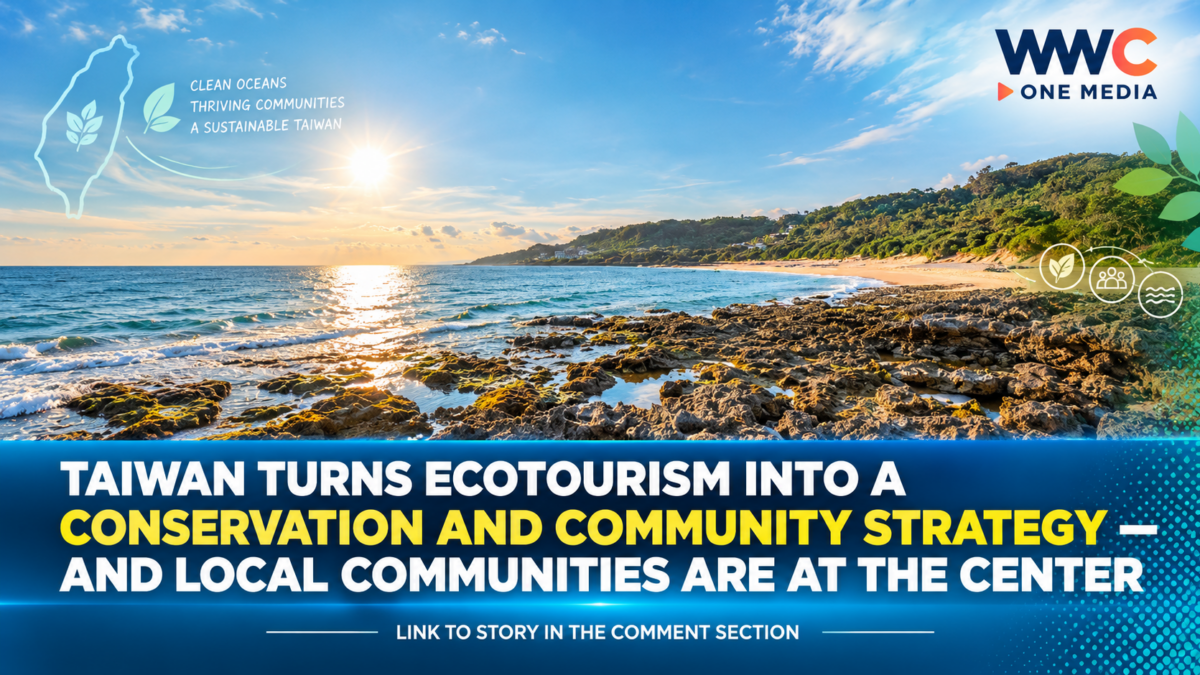
TAIPEI, Taiwan — Taiwan is increasingly looking to ecotourism as a way to protect fragile ecosystems while creating new economic opportunities for communities living around protected areas.
The approach puts local residents at the center of tourism, training them to become guides and storytellers while encouraging visitors to experience Taiwan’s natural landscapes and cultural heritage responsibly.
At the International Conference on Tourism in Taipei, Chen Mei-Hui, a professor of forestry at National Pingtung University of Science and Technology, said communities need to reclaim their culture and develop the skills to tell their own stories.
One example can be found at the Xuhai-Guanyinbi Nature Reserve in southern Taiwan, where residents have been trained as guides for visitors exploring the Alangyi Historic Trail.
According to Chen, the community-based model generates approximately NT$10 million in annual revenue, while also directing tourism spending toward nearby businesses.
Protecting One of Taiwan’s Last Unspoiled Coastlines
The Alangyi Historic Trail is regarded as one of Taiwan’s remaining major stretches of coastline without a modern highway.
The surrounding area became a nature reserve in 2012, following years of efforts to stop a proposed extension of a provincial highway through the region.
Rather than transforming the landscape for mass tourism, the ecotourism model seeks to make the community itself part of the conservation effort.
That strategy is also being applied in Wutai Township, where ecotourism has become part of the region’s recovery following Typhoon Morakot in 2009.
The disaster devastated the area and forced many residents to relocate. In 2020, a protected area covering three Indigenous communities was established, with ecotourism subsequently providing new economic opportunities while helping residents reconnect with their traditional territories and culture.
Taiwan’s Community-Based Ecotourism Model
Taiwan’s community-focused ecotourism movement dates back to 2006, when government agencies, academics and residents in Sheding, within Kenting National Park, worked together to develop tourism centered on protecting natural and cultural resources.
Chen said the goal is to move beyond a model where governments manage protected areas separately from the communities that live around them.
Instead, residents can become long-term partners in environmental management while tourism provides an economic incentive to preserve local resources.
Chen has spent about two decades promoting ecotourism as a tool for biodiversity conservation. In late 2024, she also co-founded a national platform connecting ecotourism and regional revitalization initiatives across 65 communities in Taiwan.
More Than Tourism: A Model for Rural Revitalization
The Taiwan Ecotourism Association’s chair, Kuo Yu-jen, said Taiwan’s combination of diverse ecosystems, Indigenous and other cultural traditions, community participation and conservation experience gives the island an opportunity to become an important ecotourism hub in Asia.
The bigger story is therefore not simply about attracting more tourists.
Taiwan’s community-based approach shows how tourism can potentially connect environmental protection, cultural preservation and local economic development—with residents playing a central role rather than simply serving as spectators to tourism projects.
As interest in sustainable travel grows, Taiwan is betting that one of its most valuable tourism assets may not be another major attraction—but the communities already living alongside its protected landscapes.
WWC ONE MEDIA G,A