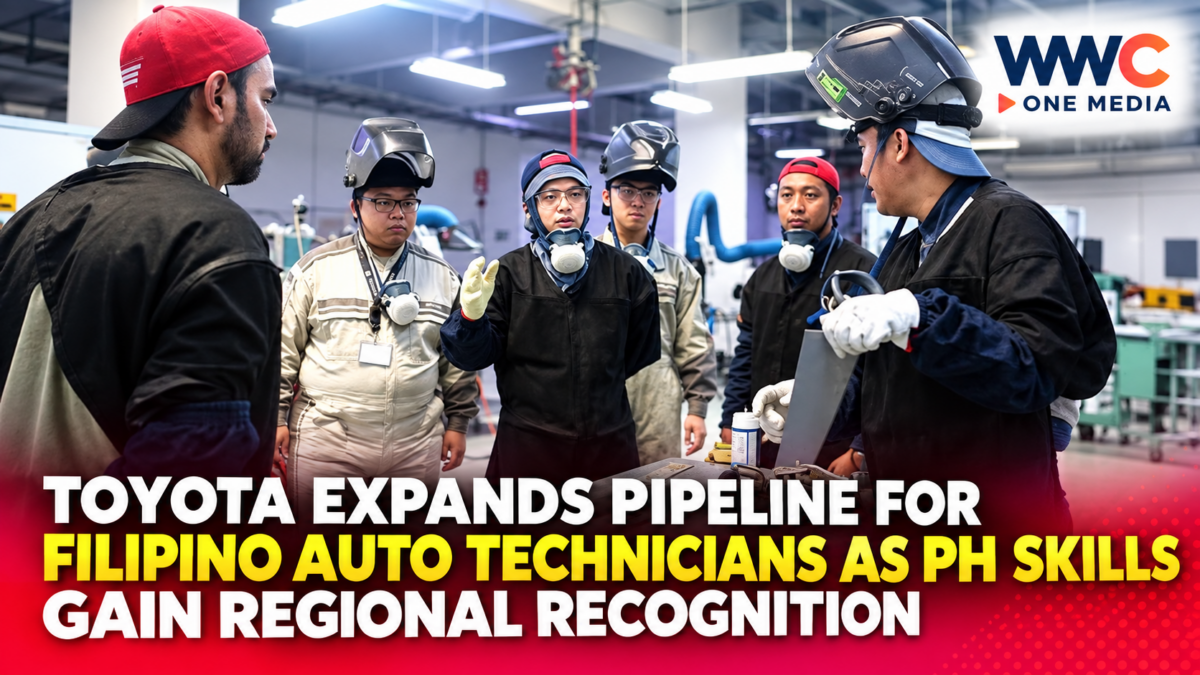
MANILA, Philippines — Toyota Motor Philippines is expanding its pipeline of Filipino automotive technicians as demand grows for workers capable of servicing not only traditional gasoline and diesel vehicles, but also hybrid and increasingly sophisticated automotive technologies.
The push gained fresh attention after 20-year-old David Kryzjan Escobar, a student of the Toyota Motor Philippines School of Technology, won the gold medal in Automobile Technology at the WorldSkills Philippines Clark 2026 competition.
Escobar competed against representatives from 10 other regions and helped Calabarzon capture 17 medals and the overall national championship. He is now expected to represent the Philippines at the WorldSkills ASEAN Competition in 2027.
For Toyota, the victory is more than another student award.
It highlights a broader strategy to build a larger pool of highly trained Filipino technicians capable of supporting Toyota dealerships locally while also supplying skilled workers to overseas automotive markets.
TOYOTA STUDENT WINS NATIONAL GOLD
Escobar is enrolled in Automotive Servicing General Job Batch 24 at TMP Tech and trained under Master Instructor Apolinar Rampola.
At the national WorldSkills competition, contestants were tested on automotive diagnosis, repair and servicing skills—areas becoming more demanding as modern vehicles integrate electronics, computers and electrified powertrains.
Toyota said competencies involving:
Gasoline engines
Diesel engines
Diagnostics
Electrical systems
Repair and servicing
and increasingly
Hybrid powertrains
remain important to the company’s after-sales operations.
That means the traditional image of an automotive mechanic working almost entirely with mechanical components is rapidly changing.
Today’s technicians increasingly need to understand software-driven diagnostics, electrical systems and high-voltage components.
TMP TECH WON SEVEN GOLD MEDALS IN 2026
Toyota Motor Philippines School of Technology participated in three WorldSkills categories at the provincial, regional and national stages this year.
Across those competitions, TMP Tech students collected seven medals—and every one of them was gold.
That record gives the school a strong benchmark for the quality of its technical training.
But Toyota’s strategy goes beyond preparing students for competitions.
TMP Tech was established specifically to create technicians for actual employment in Toyota’s after-sales network and the broader automotive sector.
NEARLY 3,000 GRADUATES SINCE 2013
Since opening in 2013, TMP Tech has produced roughly 3,000 graduates.
More than 200 graduates have also been dispatched to Japan as of 2026, giving Filipino technicians access to overseas work opportunities while helping Toyota address skilled-labor requirements abroad.
That international pipeline is becoming increasingly important.
Automotive markets around the world are facing major technological changes as manufacturers add hybrid, battery-electric and digitally connected vehicles to their lineups.
Workers trained only in traditional engine repair may eventually find themselves at a disadvantage.
Toyota is therefore trying to develop technicians capable of working across several generations of vehicle technology.
TOYOTA OPENS SECOND SCHOOL IN PAMPANGA
The company is also physically expanding its training capacity.
TMP Tech opened its second branch in San Fernando, Pampanga, in August 2026, extending the school beyond its original Santa Rosa, Laguna campus.
TESDA records show that the San Fernando campus has registered programs covering:
Automotive Servicing NC I
Automotive Servicing – Electrical Repair NC II
Automotive Servicing – Engine Repair NC II
Automotive Servicing – Chassis Repair NC II.
The Central Luzon expansion gives more students access to Toyota-linked technical training without having to study at the original Laguna campus.
It also enlarges the company’s future recruitment pool.
THE LAGUNA SCHOOL OFFERS A MUCH BROADER RANGE OF COURSES
Toyota’s original Santa Rosa campus remains the center of its technical education operations.
TESDA lists the school as an accredited technical-vocational institution offering programs ranging from Automotive Servicing NC I through more specialized qualifications.
Its registered programs include:
Automotive Servicing NC I
Chassis Repair NC II
Engine Repair NC II
Electrical Repair NC II
Automotive Servicing NC III
Automotive Body Repairing NC II
Automotive Painting NC II.
Toyota also integrates TESDA-prescribed competencies with its own TEAM 21, or Technical Education for Automotive Mastery for the 21st Century, training system.
The curriculum is designed to combine classroom instruction with hands-on industry training and can be completed in less than two years.
HYBRID VEHICLE TRAINING IS NOW PART OF THE PIPELINE
One of the most significant developments is Toyota’s move into formal electrified-vehicle training.
TESDA records show that TMP Tech now has a registered Hybrid Electric Vehicles High Voltage System program requiring 672 training hours.
That is an important shift.
Hybrid vehicles use high-voltage battery systems and electronics that require specialized safety procedures and diagnostic knowledge.
Technicians working on those systems cannot simply rely on conventional engine-repair skills.
Toyota has been one of the largest promoters of hybrid vehicles in the Philippine market, making technician training increasingly important as more electrified vehicles enter dealerships and eventually the secondhand market.
THE AUTO TECHNICIAN OF THE FUTURE NEEDS MORE THAN A WRENCH
The industry is changing rapidly.
Modern vehicles increasingly rely on:
Electronic control units
Sensors
Advanced driver-assistance systems
High-voltage batteries
Computerized diagnostic equipment
Software-controlled components
For technicians, that means the job increasingly sits somewhere between traditional mechanical work and electronics.
A worker who can diagnose a gasoline engine but cannot safely handle a hybrid system may eventually have fewer employment options.
Toyota’s expansion suggests the company expects demand for multi-skilled technicians to rise substantially.
TOYOTA PHILIPPINES HAS ALSO BECOME A REGIONAL TRAINING HUB
The technician pipeline is only one part of a bigger development.
Toyota Motor Asia recently selected Toyota Motor Philippines as a regional training hub for Asian distributors, giving Filipino instructors responsibility for training Toyota personnel from other countries.
The first leg of Toyota’s Body, Paint and Estimation regional training was held in Santa Rosa from September 7 to 18, 2026.
Body-repair instructors from:
Indonesia
Laos
Thailand
and
Pakistan
were trained by Filipino Toyota instructors in damage assessment, panel repair and welding.
The regional program is scheduled to run until 2029.
Under the current arrangement, Toyota Motor Philippines will conduct three training courses during the program’s first year for participants from Toyota affiliates across Asia.
That represents an important reversal of the traditional training model.
Instead of Filipino workers always traveling abroad to receive technical instruction, Toyota is now bringing foreign trainees to the Philippines to learn from Filipino instructors.
FILIPINO TRAINERS ARE EARNING GLOBAL TOYOTA CERTIFICATIONS
Toyota Motor Philippines’ Body, Paint and Estimation team also earned two Toyota Motor Asia certifications this year:
Paint Instructor Course Step 1
and
Estimation Instructor Course Step 1.
Additional training is lined up through 2027 for Toyota, Masters and Professional global certifications.
The goal is to ensure Philippine instructors meet the same competency standards Toyota uses across its international operations.
That matters because Toyota’s dealership network depends heavily on standardized servicing.
A vehicle repaired in Manila, Bangkok or Jakarta should ideally receive comparable technical treatment.
MANUFACTURING WORKERS ARE WINNING REGIONAL AWARDS TOO
The country’s automotive skills momentum extends beyond after-sales service.
Six Filipino Toyota manufacturing workers achieved TMP’s first complete podium sweep across all categories entered at the Toyota 2026 Asia Pacific Skills Contest.
Toyota’s Santa Rosa facility currently has the capacity to assemble more than 60,000 vehicles annually, including the Vios, Innova and Next Generation Tamaraw.
The results indicate Toyota is developing Philippine technical capabilities on both sides of the automotive value chain:
Manufacturing vehicles
and
Servicing them after they are sold.
WHY TECHNICAL TRAINING MATTERS TO TOYOTA’S BUSINESS
For an automaker, selling a vehicle is only the beginning of the customer relationship.
Cars may remain on Philippine roads for 10, 15 or even 20 years.
During that period, owners need:
Preventive maintenance
Mechanical repairs
Electrical diagnosis
Body repair
Replacement parts
and increasingly
Hybrid-system servicing.
A shortage of qualified technicians can therefore become a business problem.
Customers waiting too long for repairs or receiving poor service may eventually change brands.
By training its own pipeline of technicians, Toyota can protect the quality of its dealership network while creating a steady labor supply.
THE PHILIPPINES COULD EXPORT MORE AUTOMOTIVE SKILLS
Toyota’s experience also points to a broader economic opportunity.
The Philippines has long exported nurses, engineers, seafarers and construction workers.
Automotive technicians could become another high-value skilled-labor category.
TMP Tech already has more than 200 graduates dispatched to Japan, while Toyota Motor Philippines is now training instructors from other Asian countries.
If the country’s technical-vocational system can produce more workers who understand hybrid systems, diagnostics, electronics and advanced automotive repair, Filipino technicians could become more competitive across Asia and other international markets.
BUT TRAINING HAS TO KEEP UP WITH THE CARS
The challenge is speed.
Vehicle technology is changing faster than many traditional vocational curricula.
Hybrid vehicles are already common.
Battery-electric vehicles are increasing.
Advanced driver-assistance systems are becoming standard on more models.
Connected vehicles generate growing amounts of diagnostic data.
That means automotive schools cannot train tomorrow’s workers using yesterday’s repair methods.
Toyota’s addition of high-voltage hybrid training and its regional skills programs suggests the company recognizes that shift.
THE BIGGER STORY: TOYOTA IS BUILDING A SKILLED-WORKER PIPELINE
Escobar’s WorldSkills gold medal makes an easy headline.
But the bigger story is the system behind it.
Toyota now has:
Two technical-school campuses
Nearly 3,000 graduates
More than 200 graduates deployed to Japan
TESDA-accredited automotive programs
Formal hybrid high-voltage training
and
A new role training Toyota instructors from across Asia.
That gives the Philippine automotive sector something potentially more valuable than another trophy.
It creates a pipeline of workers who can move between conventional cars, hybrids and increasingly sophisticated vehicle technologies.
Escobar will now take Philippine automotive skills to the WorldSkills ASEAN stage in 2027.
But Toyota’s bigger bet is that thousands of technicians following behind him will eventually take those same skills into dealerships, factories and automotive workplaces across the Philippines—and possibly far beyond it.