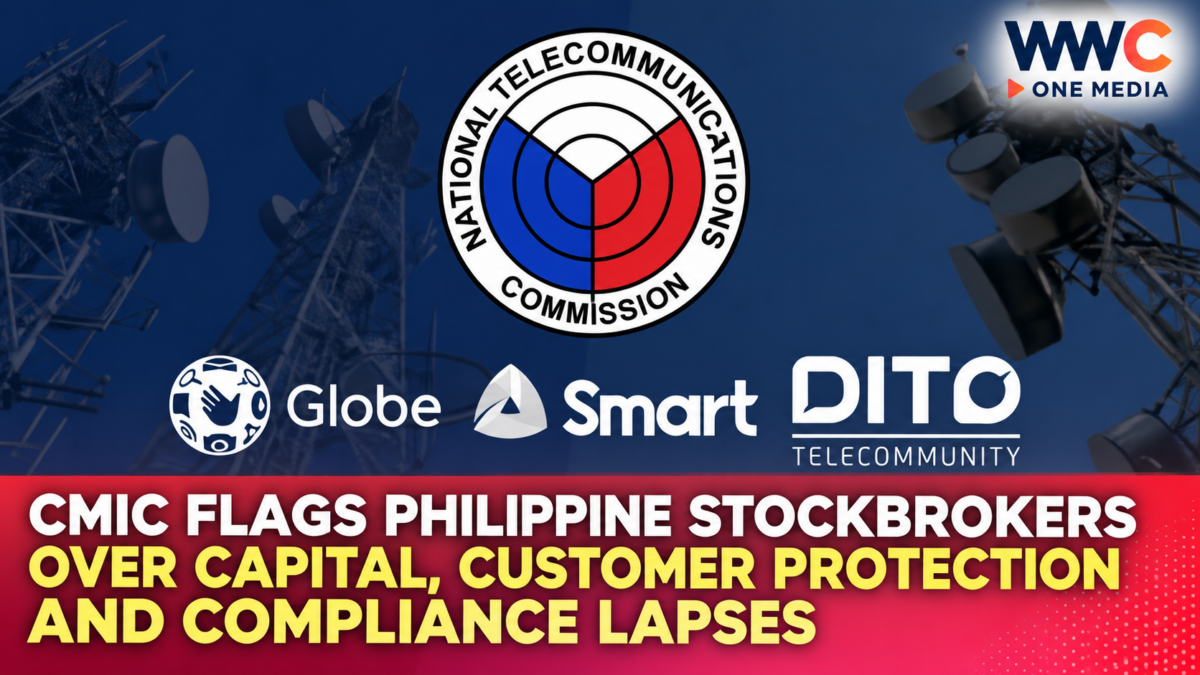
MANILA, Philippines — The Philippine stock market’s regulatory watchdog has penalized dozens of brokerage firms over the past year for violations ranging from weak capital safeguards and customer-protection controls to incomplete records and supervisory failures, putting renewed attention on the firms entrusted with Filipino investors’ money and securities.
The Capital Markets Integrity Corp., or CMIC, disclosed a long list of disciplinary actions covering Philippine Stock Exchange trading participants from October 2, 2025 through September 25, 2026.
The sanctions included both monetary penalties and written reprimands, according to CMIC records reviewed by InsiderPH.
The watchdog did not disclose the peso amounts attached to most of the monetary penalties.
The violations covered several of the most important rules governing stockbrokers, including:
Capital adequacy
Customer-fund protection
Books and client records
Risk calculations
Internal supervision
Regulatory reporting
and
Operational controls.
The disclosures matter because brokerage firms sit directly between investors and the Philippine stock market.
When an investor deposits cash, buys shares or sells securities, brokers are required to maintain enough capital, properly segregate customer assets and keep complete records so clients remain protected even if the brokerage itself encounters financial problems.
GLOBALINKS AND MOUNT PEAK DREW MULTIPLE PENALTIES
Among the firms with particularly lengthy lists of sanctions were Globalinks Securities & Stocks Inc. and Mount Peak Securities Inc.
InsiderPH reported that both accumulated multiple monetary penalties involving several regulatory requirements.
Globalinks had already attracted regulatory attention before the latest disciplinary list.
CMIC involuntarily suspended Globalinks on July 9, 2025, citing continuing breaches of capitalization requirements under Article VIII of CMIC rules.
During that suspension, the brokerage lost access to:
The Philippine Stock Exchange trading system
Philippine Depository and Trust Corp. facilities
and
Securities Clearing Corp. of the Philippines clearing facilities.
Client securities could still be transferred to other brokerage firms under specified conditions, while proprietary trading and transactions by related parties were prohibited.
CMIC later lifted Globalinks’ suspension on October 14, 2025, after determining that the firm had complied with the relevant capitalization requirements.
Globalinks is currently listed by CMIC as an active institutional trading participant.
MOUNT PEAK REMAINS SUSPENDED
Mount Peak’s situation is more serious from an operational standpoint.
CMIC’s directory continues to list the brokerage as suspended, according to the regulator’s current records cited in the InsiderPH report.
Its suspension dates back to August 2025.
The continued suspension illustrates how capitalization or compliance problems can eventually move beyond fines and reprimands and directly affect a brokerage firm’s ability to operate.
CMIC rules allow the regulator to impose involuntary suspension when a trading participant fails to correct specified financial deficiencies.
WHY CAPITAL REQUIREMENTS MATTER
Capital rules may sound technical, but they are one of the main protections for brokerage customers.
Broker-dealers must maintain enough financial resources to withstand market losses and meet their obligations to clients and clearing institutions.
Under CMIC rules, brokerages subject to risk-based capital adequacy requirements must calculate and submit their financial condition regularly.
The rules include minimum requirements involving a brokerage firm’s Risk-Based Capital Adequacy ratio and Net Liquid Capital.
Current CMIC rules state that a trading participant can face suspension if it fails to improve its financial position after breaching:
A minimum RBCA ratio of 1.1
and
Minimum Net Liquid Capital of ₱5 million.
The framework is intended to ensure that brokers have a financial cushion available before problems become severe enough to threaten customer assets or market settlement obligations.
CUSTOMER MONEY MUST BE KEPT SEPARATE
Another major category in CMIC’s disciplinary list involved customer protection.
Under CMIC rules, brokerage firms must maintain a dedicated Special Reserve Bank Account for the Exclusive Benefit of Customers whenever reserves are required.
That account must remain separate from the brokerage firm’s own operating bank accounts.
The principle is straightforward:
Customer money belongs to customers—not to the broker.
Segregating those funds reduces the risk that client cash will be mixed with company operating funds or exposed if the brokerage runs into financial trouble.
CMIC classifies the failure to maintain the required separate reserve account as a major violation.
Depending on the number of offenses, major violations can carry monetary fines that escalate with repeated breaches.
CLIENT RECORDS ARE ALSO PART OF INVESTOR PROTECTION
Several commonly violated CMIC provisions involve customer information.
Brokerages are required to maintain detailed account records including:
Customer name
Residential address
Contact details
Date and place of birth
Nationality
Authorized representatives for institutional accounts
and
Specimen signatures, among other information.
CMIC also requires active customer account information forms to be periodically updated.
Failure to maintain or update those records is classified among the regulator’s frequently violated rules.
These requirements are important not only for administrative purposes but also for anti-fraud, anti-money-laundering and investor-protection controls.
Incomplete or outdated records can make it harder for a broker to verify instructions, resolve disputes or detect suspicious transactions.
PHILIPPINE EQUITY PARTNERS RECEIVED THREE MONETARY PENALTIES
Another notable firm in the regulatory disclosure was Philippine Equity Partners Inc.
According to InsiderPH, the brokerage received three monetary penalties covering areas related to:
Capital and operational-risk requirements
Customer protection
and
Supervision.
Philippine Equity Partners remains listed by CMIC as an active retail and institutional trading participant.
Its nominee is Lorenzo Andres Roxas, who also joined the Philippine Stock Exchange board in July.
The disciplinary actions do not mean the brokerage was suspended, nor does the publication itself establish that customers suffered financial losses.
They represent regulatory findings involving specific compliance requirements.
That distinction is important whenever disciplinary lists are reported.
WEALTH SECURITIES WAS ALSO CITED
Wealth Securities Inc. also appeared in CMIC’s disciplinary list.
The brokerage received a combination of written reprimands and monetary penalties for regulatory violations during the period reviewed.
CMIC currently lists Wealth Securities as an active retail brokerage offering online trading services.
The company’s nominee is Wilson Sy, a former chairman of the Philippine Stock Exchange.
Again, the sanctions are regulatory compliance actions and should not automatically be interpreted as evidence of fraud or loss of client funds.
EVEN DECADES-OLD SECURITIES RULES ARE STILL BEING ENFORCED
Two other firms cited by InsiderPH—Diversified Securities Inc. and G.D. Tan & Company Inc.—were penalized under rules linked to Presidential Decree No. 154.
That decree dates back decades, underscoring how some parts of the Philippine securities regulatory framework continue to rely on long-established financial safeguards.
Both firms are currently listed by CMIC as active trading participants.
NOT EVERY VIOLATION LEADS TO A SUSPENSION
The disciplinary publication contains different levels of sanctions.
Some violations resulted in:
Written reprimands
while others resulted in:
Monetary penalties
and more serious or continuing financial breaches can ultimately lead to:
Suspension of trading operations.
CMIC rules differentiate among violations depending on seriousness and frequency.
For example, some major violations can carry escalating fines:
First offense: ₱10,000 to ₱30,000
Second offense: ₱30,000 to ₱50,000
Third offense: ₱50,000 to ₱75,000
Fourth and succeeding offenses: at least ₱75,000.
Those are rule-based sanction ranges and should not be interpreted as the actual undisclosed penalties imposed on every broker appearing in the latest disciplinary list.
CMIC IS THE PSE MARKET’S FRONTLINE BROKER WATCHDOG
CMIC serves as the independent regulatory organization responsible for overseeing trading participants in the Philippine stock market.
Its rules cover areas including:
Broker conduct
Professional ethics
Customer protection
Capitalization
Books and records
Trading irregularities
and
Disciplinary sanctions.
The organization also carries out annual regulatory examinations of brokerage firms.
CMIC announced the commencement of its 2026 Annual Regulatory Examination on July 14, continuing its regular inspection of trading participants.
The watchdog also requires brokers to submit periodic financial information, including risk-based capital data used to assess whether firms remain financially capable of meeting their obligations.
ANOTHER BROKER WAS SUSPENDED IN 2026
The latest disciplinary list comes amid other enforcement activity this year.
CMIC imposed an involuntary suspension on Benjamin Co Ca & Co. Inc. in August 2026, restricting the brokerage’s access to trading, clearing and depository systems.
That case shows that CMIC’s enforcement activity is not confined to historical violations listed once a year.
The regulator can intervene directly when it believes a trading participant no longer meets requirements necessary for continued market access.
CMIC IS ALSO REVIEWING BROKER CAPITAL RULES
Regulation may become stricter still.
On October 1, just days after publishing its disciplinary actions, CMIC requested comments on proposed amendments relating to the unimpaired paid-up capital and surety bond requirements of broker-dealers.
The timing is significant.
Capital requirements determine how much financial backing a brokerage must maintain before it can operate.
Higher requirements can strengthen resilience but may also make it more expensive for smaller brokerage houses to stay in business.
The debate therefore involves a trade-off between encouraging competition and ensuring firms are financially strong enough to protect customers.
INVESTORS CAN CHECK WHETHER THEIR BROKER IS ACTIVE
For retail investors, the regulatory disclosures provide a reminder that choosing a broker involves more than comparing trading commissions or mobile apps.
CMIC maintains a public directory showing whether individual brokerage firms are:
Active
Suspended
or otherwise subject to operational restrictions.
The watchdog also accepts investor complaints and information about possible rule violations.
Investors can therefore check a broker’s regulatory status before opening or maintaining an account.
WHY THIS MATTERS MORE AS MORE FILIPINOS INVEST ONLINE
The Philippine brokerage industry is changing.
Trading that once required phone calls to a broker can now be carried out in seconds through online platforms and mobile applications.
That accessibility can help expand participation in the stock market.
But it also means increasingly large numbers of investors are trusting financial institutions they may never interact with personally.
Behind every buy button is a brokerage responsible for:
Holding customer cash
Safekeeping securities
Recording transactions
Calculating risks
and
Completing settlement obligations.
If those systems fail, customers can be exposed even when the stocks they purchased perform exactly as expected.
THE BIGGER STORY: THE RISK ISN’T ALWAYS IN THE STOCK
Investors usually think about risk in terms of whether a share price rises or falls.
CMIC’s latest disciplinary list highlights another layer that receives far less attention:
the financial and operational strength of the broker holding the account.
A stock investor can select a strong company, make a correct investment decision and still depend on a brokerage firm to properly safeguard cash, securities and records.
That is why capital adequacy and customer-protection rules exist.
The latest penalties do not mean the Philippine brokerage system is broadly unsafe, nor do they establish that every cited firm endangered client assets.
But the list demonstrates that regulators continue to find compliance weaknesses across parts of the industry.
And as millions of Filipinos gain easier access to stocks through digital platforms, the question for investors increasingly goes beyond:
“Which stock should I buy?”
It also becomes:
“How strong are the systems—and the broker—holding my money?”