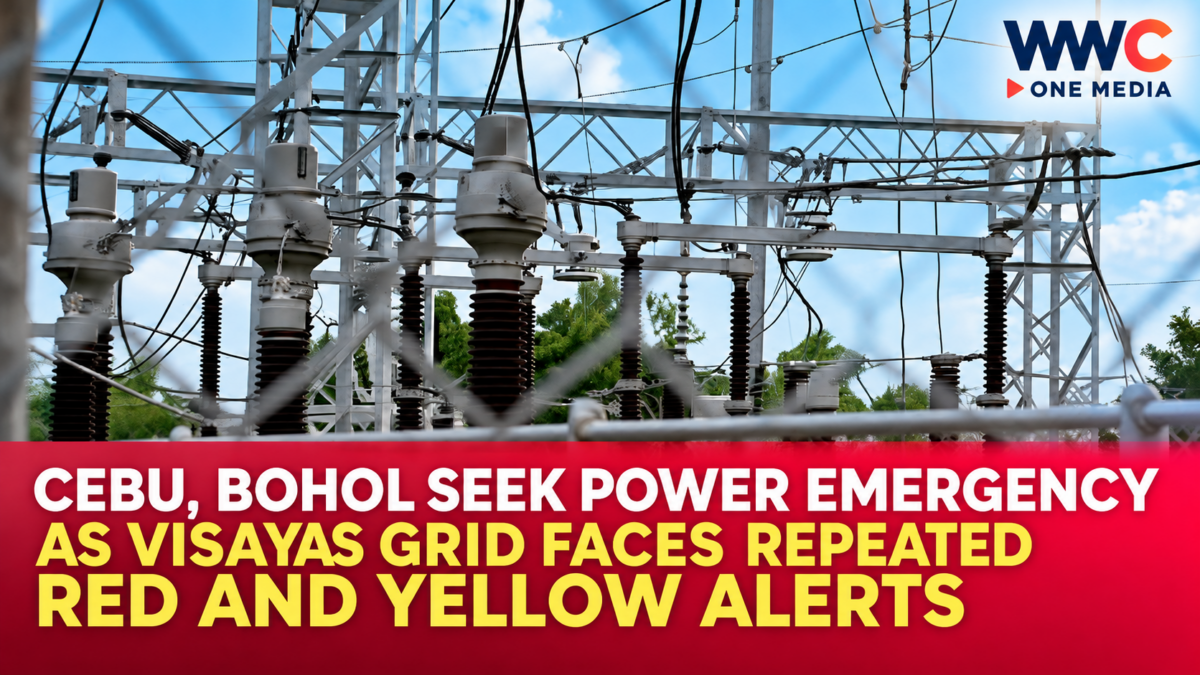
CEBU CITY, Philippines — Central Visayas leaders are asking President Ferdinand Marcos Jr. to declare a state of power emergency covering Cebu and Bohol as repeated power-plant failures, thin electricity reserves and limited imports continue to expose one of the Philippines’ fastest-growing economic regions to brownouts.
The Regional Development Council in Central Visayas (RDC-7) approved the appeal during its third-quarter meeting in Carcar City on September 30, calling for presidential action upon the recommendation of the Department of Energy.
The proposed emergency declaration is intended to accelerate short-term measures to stabilize electricity supply while speeding up new generating plants, transmission lines and substations needed to strengthen the Visayas grid.
The move comes after months of repeated red and yellow alerts that have disrupted homes and businesses throughout the Visayas.
And while several generating plants are expected to return to service, government officials acknowledge that the deeper supply problem could take years to fully solve.
WHY CEBU AND BOHOL WANT AN EMERGENCY DECLARATION
RDC-7 said an emergency declaration could give national agencies greater urgency in addressing immediate electricity shortages and help move critical power infrastructure projects faster.
Among the priorities are:
Accelerating the construction or expansion of power plants
Fast-tracking NGCP transmission and substation projects
Encouraging private-sector investment in new generation capacity
Deploying short-term power sources while permanent facilities are built
Improving reserve capacity so one plant failure does not immediately threaten the grid
Cebu Gov. Pamela Baricuatro, who chairs RDC-7, supported the resolution after Visayas provinces endured repeated grid alerts and rotational outages.
Jennifer Bretaña, regional director of the Department of Economy, Planning, and Development in Central Visayas, said Western and Eastern Visayas development councils were also expected to consider similar resolutions.
The goal, she said, is for the wider Visayas bloc to press for stronger national action on the region’s electricity shortage.
VISAYAS HAS ALREADY RECORDED MORE THAN 140 GRID ALERTS
The urgency becomes clearer when looking at the grid numbers.
By September 16, the Visayas had already recorded:
40 red alerts
104 yellow alerts
since the beginning of 2026.
A red alert means available electricity is insufficient to meet consumer demand plus the grid’s required regulating reserve, creating the possibility of rotational outages.
A yellow alert means the grid still has enough electricity to meet demand but does not have sufficient contingency reserves if another major generating unit unexpectedly goes offline.
The alerts have repeatedly been triggered by a combination of forced plant outages, generating units running below full capacity and limited electricity imports from Mindanao.
NEARLY 1,000 MW HAS BEEN MISSING FROM THE GRID
As recently as September 28, NGCP placed the Visayas grid under another yellow alert.
Available capacity stood at 2,572 megawatts, while peak demand was projected at 2,374 MW, leaving only a thin margin for unexpected failures.
NGCP said three major generating units were unavailable:
Panay Energy Development Corp. Unit 3
KEPCO SPC Power Corp. Unit 2
Therma Visayas Inc. Unit 1
Combined forced outages and reduced plant output left approximately 928.3 MW unavailable to the grid.
Earlier in September, conditions became even tighter.
On September 13, available supply fell to only 2,158 MW against peak demand of 2,292 MW, forcing another round of red and yellow alerts.
At that point, approximately 1,044.5 MW of capacity was unavailable because of plant outages and derated operations.
CEBU HAS FELT THE CONSEQUENCES DIRECTLY
Cebu businesses and households have experienced rotational brownouts as utilities respond to orders from the grid operator to reduce electricity consumption during supply shortages.
On September 3, NGCP placed the Visayas grid under red alert for much of the afternoon and evening, prompting warnings that some Cebu customers could face outages lasting as long as 2.5 hours.
Distribution utility Visayan Electric has also warned that brownout schedules can change quickly because grid conditions are monitored in real time.
A yellow-alert situation can deteriorate into a red alert if another generator fails, meaning customers can lose electricity earlier—or avoid an expected outage altogether—depending on actual supply conditions.
For businesses, this uncertainty can be almost as disruptive as the outages themselves.
Manufacturing plants, malls, hotels, BPO offices, hospitals and small businesses depend on continuous electricity, while companies running backup generators face additional fuel and operating costs.
DOE HAS ALREADY ORDERED EMERGENCY STEPS
The Department of Energy has been trying to restore lost capacity while developing temporary sources of electricity.
Energy Secretary Sharon Garin said in September that the immediate strategy included:
Restoring generating units currently offline
Deploying 253 MW of battery energy storage
Securing around 200 MW to 250 MW of temporary generation
Addressing transmission constraints
Accelerating permanent power plants scheduled for later years.
Battery storage is particularly important because the Visayas has significant solar and other renewable generation.
Those facilities can produce large amounts of electricity during the daytime, but output may drop just as electricity demand rises during the late afternoon and evening.
Batteries can store electricity generated earlier in the day and release it during those peak periods.
DOE simulations indicated that the planned storage capacity could reduce the frequency of grid alerts.
253 MW OF BATTERIES COULD PROVIDE SOME RELIEF
The DOE has directed NGCP to move forward with more than 250 MW of battery energy storage capacity for the Visayas.
Garin said the additional reserves could significantly reduce red and yellow alerts by giving the grid more backup supply whenever a generating plant suddenly trips offline.
But batteries will not permanently solve the underlying shortage.
DOE considers them a bridge until larger generation and transmission projects become operational.
NEW POWER PLANTS MAY NOT ARRIVE UNTIL 2028 AND 2029
The uncomfortable reality for the Visayas is that many permanent solutions are still years away.
The DOE has outlined a regional expansion plan that includes:
135 MW of new baseload capacity in Panay by 2028
Another 270 MW by 2029
An additional 150 MW by 2030
as well as potentially 220 MW to 440 MW of gas-fired mid-merit capacity beginning in 2028.
Energy Secretary Garin acknowledged in September that some of these projects should have been planned much earlier.
The department expects the Visayas power system to become substantially healthier by around 2029, when more permanent generation and transmission projects are expected to be operating.
That timeline explains why local leaders are demanding faster action today.
CEBU IS ALSO PUSHING ITS OWN ENERGY PROJECTS
Cebu’s provincial government has been trying to attract additional electricity generation while acknowledging that actual power generation and transmission remain regulated at the national level.
Among the projects being facilitated are an ACCIONA solar project in Daanbantayan and an Alternergy wind project in Alegria.
Cebu is also looking at the redevelopment of the Alegria oil and gas field, after a petroleum service contract was approved earlier this year.
The province is scheduled to host a Cebu Energy Summit on October 7, bringing together government agencies, utilities, investors and energy companies to discuss immediate and long-term supply requirements.
BOHOL FACES AN EVEN BIGGER LOCAL-SUPPLY CHALLENGE
Bohol’s position within the interconnected Visayas grid has also become part of the debate.
Cebu Energy Rights Advocates, an advocacy group, argued that Bohol’s peak electricity demand exceeds 100 MW, while dependable local generating capacity is only around 26 MW to 30 MW.
The group has urged Bohol and several Negros provinces to reconsider local restrictions on coal and diesel plants, arguing that provinces without enough dependable local supply must import electricity from elsewhere in the Visayas.
That argument is contested because local governments have also sought cleaner power sources and greater renewable-energy development.
The larger grid challenge is therefore not simply about building more power plants—it is about determining what type of generation should be built, where it should be located and how rapidly transmission infrastructure can connect it.
THE VISAYAS CANNOT ALWAYS RELY ON MINDANAO
One reason the electricity shortage has become more difficult is that the Visayas normally has the ability to import power from neighboring grids.
But Mindanao has faced tight supply conditions of its own.
During several September Visayas alerts, imports from Mindanao were limited because generating plants there were also unavailable.
On September 13, for example, Mindanao itself was placed under a yellow alert as available supply narrowed against demand.
That means interconnected grids provide valuable backup—but only when another region actually has electricity to spare.
The DOE’s longer-term objective is therefore to make the Visayas less dependent on imported electricity from either Mindanao or Luzon.
TRANSMISSION IS PART OF THE PROBLEM TOO
Building generating plants alone will not guarantee power reliability.
New electricity still needs transmission lines capable of carrying it to homes and businesses.
The DOE has called on NGCP to accelerate projects including proposed Batangas-Mindoro and Mindoro-Panay interconnections, which could provide another route for bringing electricity into the Visayas.
Transmission capacity will also need to expand as new generating projects begin coming online from 2028 onward.
That is one reason RDC-7’s emergency proposal specifically calls not only for additional generation but also for faster transmission and substation construction.
THIS IS DIFFERENT FROM THE NATIONAL ENERGY EMERGENCY
The Philippines was already placed under a national energy emergency in March 2026, when the Marcos administration issued measures responding to global fuel-supply risks and sharply higher energy prices linked to the Middle East conflict.
DOE subsequently ordered fuel conservation and prioritization measures throughout the power sector.
The latest RDC-7 request is focused specifically on the persistent electricity-supply and infrastructure problems affecting Cebu, Bohol and potentially the wider Visayas.
In other words, the issue has shifted from international fuel risks alone to a more immediate regional problem involving insufficient reserves, unreliable generating plants and infrastructure that cannot yet provide enough backup capacity.
THE REAL TEST: CAN THE GRID SURVIVE UNTIL THE BIG PROJECTS ARRIVE?
The Visayas does not lack power projects on paper.
New generation, renewable-energy developments, battery storage, temporary generators and transmission links are all being discussed or developed.
The problem is timing.
Permanent plants expected to materially improve the region’s supply picture may not arrive until 2028 or 2029.
Until then, Cebu, Bohol and neighboring islands remain vulnerable whenever a large generating unit unexpectedly shuts down or another grid has too little excess electricity to export.
That is the central reason behind the emergency request.
For households, the issue means lights, appliances and daily routines disrupted without much warning.
For businesses, it means lost productivity, generator costs and uncertainty in one of the country’s biggest regional economies.
RDC-7 is now asking Malacañang to treat those risks as an emergency.
But even if an emergency declaration accelerates permits and projects, the harder challenge remains unchanged:
How quickly can the Visayas add enough dependable electricity—and enough backup—to stop a single power-plant failure from turning into another round of brownouts?