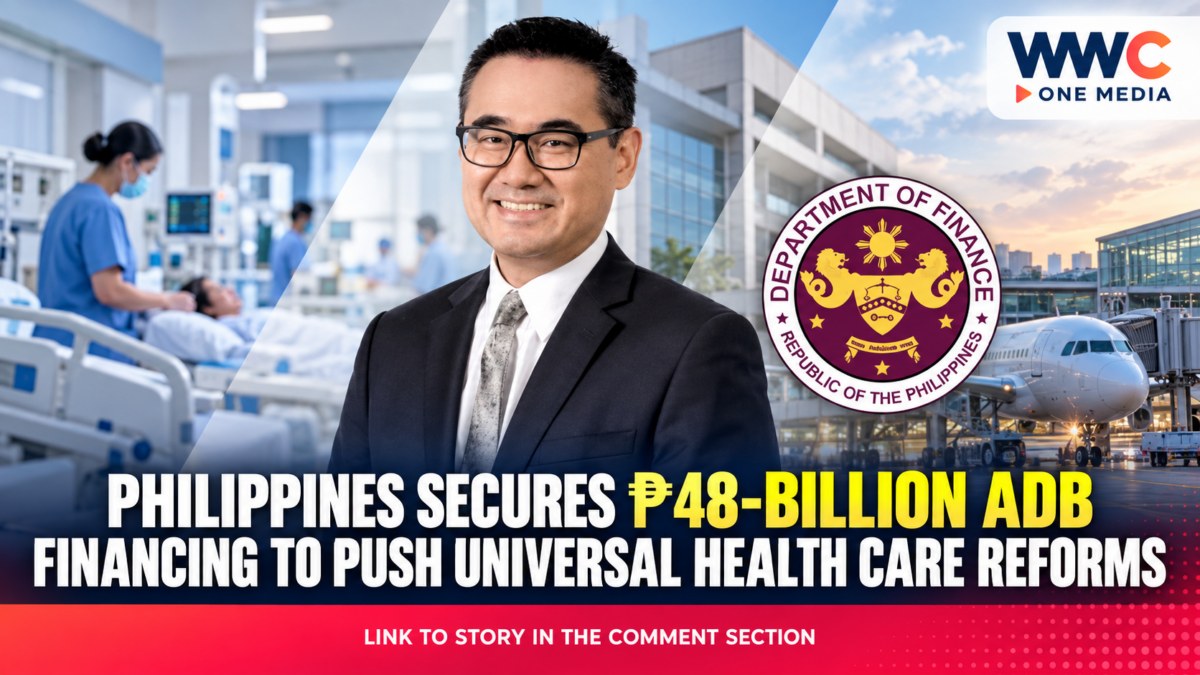
MANILA, Philippines — The Philippines has secured about ₱48 billion in new financing from the Asian Development Bank to accelerate Universal Health Care reforms, putting fresh money behind an ambitious effort to improve hospitals, primary care, PhilHealth financing and health-data systems while Filipino families continue to shoulder a large share of medical costs themselves.
Finance Secretary Frederick Go signed a financing agreement worth JPY119.745 billion, equivalent to roughly ₱48 billion, supporting the government’s Build Universal Health Care Program–Subprogram 3 or BUHC3.
The financing does not simply fund new hospitals or buy medical equipment.
Instead, it backs a wider overhaul of how Philippine health care is financed, purchased, delivered, monitored and held accountable—areas that remain critical seven years after the Universal Health Care Act became law.
₱48 BILLION TARGETS THREE BIG HEALTH SYSTEM PROBLEMS
The latest financing will support reforms across three major areas:
1. Sustainable health financing and strategic purchasing
The government wants health funds to be used more efficiently, including improving how PhilHealth and public institutions purchase medical services.
2. Integrated delivery of quality health services
The program seeks to connect primary care providers, hospitals, provincial health systems and other facilities so patients can move through the health system more effectively.
3. Better health information and accountability
Authorities are also targeting stronger information systems, better health-data management and clearer measurements of whether government health programs are actually producing results.
The reforms will also incorporate gender-specific health needs and climate-related health risks, an increasingly important issue as extreme heat, flooding and other climate events place additional pressure on hospitals and vulnerable communities.
THIS IS THE THIRD STAGE OF A MUCH BIGGER HEALTH REFORM PROGRAM
The new financing is not a standalone project.
BUHC3 is the final stage of a three-part ADB program designed to support implementation of the Universal Health Care Act of 2019.
The law aims to ensure Filipinos have equitable access to quality health care while reducing the financial burden of medical treatment.
ADB previously approved $450 million for Subprogram 2 in December 2023, focusing on sustainable financing, integrated health services and interoperable health-information systems.
Subprogram 1, meanwhile, supported reforms including the use of revenues from excise taxes on tobacco, alcohol and sugary drinks for health spending and mechanisms allowing local health funds to be pooled for more efficient purchasing of health services.
ADB RAISED THE LATEST LOAN TO $750 MILLION
There is another important part of the story.
ADB approved $750 million for BUHC3 on August 11, 2026, after increasing the proposed financing by $250 million.
The multilateral lender said the increase was made as higher oil prices and supply disruptions linked to conflict in the Middle East increased government financing pressures.
ADB President Masato Kanda said global conflict can affect households far beyond the battlefield through higher medicine, energy and other essential costs.
ADB’s project database also lists $187.9 million in cofinancing from the Japan International Cooperation Agency, alongside the $750-million ADB loan for the program.
That means the broader international financing package surrounding the reform program extends beyond the ₱48-billion ADB financing agreement highlighted in the latest Philippine announcement.
DOH AND PHILHEALTH WILL CARRY OUT THE REFORMS
The Department of Health and Philippine Health Insurance Corp. will be responsible for implementing the program.
Their task goes beyond expanding insurance coverage.
The reforms are intended to improve how national government agencies, PhilHealth, local governments and health-care providers work together—a persistent challenge because Philippine health services are divided among different government levels and institutions.
Finance Secretary Go described the financing as a long-term investment in both human capital and national resilience.
The government’s objective is to create a health system that is more responsive to patients while also becoming more financially sustainable and accountable.
WHY IT MATTERS: FILIPINOS STILL PAY A HUGE SHARE OF MEDICAL COSTS
The size of the financing becomes more significant when compared with what Filipino households continue to spend on health.
According to the Philippine Statistics Authority, total Philippine health expenditure reached ₱1.87 trillion in 2025, up 15.1% from ₱1.63 trillion in 2024.
Health expenditure was equivalent to 6.7% of gross domestic product.
But despite expanded public health programs, Filipino households still paid 41.2% of current health expenditures directly out of pocket.
Government and compulsory health-financing schemes accounted for 46.5%, while voluntary health schemes represented the remainder.
That means medical bills, medicines, diagnostic tests and other health expenses continue to consume significant amounts of household income.
And this is precisely one of the problems Universal Health Care was designed to address.
PHILHEALTH HAS BEEN EXPANDING PRIMARY CARE
There have already been signs of progress in primary health care.
PhilHealth said in May that its Yaman ng Kalusugan Program, or YAKAP, had reached approximately 33.2 million Filipinos through 4,287 accredited clinics nationwide.
YAKAP gives registered members access to primary-care consultations, selected laboratory and diagnostic services and medicines.
PhilHealth’s GAMOT benefit can also provide eligible members with up to ₱20,000 worth of essential outpatient medicines annually.
The strategy is significant because it aims to shift health care away from an overwhelmingly hospital-centered model.
Instead of waiting until patients become seriously ill and require expensive hospitalization, the system is trying to encourage earlier diagnosis, disease prevention and continuous primary care.
BETTER INFORMATION SYSTEMS COULD BE JUST AS IMPORTANT AS MORE MONEY
One of the less visible—but potentially transformative—parts of the ADB program involves health information.
The Philippines has long struggled with fragmented patient information spread across hospitals, clinics, local governments, PhilHealth and private providers.
ADB’s UHC program identifies interoperable health information and data systems as a necessary part of integrating care.
A patient visiting a barangay health center, provincial hospital and specialist facility should ideally move through a connected network where relevant medical information can follow them.
Better data could also allow government agencies to identify which treatments are working, where shortages exist and whether billions of pesos in health spending are actually improving patient outcomes.
LOCAL GOVERNMENTS REMAIN CRITICAL
Universal Health Care cannot succeed through Manila-based agencies alone.
Cities, provinces and municipalities operate large portions of the country’s public health system.
Yet recent discussions among local officials and health experts have continued to highlight problems involving financing, patient-data governance and translating national UHC policies into actual local services.
Earlier research cited by InsiderPH also found that although LGU health budgets had increased in several areas, weak coordination, overlapping requirements and dependence on national transfers could reduce the impact of that spending.
BUHC3’s emphasis on national and local implementation is intended partly to address those structural weaknesses.
THE REAL TEST ISN’T THE ₱48 BILLION — IT’S WHAT PATIENTS ACTUALLY EXPERIENCE
The new ADB financing represents a major injection of support into Philippine health reform.
But borrowing billions of pesos will not automatically translate into shorter hospital lines, cheaper medicines or lower medical bills.
The larger challenge is implementation.
For ordinary Filipinos, Universal Health Care ultimately succeeds only if a patient can visit a clinic earlier, find available doctors and medicines, obtain diagnostic tests without excessive delays, receive adequate PhilHealth coverage and leave the health system without devastating their family’s finances.
That is why the most important measure of this ₱48-billion program will not be how much money is released.
It will be whether Filipinos eventually have to reach into their own pockets less often when they become sick.
With households still paying 41.2% of current health expenses themselves, the Philippines has billions of reasons to make sure this latest round of health financing produces results ordinary patients can actually feel.