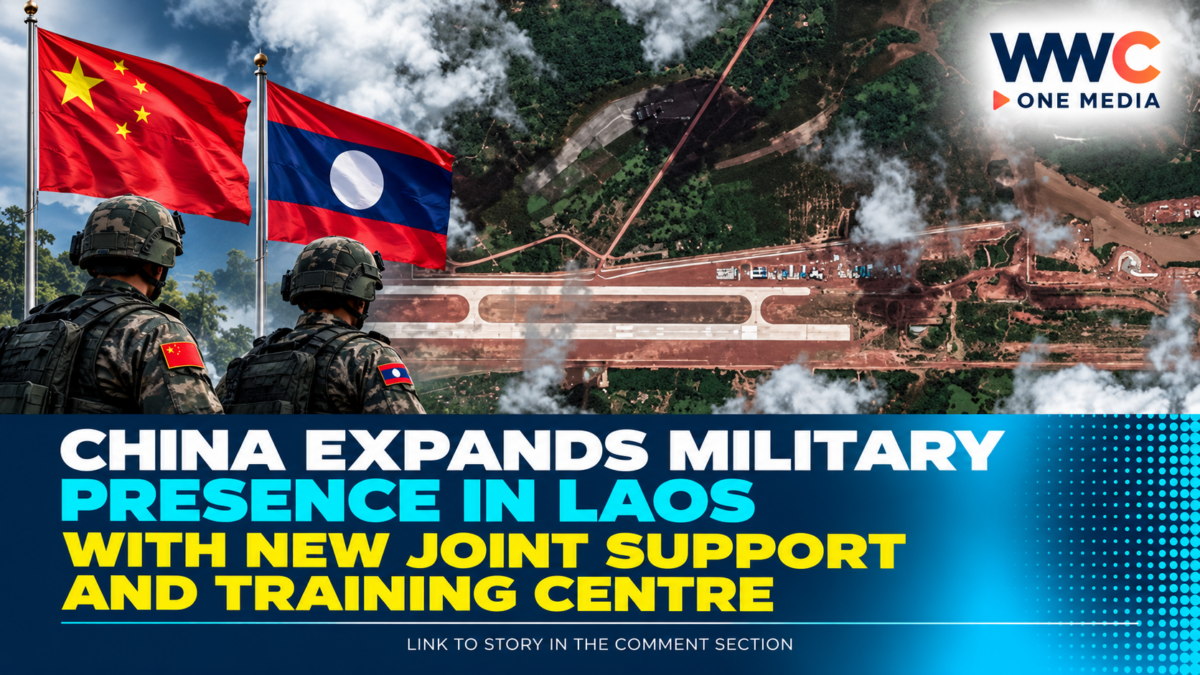
China has established a new military support and training facility in Laos, expanding Beijing’s defence presence in Southeast Asia and deepening its military relationship with the landlocked country.
The China-Laos Joint Support and Training Centre and the China-Laos Friendship Aviation Academy are now operational at an airport in Ban Keun, about 50 kilometers north of the Lao capital Vientiane, according to China’s Ministry of National Defence.
Commercial satellite imagery reviewed by Reuters shows that construction at the site began in late 2025 and transformed what had been largely agricultural land. The expanded facility includes a paved runway, parallel taxiway, aircraft apron and several new buildings.
China said the facility will be used to train air force pilots and described the centre as not being directed against any third country. However, security analysts said its joint support and training role could give China more persistent access to a logistics hub capable of supporting military personnel rotating through Laos.
The development has attracted particular attention because of its potential strategic significance. Singapore-based security scholar Collin Koh said the facility appears more similar to China’s logistics base in Djibouti than its joint facility at Cambodia’s Ream naval base, and suggested it could represent the first full-fledged overseas People’s Liberation Army base in Southeast Asia.
China already operates a joint support and training centre at Cambodia’s Ream naval base, which was formally inaugurated in April 2025. Cambodia has maintained that Chinese personnel and warships are not permanently stationed there.
For Laos, the new facility could also reduce the need for its military personnel to travel abroad for advanced training. The Lao air force operates a relatively small fleet that includes aircraft supplied by China and Russia, while the two countries have increased military cooperation and conducted joint exercises.
The development comes as China continues expanding its military footprint beyond its borders. Beijing operates a military logistics base in Djibouti and has developed military-grade facilities on several disputed features in the South China Sea. Analysts and military officials have also been monitoring additional construction activity elsewhere in the region.
Thailand, which shares a long border with Laos and maintains relationships with both China and the United States, said Laos has the sovereign right to decide whether to permit such a facility. Thai defence officials nevertheless said Bangkok would continue monitoring developments and their implications for regional trust.
The United States has also been watching China’s overseas military expansion, although Laos was not among the countries identified in a previous Pentagon assessment of locations where Beijing had plans for military facilities. Analysts noted that the immediate military advantage of operating from Laos is not entirely clear because China can already project power from its nearby Yunnan province.
For now, the Ban Keun facility is officially presented as a joint training and support centre. Its longer-term significance will depend on what personnel, equipment and operational access China and Laos ultimately maintain there, details that have not been publicly disclosed.