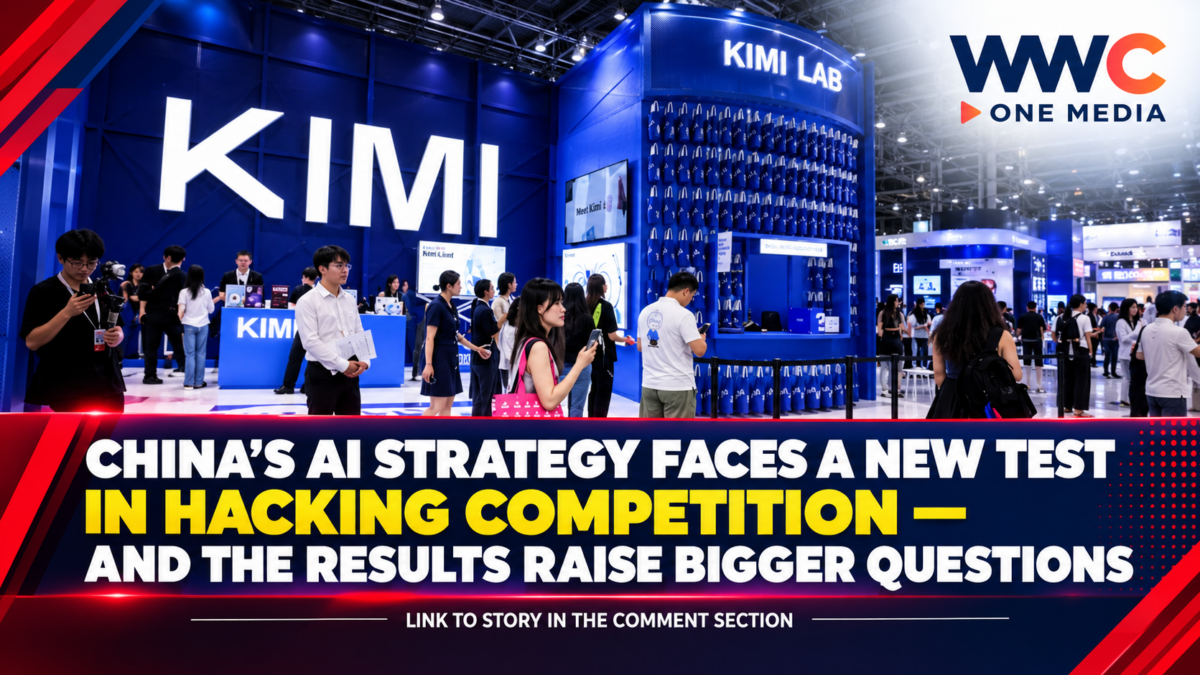
China’s rapidly evolving artificial intelligence strategy is gaining attention beyond chatbots and consumer applications, with cybersecurity emerging as another arena where the country’s approach to AI is being put to the test.
A recent report by The Straits Times examined a hacking competition and related developments that highlight how Chinese researchers and developers are experimenting with AI for cybersecurity, while also raising questions about the advantages and risks of more open AI models.
At the heart of the debate is China’s growing reliance on open-weight AI models. Unlike closed systems that are primarily accessed through their developers’ servers, open-weight models can be downloaded, modified and operated independently.
That distinction has become increasingly significant in cybersecurity.
Researchers have pointed to cases where open-weight Chinese AI models have been useful for examining malicious code and investigating cyber incidents. The Straits Times reported that Hugging Face used China’s GLM-5.2 model to help analyse a July intrusion after restrictions on some closed AI models made them less useful for the forensic investigation.
The development comes as AI is becoming increasingly intertwined with cyber operations. Researchers at Taiwanese cybersecurity firm TeamT5 have reported that Chinese state-affiliated hacking groups have incorporated DeepSeek and other open-source AI models into their activities, using AI to automate tasks and assist with the development of malicious software.
The broader significance goes beyond any single hacking contest.
China has increasingly promoted open-weight and open-source AI as part of a strategy that could allow countries to run powerful models locally, retain greater control over their data and reduce dependence on foreign technology providers. Chinese models have also gained traction because they can be significantly cheaper than some leading proprietary systems.
That approach is creating a different kind of competition with the United States.
The US remains home to several leading frontier AI developers, while China has built momentum around models that can be downloaded, modified and deployed more independently. The contrasting approaches are increasingly connected to questions about cybersecurity, technology standards and digital sovereignty.
There are also significant concerns.
Open-weight systems can provide researchers with greater visibility and flexibility, but the same characteristics can make them easier to modify and redistribute. Security researchers have therefore warned that greater openness can create additional challenges when powerful AI systems are used for malicious purposes.
The result is a complicated picture: China’s AI strategy is not simply about building increasingly capable models. It is also about how those models are distributed, who can control them and how they can be incorporated into real-world technologies.
As AI becomes more deeply embedded in cybersecurity, the competition may ultimately be measured not only by which country produces the most powerful model, but by which approach proves most adaptable across the global technology landscape.
And that is where the hacking competition becomes particularly significant: it offers a glimpse of how AI could change the balance between cyber defenders and attackers — while leaving the larger question of who sets the rules for that technology still unresolved.
WWC ONE MEDIA G,A