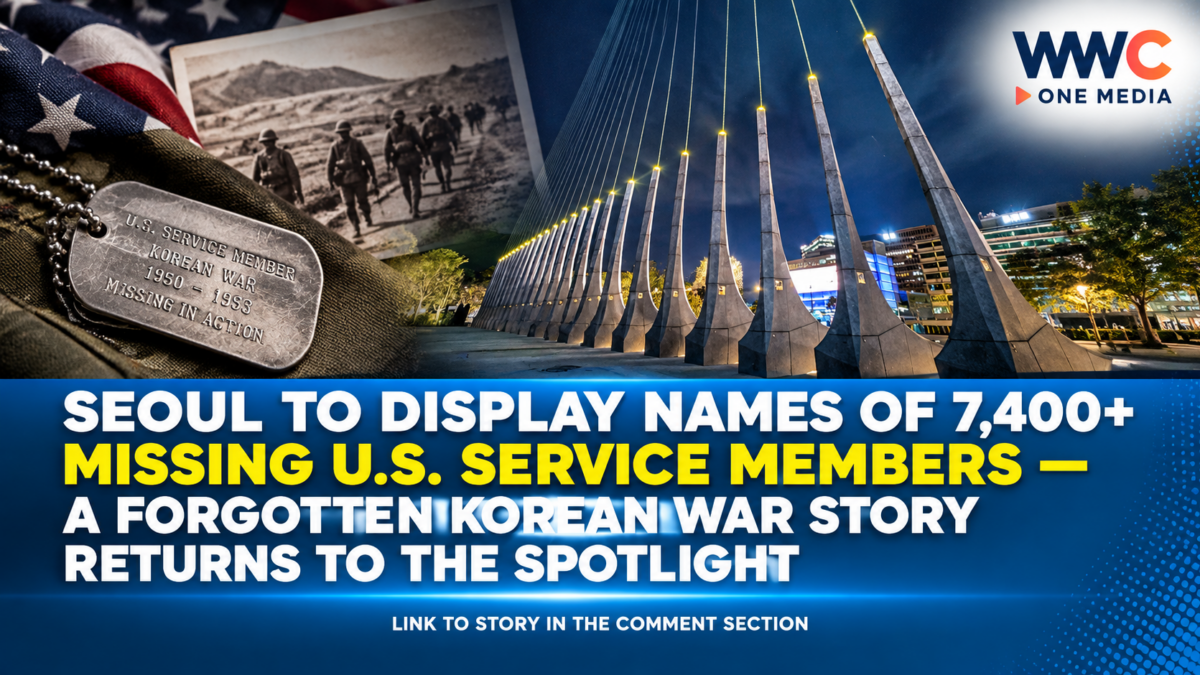
Seoul is putting the names of more than 7,400 U.S. service members still missing from the Korean War on public display this October, creating a new moment of remembrance at one of the capital’s major memorial spaces.
The video tribute will run throughout October at the Garden of Gratitude in Gwanghwamun Square, where a media wall inside the underground Freedom Hall will display the names of U.S. service members who remain unaccounted for from the 1950–53 conflict.
The display is being presented in connection with Armed Forces Day on Oct. 1 and United Nations Day on Oct. 24.
More Than 7,400 Names Will Appear
The names were provided by a support organization for families of missing U.S. troops, using lists received from the U.S. Defense POW/MIA Accounting Agency (DPAA).
The new display complements another memorial inside Freedom Hall that continues to show the names of service members who were killed during the Korean War.
Rather than presenting the Korean War only through monuments and historical dates, the October exhibition puts individual names at the center of the remembrance.
Garden of Gratitude Becomes a Major Seoul Memorial Space
The Garden of Gratitude was created at Gwanghwamun Square to commemorate the countries and personnel connected to the Korean War and to provide a public space where visitors can encounter the history of the conflict.
The site includes the outdoor “Light of Gratitude 23” installation and the underground Freedom Hall. Seoul’s government says the 23 structures represent South Korea and the 22 nations that participated in the Korean War.
The memorial has already attracted significant public attention. More than 100,000 people visited in August, while the outdoor light installation and Freedom Hall recorded an average of 4,393 visitors per day from Sept. 1 to 27, according to the Seoul Metropolitan Government.
Autumn Events Add Another Layer to the Memorial
The remembrance program will coincide with a wider series of autumn activities around Gwanghwamun Square.
The Garden of Gratitude’s lights were illuminated in yellow on Sept. 28 to mark the anniversary of Seoul’s recapture in 1950. The installation is scheduled to shine blue on United Nations Day, Oct. 24, followed by another special lighting event on Nov. 11, the International Day of Remembrance for U.N. Korean War veterans.
Other activities include an autumn market, a stamp tour, free Korean calligraphy programs and guided historical tours.
On Oct. 9, Hangeul Day, visitors can join a guided route connecting the King Sejong statue with the Garden of Gratitude, covering aspects of both Joseon-era history and the Korean War.
A List of Names With a Story Behind Every One
The October display is ultimately about more than a number.
Behind the figure of 7,400-plus missing U.S. service members are individual identities that remain part of the Korean War’s unresolved legacy.
By placing those names on a public media wall in central Seoul, the city is bringing that history into an everyday civic space — where residents and visitors can encounter it alongside the city’s cultural and autumn programs.
As Seoul continues developing the Garden of Gratitude, the October tribute adds another chapter to the site’s mission of connecting remembrance, history and public life.
And when thousands of names begin appearing across the screen in October, the scale of what remains unaccounted for from the Korean War will be impossible to overlook.
WWC ONE MEDIA G,A