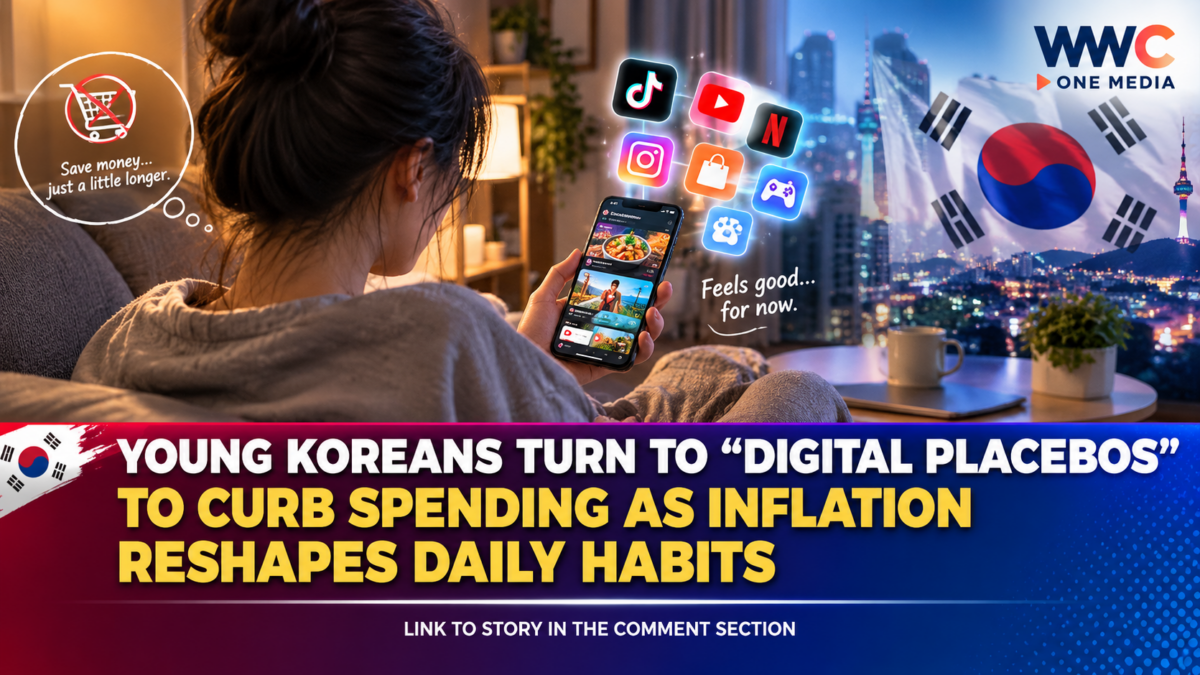
SEOUL — What if you could order your favorite meal, watch the delivery tracker move toward your home — and never actually receive the food or spend a single won?
That is the idea behind a growing trend among young South Koreans turning to “digital placebos”: apps and websites that recreate the emotional experience of spending or consuming without the real-world cost.
One example, FoodNeverArrives, lets users browse menus, place simulated orders and track a fictional delivery. Instead of food, users receive a virtual receipt showing the money and calories they have saved. The app has surpassed 10,000 downloads since launching on Google Play in July.
The satisfaction of ordering — without the bill
The concept emerged from a simple question: Do people always want the product itself, or sometimes the anticipation and ritual surrounding it?
FoodNeverArrives developer Park Seo-hyun, 22, said she was inspired by her own habit of browsing delivery menus and sometimes losing interest once the food arrived. The app was designed to let users experience the ordering process while allowing the impulse to pass without an actual purchase.
For budget-conscious consumers, the appeal is straightforward: the simulation can provide a sense of satisfaction while avoiding delivery charges and the cost of the meal.
The trend comes as young adults contend with rising living costs and increasingly conscious spending habits.
From virtual food orders to virtual breaks
The phenomenon has expanded beyond food.
Maeumjaro, for example, simulates the experience of receiving a weight-loss injection without delivering any medication. Users interact with an on-screen simulation rather than an actual medical treatment.
Another platform, Online Damta, recreates the social ritual of a workplace cigarette break digitally. Users can watch a virtual cigarette burn while interacting with anonymous messages from other users.
The appeal for some users is less about the physical activity and more about reproducing a familiar pause from everyday stress.
Experts call it a new form of self-management
Sociology professor Koo Jeong-woo of Sungkyunkwan University says these digital experiences differ from traditional placebos because users know the simulations are fake.
Instead, users deliberately employ them as self-management tools, combining familiar digital experiences with an attempt to control their behavior.
Consumer science professor emeritus Lee Eun-hee of Inha University similarly described the simulations as a mechanism that can help people resist consumption impulses by reproducing some of the experience of buying or consuming something.
But can a digital substitute really work long term?
Experts caution that the trend should not be mistaken for a proven long-term solution.
Kang Jae-heon, a family medicine professor at Kangbuk Samsung Hospital, said such simulations may help reduce urges to smoke or overeat to some extent, but their effects are unlikely to be substantial over the long term because they do not provide the same physical or psychological satisfaction as the real behavior.
That limitation may be central to understanding the trend.
For young consumers facing pressure to spend less, digital placebos offer something unusual: the ritual without the purchase, the anticipation without the bill and the break without the real-world behavior.
As these virtual experiences spread, South Korea’s latest digital trend may reveal just how much of modern consumption is driven not only by what people buy, but by the feeling of buying it.
WWC ONE MEDIA G,A