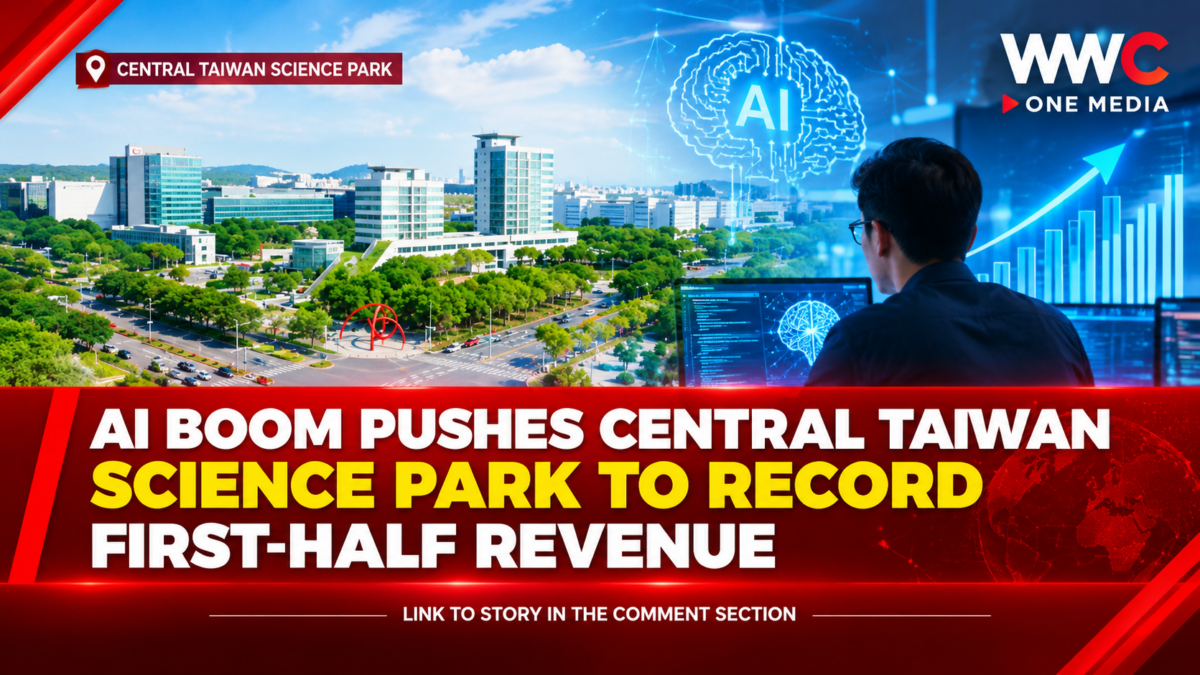
Taiwan’s artificial intelligence boom is delivering another major economic milestone, with Central Taiwan Science Park posting record first-half revenue as demand for advanced chips and high-performance computing continues to accelerate.
Revenue at the science park climbed 20.63% year on year to NT$643.63 billion (US$20.21 billion) in the first half of 2026, according to the park administration. Exports also reached a first-half record of NT$476.17 billion, surging 64.62% from the same period a year earlier.
The growth is also translating into jobs. Employment at the park reached a record 63,111 workers, an increase of 3,836, or 6.47%, compared with a year earlier.
AI CHIPS LEAD THE SURGE
The integrated-circuit sector was the biggest growth driver, with revenue increasing 25.69% as the AI boom fueled demand for high-performance computing chips and memory.
A shortage of advanced packaging capacity also provided additional support for the sector, according to Taiwan News’ reporting citing United Daily News.
Other industries also posted significant gains. Precision machinery revenue rose 22.56%, helped by semiconductor companies expanding advanced-process facilities and increasing demand for production equipment and precision components.
Biotechnology revenue increased 17.26%, supported by expanding international distribution networks and stronger global market share for a key drug.
But the expansion was not uniform across every sector.
Optoelectronics revenue dropped 10.72% as demand for large LCD panels weakened, while computers and peripherals revenue declined 18.28% amid a generational transition in fingerprint-recognition modules and softer customer demand.
EXPANSION CONTINUES AS DEMAND GROWS
The science park administration is also expanding infrastructure to accommodate businesses and workers.
New standard factory buildings at Erlin Science Park have been completed and are being prepared for leasing, while construction of the second phase of employee dormitories at Taichung Science Park began in August. The National Experimental High School at Central Taiwan Science Park also added seven elementary classes this year after opening a new building last year.
The strong first-half numbers, however, come with challenges.
Park officials warned that global tariffs, Middle East tensions and supply-chain uncertainty could weigh on industries during the second half of the year. At the same time, continued demand for high-performance computing chips and memory, alongside the expansion of advanced semiconductor facilities, is expected to support several key sectors.
For now, the figures show how deeply Taiwan’s industrial growth is being tied to the global AI boom — with semiconductor demand driving record activity across one of the island’s major technology hubs.
But with geopolitical and supply-chain risks still looming, the next phase of Taiwan’s AI-fueled growth could be just as important as the record it has already achieved.
WWC ONE MEDIA G,A