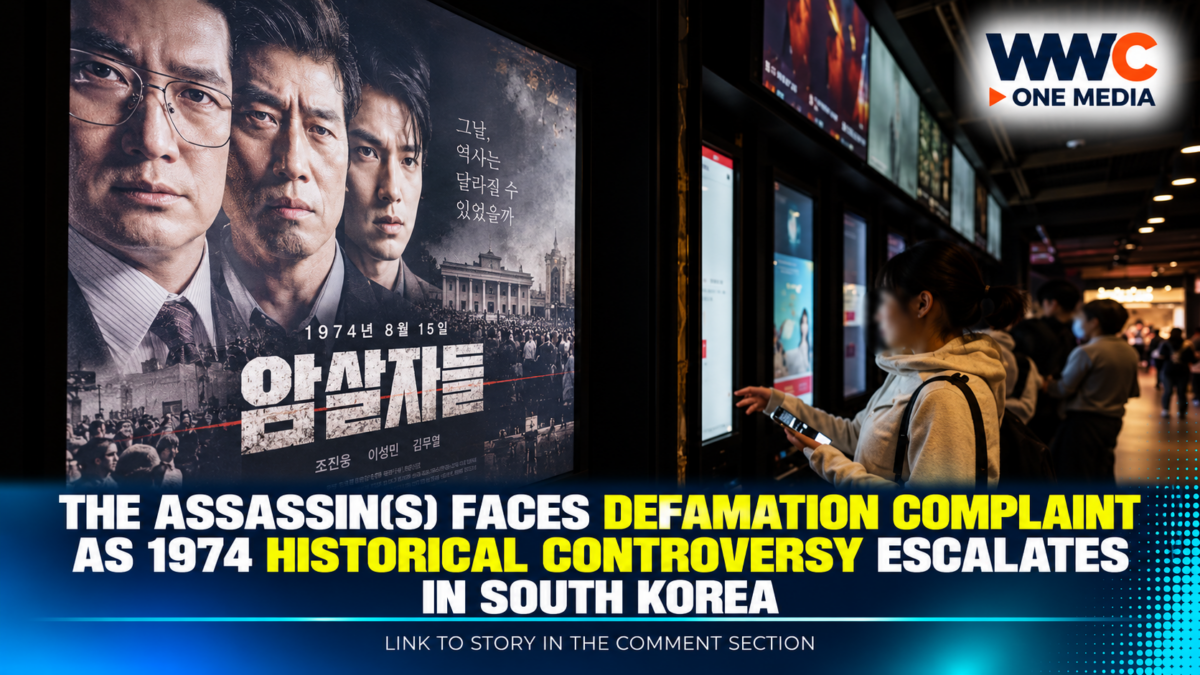
SEOUL — South Korea’s box-office hit “The Assassin(s)” is facing a legal challenge after a former city councilor filed a police complaint against director Hur Jin-ho and the film’s production team, accusing them of defamation over the movie’s portrayal of the 1974 shooting that killed then-first lady Yuk Young-soo.
The complaint, filed Tuesday, alleges that the film presents or suggests a fictional scenario in which then-President Park Chung-hee or government and intelligence officials could have been involved in the attack.
The filmmakers have rejected that interpretation, saying the movie does not identify any particular individual as the mastermind or present its dramatic hypotheses as established historical facts.
Film Turns Historical Event Into Legal and Political Dispute
“The Assassin(s),” directed by Hur Jin-ho and released Sept. 23, takes inspiration from the Aug. 15, 1974 shooting at Seoul’s National Theater.
During the incident, Moon Se-gwang, a Japan-based Korean, opened fire during a ceremony targeting then-President Park Chung-hee. Yuk Young-soo was fatally shot. The movie uses the historical event as the foundation for a fictional investigation involving detectives and journalists.
The controversy centers on scenes that raise the possibility of involvement by people inside the government or intelligence establishment.
Critics argue that these elements could lead some viewers to interpret a fictional hypothesis as a claim about what actually happened. The production team, however, says it researched publicly available records and combined them with cinematic imagination rather than attempting to establish a new historical conclusion.
Production Team Defends Creative Approach
In a statement issued Monday, the filmmakers said the movie was reconstructed from various records related to the 1974 incident, with fictional elements added for dramatic purposes.
The production team said the film does not designate a specific person as being behind the shooting and does not present its fictional hypotheses as historical fact. It also denied that the film was created for a specific political purpose.
The dispute has nevertheless intensified, with the Park Chung-hee Presidential Memorial Foundation calling for an apology from the production company and a halt to screenings. The foundation has argued that parts of the film conflict with official investigation and trial records concerning the 1974 incident.
Political Debate Moves Beyond the Movie
The controversy has also entered South Korea’s political arena, with lawmakers from opposing parties taking different positions on whether the film should be regarded primarily as historical fiction or criticized for its treatment of a real tragedy.
Some opposition figures have called for greater scrutiny of the movie, while members of the ruling Democratic Party have defended the principle of artistic freedom and argued that audiences should make their own judgments about the work.
The dispute is expected to receive further attention during an upcoming National Assembly audit, where lawmakers have discussed calling director Hur to testify.
Box Office Success Adds to the Spotlight
Despite the controversy, “The Assassin(s)” has attracted a large audience.
The film reportedly drew about 1.4 million viewers during the four-day Chuseok holiday, while Korean Film Council data put cumulative admissions above 1.56 million through Sept. 27.
That success has placed even greater attention on the debate over where historical drama ends and fictional interpretation begins.
At the center of the dispute is a broader question: When a film reconstructs a real historical tragedy with fictional elements, how should audiences distinguish cinematic speculation from established history?
For “The Assassin(s),” that question is no longer confined to movie theaters — it has now moved into South Korea’s legal and political arena.
WWC ONE MEDIA G,A