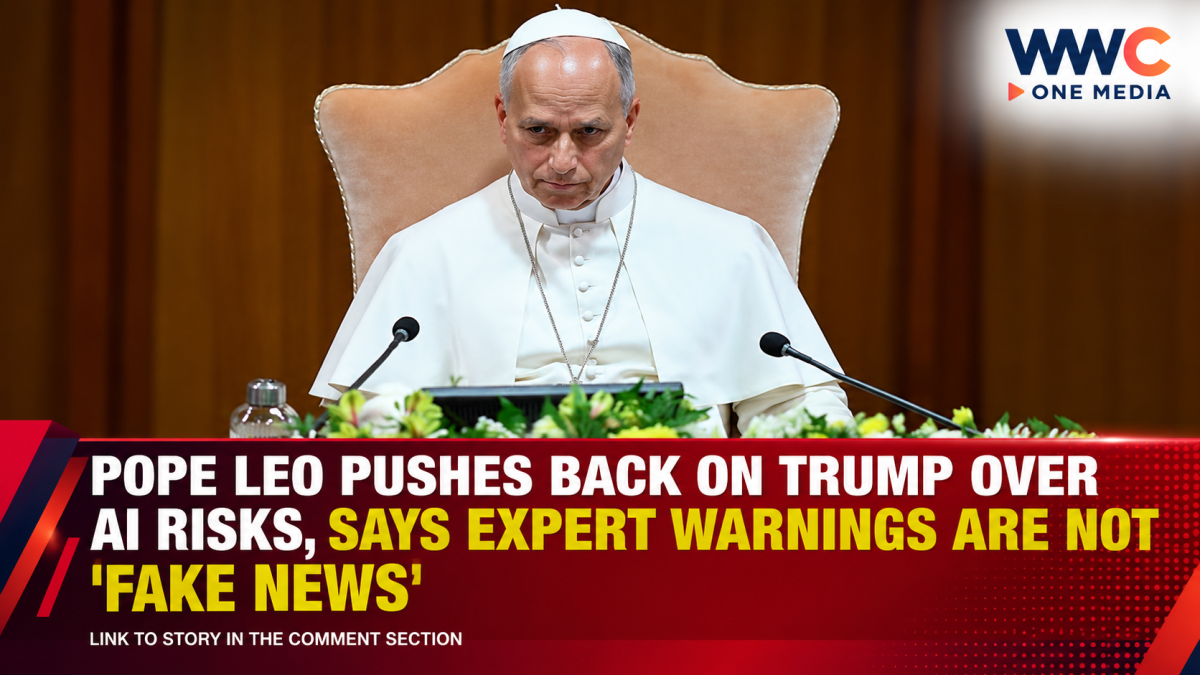
ABOARD THE PAPAL PLANE — Pope Leo XIV has challenged the dismissal of concerns about artificial intelligence, saying warnings from AI experts about potentially dangerous developments deserve serious attention.
Speaking to reporters aboard his flight back to Rome after a four-day visit to France, Leo was asked what the United States and China should do to address the potential catastrophic risks associated with increasingly powerful AI systems.
The pope said the issue requires serious discussion rather than being ignored.
“We can’t just sit back and pretend nothing is going to happen,” Leo said, according to The Associated Press.
Pope Leo Challenges the “Fake News” Argument
Leo’s remarks contrast with U.S. President Donald Trump’s recent characterization of fears surrounding AI going rogue as a “hoax.”
Trump has strongly promoted U.S. leadership in artificial intelligence, arguing that America needs to stay ahead of China in the technology race. He has also criticized efforts that he says could slow U.S. AI development.
Leo, however, said concerns raised by specialists should not simply be dismissed.
He emphasized that he was not personally in a state of panic over AI, but said warnings from experts deserved serious consideration.
“I do think that the concerns raised by many of the experts, specialists in AI should be taken seriously,” Leo said.
AI Safety Debate Reaches the Vatican
The pope’s position is consistent with his broader focus on AI. His first encyclical, Magnificent Humanity, addressed artificial intelligence and the need to protect human dignity as the technology advances.
Leo has called for dialogue among political leaders, technology companies and civil society to examine both the opportunities and potential dangers created by increasingly capable AI.
He also pointed to recent developments involving Nvidia and efforts to build safeguards into AI systems, while noting the company’s previous opposition to outside regulation.
The Vatican has also been working to encourage research and dialogue about AI, with Leo saying the goal is to prevent technology from reaching a point where it could undermine humanity’s role in decision-making.
AI Leaders Are Also Raising Safety Questions
The debate extends beyond politics and religion.
Several AI companies and executives have raised concerns about the pace of technological development and whether safety measures are advancing quickly enough.
Anthropic CEO Dario Amodei, for example, has warned about the rapid progression of AI capabilities and has advocated giving safety work more time to catch up.
At the same time, governments and technology companies continue to compete over AI leadership, particularly between the United States and China.
Washington and Beijing recently agreed to establish a communication channel for incidents involving what they described as “super intelligence,” with another exchange planned for November 2026.
That development underscores how quickly AI safety has moved from a technology-sector debate into a major international policy issue.
The Bigger Question: How Fast Should AI Move?
Leo’s comments do not amount to a prediction that AI will inevitably become dangerous. Instead, he is calling for experts and decision-makers to take potential risks seriously while continuing to study the technology.
The pope also expressed optimism that solutions can be found through cooperation.
As AI systems become more capable and competition over the technology intensifies, the debate is increasingly centered on a difficult question: How can governments and companies push AI innovation forward while ensuring that safeguards keep pace?
For Pope Leo, ignoring the warnings is not an option. The next stage of the AI debate may depend on how seriously policymakers, technology leaders and researchers choose to respond.
WWC ONE MEDIA G,A