Why Taiwan Independence Is Back in the Spotlight
TAIPEI — The debate over Taiwan’s political status has again moved to the center of international attention after Chinese President Xi Jinping urged US President Donald Trump to oppose “Taiwan independence” during their Sept. 24 meeting.
Beijing says Taiwan is part of China and that reunification is a national objective. Taiwan’s government maintains that the Republic of China (Taiwan) is a sovereign, self-governing state and that the People’s Republic of China has no authority over Taiwan.
The disagreement creates a situation that can be difficult to describe with a simple “independent” or “not independent” label.
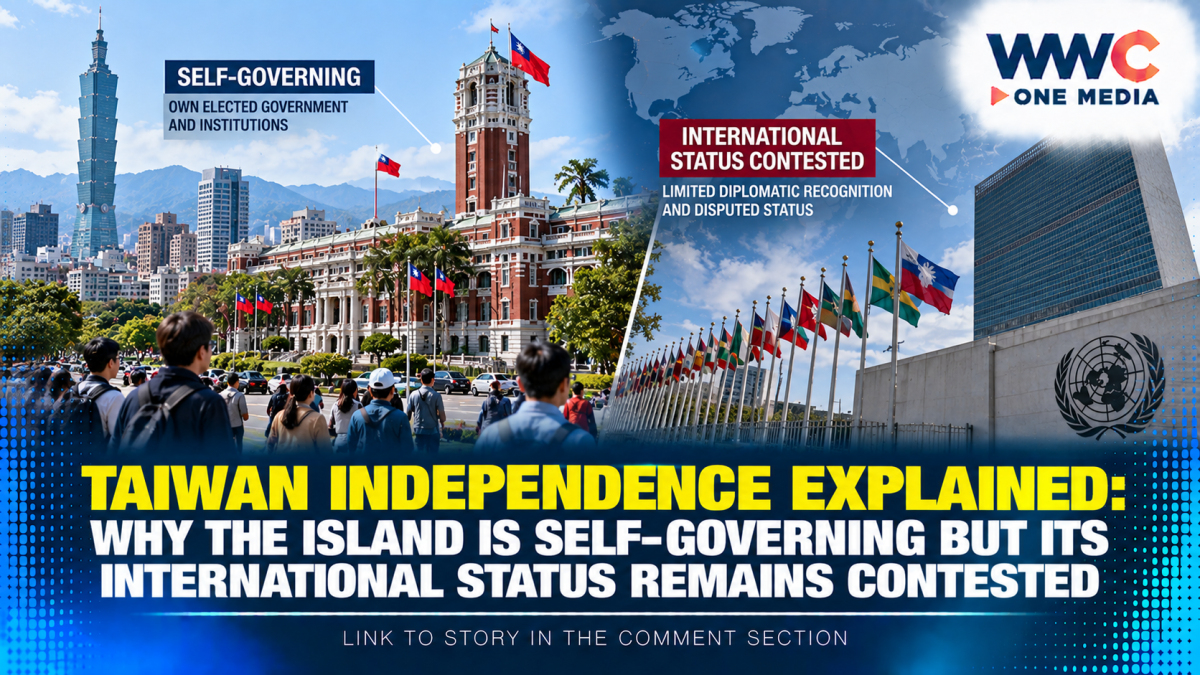
Taiwan functions as a self-governing political system, but its formal diplomatic status is constrained by the fact that most countries do not maintain official diplomatic relations with Taipei.
What Is Taiwan’s Official Name?
Taiwan’s formal constitutional name is the Republic of China (ROC).
The name dates to the government that controlled China before the Chinese Communist Party established the People’s Republic of China (PRC) in 1949.
After losing the Chinese Civil War, the ROC government relocated to Taiwan. The PRC was established on the mainland and subsequently claimed sovereignty over Taiwan.
Taiwan continued to use the name Republic of China, while the People’s Republic of China claimed to be the sole legitimate government representing China, including Taiwan.
Is Taiwan Independent in Practice?
In practical terms, Taiwan operates with many of the institutions normally associated with an independent state.
It has:
- An elected government
- Its own military
- Its own currency
- Its own passport
- Its own courts and legal system
- Control over the territory it administers
- Regular democratic elections
Taiwan’s government therefore describes the Republic of China as sovereign and independent.
Reuters has described the situation as de facto independence, while noting that Taiwan does not have formal diplomatic recognition from most countries.
That distinction — between how Taiwan functions internally and how it is treated diplomatically — is central to understanding the issue.
Why Doesn’t Taiwan Simply Declare a New Country?
A formal declaration creating a new state called the “Republic of Taiwan” would involve major constitutional and political questions.
Under Taiwan’s current constitutional framework, changing the country’s official constitutional structure would not simply be a decision made by the president.
Reuters reported that a constitutional amendment would require approval by a supermajority of legislators followed by a referendum meeting specified thresholds.
Taiwan has not undertaken such a process.
The debate therefore often distinguishes between Taiwan’s existing self-government under the Republic of China framework and a hypothetical future move to formally establish a new constitutional state.
What Does China Say?
Beijing’s position is unequivocal: Taiwan is part of China, and the People’s Republic of China is the sole legal government representing China.
Chinese officials reject the concept of Taiwan independence and describe reunification as a national objective.
China also has a domestic legal framework addressing the issue. Its 2005 Anti-Secession Law provides a legal basis for using “non-peaceful means” under circumstances specified by the law if Taiwan were to secede or if possibilities for peaceful reunification were deemed exhausted.
Beijing’s position is therefore fundamentally different from Taipei’s claim that the two governments are not subordinate to one another.
What Does Taiwan Say?
Taiwan’s government maintains that the Republic of China (Taiwan) is sovereign and independent and that the People’s Republic of China does not govern Taiwan.
Taiwan’s Ministry of Foreign Affairs has described this as the existing cross-Strait status quo and rejects Beijing’s claim that Taiwan’s international participation requires approval from the PRC.
Taipei has also emphasized maintaining the existing status quo across the Taiwan Strait rather than pursuing a constitutional change to create a new state.
Where Does the United States Stand?
The United States has maintained a deliberately complex position for decades.
Washington recognizes the People’s Republic of China as the government of China while maintaining unofficial relations with Taiwan.
US policy is shaped by the Taiwan Relations Act, longstanding policy statements and what is commonly described as strategic ambiguity.
The latest debate has attracted particular attention because Xi’s Sept. 24 request that Washington “oppose” Taiwan independence uses wording that goes beyond simply describing the existing US position, according to The Straits Times and analysis cited in its report.
Why Is Taiwan’s UN Status Different?
Another important part of the puzzle is Taiwan’s position in international organizations.
In 1971, the United Nations recognized the People’s Republic of China as the representative of China, replacing the Republic of China government in Taipei.
Since then, Taiwan has had limited formal diplomatic recognition compared with most sovereign states, although it maintains extensive unofficial economic, cultural and political relationships around the world.
This creates another distinction:
Taiwan’s ability to govern itself is not the same question as its level of formal diplomatic recognition.
Why the Words Matter
Terms such as “Taiwan independence,” “One China,” “reunification,” “sovereignty” and “status quo” can mean different things depending on who is using them.
For Beijing, “Taiwan independence” refers to efforts to separate Taiwan from China.
For Taiwan’s government, the existing Republic of China political system is already sovereign and self-governing.
For Washington and other governments, diplomatic policies toward Taiwan often deliberately avoid resolving every question about Taiwan’s ultimate international status.
That is why seemingly small changes in diplomatic language can attract considerable attention.
So, Is Taiwan Already Independent?
The answer depends on what is meant by “independent.”
In practical governance: Taiwan operates independently of the People’s Republic of China, with its own elected authorities, military, legal system, currency and passport.
Under its current constitutional framework: Taiwan officially operates as the Republic of China rather than under a state formally named the “Republic of Taiwan.”
Internationally: Taiwan has extensive unofficial relations but lacks formal diplomatic recognition from most countries.
From Beijing’s perspective: Taiwan is part of China and not an independent state.
From Taipei’s perspective: the Republic of China (Taiwan) is a sovereign state and the PRC has no authority over it.
Those competing positions have existed for decades, leaving Taiwan in a distinctive position: self-governing in practice while its sovereignty and international status remain deeply contested.
The latest Xi-Trump discussion shows why the question remains internationally significant — and why the terminology surrounding Taiwan continues to matter far beyond the island itself.
WWC ONE MEDIA G,A