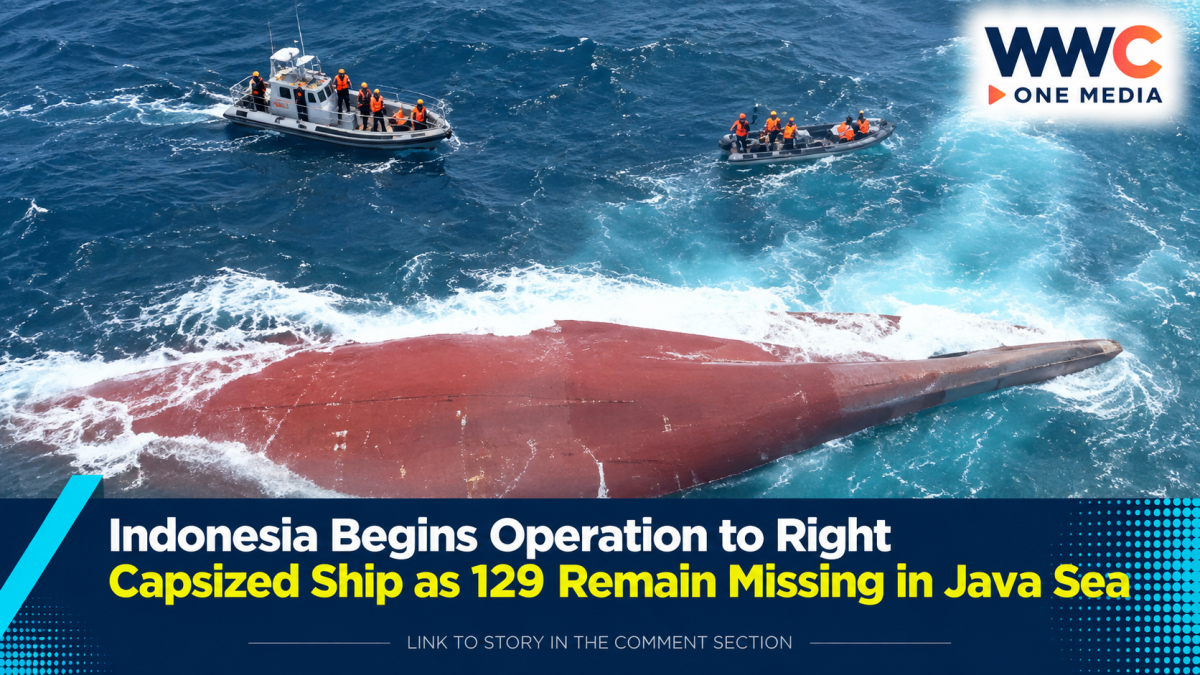
JAKARTA — Indonesian authorities have begun a complex operation to right the Virgo Transport 8, the passenger ship that capsized in the Java Sea, in an effort to gain access to the wreck and continue the search for 129 people still missing.
The ferry was carrying 243 people when it overturned early Sept. 13 while traveling from Surabaya in East Java to Banjarmasin in South Kalimantan. So far, 108 people have been rescued and six deaths confirmed, with the number of missing unchanged in the latest official figures.
The operation comes after days of difficult weather and dangerous underwater conditions prevented divers from reaching much of the vessel.
Rescue Operation Enters a Critical New Phase
The Virgo Transport 8 initially remained partially afloat after the accident but has since completely sunk to the seabed.
Authorities are now working to turn the vessel upright, with the operation expected to create safer and more practical access for divers and rescuers searching the wreck.
Indonesia’s national rescue agency, Navy, maritime police and other agencies are involved, while the vessel’s owner is responsible under Indonesian law for the salvage operation.
Officials have said that righting the ship could normally take around 24 hours, although complications could make the process longer.
Why Divers Have Struggled to Reach the Wreck
The search has been severely hampered by conditions beneath the Java Sea.
Officials said currents near the wreck had reached almost 7 knots, considerably higher than the roughly 1.5-knot threshold considered suitable for diving operations.
That forced Navy diving teams to withdraw after attempting to reach the vessel.
Strong currents were not the only obstacle.
Rescuers have also faced high waves, poor underwater visibility, water pressure and the physical design of the overturned hull.
Reuters reported that around 60 divers from Indonesia’s Navy and national rescue agency had been unable to reach the submerged wreck during earlier attempts.
More Than 1,000 Personnel Involved
The rescue operation has expanded significantly since the accident.
The latest Reuters reporting says approximately 1,100 personnel are involved, supported by 17 ships and five helicopters and other aircraft.
Surface and aerial searches have continued while authorities prepare for more extensive underwater operations.
Earlier in the operation, Indonesia also deployed specialized underwater equipment, including Navy capabilities designed to help locate people and map conditions around the wreck.
Families Wait for News
For families of the 129 missing passengers and crew, the prolonged search has brought increasing anxiety as each day passes without a confirmed breakthrough.
CNA reported that relatives had gathered at the rescue command center in Banjarmasin while authorities struggled to launch underwater operations because of rough seas and strong winds.
The authorities have continued to treat the operation as a search-and-rescue mission, while the possibility of finding additional survivors remains part of the effort.
What Happened to the Ferry?
The Virgo Transport 8 was making a roughly 20-hour voyage from Surabaya to Banjarmasin when it encountered bad weather early Sept. 13.
The ship lost contact with its operator after departing Surabaya and later capsized in the Masalembo area of the Java Sea, roughly 150 kilometers from Banjarmasin.
The vessel is approximately 119 meters long, was built in Japan in 1987 and was carrying 89 vehicles in addition to passengers and crew, according to its manifest.
Authorities have not yet established the cause of the accident.
Some survivors described the ship listing suddenly in rough seas, while one survivor told AP that the vessel appeared crowded. Those accounts are being reported as witness statements and do not establish the official cause of the capsize.
Investigators Will Examine the Wreck
The salvage operation is not only about locating missing people.
Once the search and evacuation phase is completed, authorities intend to tow the vessel away for further investigation into what caused it to overturn.
Indonesia’s National Transportation Safety Committee is involved in the investigation, and Navy divers have already recovered or documented material that may assist investigators.
That means the wreck itself could eventually become an important source of evidence about the accident.
A Race Against Dangerous Conditions
The operation is now balancing two urgent priorities: reaching the wreck and protecting rescuers working in hazardous underwater conditions.
Righting a large passenger ship on the seabed is a technically difficult operation, particularly when strong currents and waves continue to affect the area.
Authorities therefore face the challenge of improving access to the vessel without putting divers and other rescue personnel at unnecessary risk.
For the families waiting in Banjarmasin, however, the operation represents a crucial new stage in the search.
The latest figures remain unchanged—108 rescued, six confirmed dead and 129 still missing—but Indonesian authorities are now attempting to reach the wreck itself after days of weather-related delays.
The next major development could come when rescuers finally gain full access to the submerged ferry.