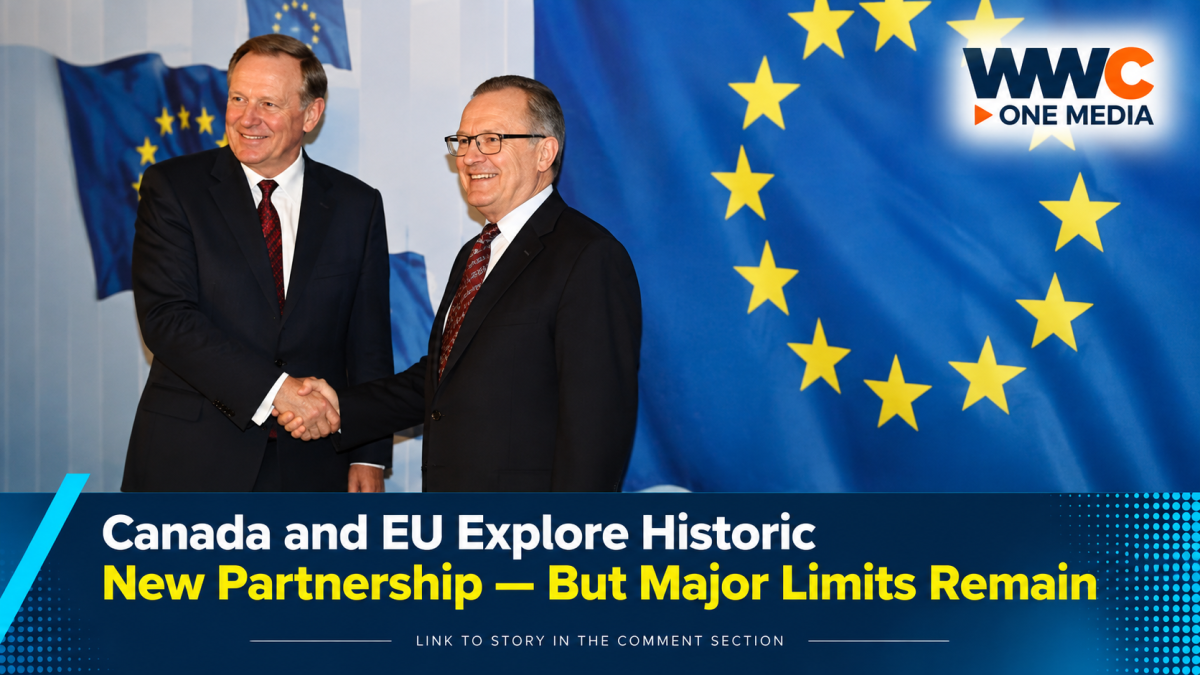
BRUSSELS/OTTAWA — Canada and the European Union are moving toward an unusually close partnership, but the ambitious proposal unveiled this week still faces significant limits before it could become a concrete political or economic framework.
European Commission President Ursula von der Leyen proposed that Canada become the European Union’s first “associate member,” an arrangement that does not currently exist as a defined EU status. The proposal came as Canadian Prime Minister Mark Carney seeks deeper economic and security ties with Europe while Ottawa works to diversify its relationships amid strained Canada-U.S. trade relations.
Carney welcomed the proposal during his address to the European Parliament on September 17, saying Canada is prepared to pursue a substantially deeper partnership with Europe. But he also made clear that Canada is not seeking full EU membership or a transfer of Canadian sovereignty.
A Historic Offer — But What Does “Associate Member” Mean?
The phrase has generated headlines because it would represent a new form of EU relationship.
Von der Leyen said the EU wants to take its relationship with Canada to the “highest level possible,” opening discussions on an arrangement that could go beyond the existing Canada-EU Comprehensive Economic and Trade Agreement, or CETA.
The problem is that associate membership is not an established EU membership category with a ready-made set of rights and obligations.
The precise structure would therefore have to be negotiated and defined. Reuters reported that European diplomats see opportunities for closer cooperation, but there was no finalized comprehensive plan when Carney began his European trip.
That means the proposal is significant politically, but it should not be interpreted as Canada joining the EU.
Carney Draws a Clear Line on Full Membership
Speaking to European lawmakers, Carney said Canada is interested in a different framework from full membership.
His government wants a partnership that strengthens Canada’s ability to act independently while connecting it more closely with European markets, technology and security capabilities.
The areas being discussed include:
- Critical minerals
- Defense industrial capacity
- Artificial intelligence and computing
- Energy security
- Space
- Digital trade
- Financial services and payments
- Strategic infrastructure
Canada also brings substantial energy and critical-mineral resources, along with capabilities in AI, quantum technology, space and financial services, while Europe offers a large market, advanced manufacturing and a major regulatory and research ecosystem.
Why the U.S. Relationship Matters
The push toward Europe comes against the backdrop of deteriorating Canada-U.S. trade relations.
The United States remains Canada’s overwhelmingly dominant trading partner, making diversification a major challenge for Ottawa. Carney has pledged to increase Canada’s trade outside the United States over the next decade.
Reuters reported that Canada is seeking to double its non-U.S. trade during that period as Ottawa attempts to reduce its exposure to economic pressure from its southern neighbor.
The European relationship is therefore about more than diplomacy. For Canada, expanding commercial and strategic connections with Europe could provide additional markets and partnerships in areas such as energy, technology and critical minerals.
But neither side has suggested that Europe could simply replace the economic relationship Canada has with the United States.
CETA Already Provides the Foundation
Canada and the EU already have a major trade framework through CETA, which has been provisionally applied since 2017.
Carney’s government now wants to build beyond that foundation.
Canadian and European leaders have also agreed on a Strategic Partnership Agreement, while Canada has become the first non-European participant in the EU’s SAFE defense procurement initiative, adding another layer to the relationship.
The proposed associate relationship would therefore be an attempt to connect these existing arrangements into something broader.
Trade Obstacles Have Not Disappeared
Closer political relations do not automatically eliminate longstanding economic disagreements.
Reuters reported that European officials have identified Canada’s protected telecommunications and dairy sectors as areas where market-access questions remain.
CETA itself has also not been fully ratified by every EU member state, illustrating that even agreements already negotiated between Ottawa and Brussels can face a lengthy political process.
These issues could become important if Canada and the EU attempt to create deeper economic integration.
The challenge will be turning political goodwill into specific agreements that both sides are willing and legally able to implement.
Defense Could Be One of the Fastest-Moving Areas
Security cooperation may offer fewer political obstacles than some trade issues.
Canada and European countries share concerns about Russia’s war against Ukraine, Arctic security and the future of transatlantic defense cooperation.
Canada’s participation in the EU’s SAFE defense procurement framework already provides a practical mechanism for greater cooperation between Canadian and European defense industries.
Carney has also emphasized cooperation in strategic capabilities and defense industrial capacity as part of his proposed alliance.
The relationship, however, would remain separate from EU membership and would not turn Canada into an EU country.
October Summit Could Put the Proposal to the Test
The next major stage is expected to be the Canada-EU summit in Montreal in late October.
Reuters reported that Carney said more detailed discussions on the proposed relationship would begin at that meeting.
That summit could help determine whether the associate-member idea develops into a defined negotiating framework or remains primarily a political signal of closer ties.
For now, the proposal represents a significant diplomatic opening rather than a completed agreement.
Canada and Europe Are Moving Closer — But the Details Will Decide How Far
The EU’s offer is unprecedented, and Carney has embraced the broader ambition of building a closer Canada-Europe relationship.
But several questions remain unanswered: What rights would an associate member receive? What obligations would Canada accept? How would the arrangement fit within EU law? And how much additional market access would either side be willing to provide?
Those questions will determine whether the proposal becomes a lasting new model for EU partnerships or remains a symbolic declaration of shared strategic interests.
For now, Canada and the EU are clearly signaling that they want to move beyond their existing relationship. How far they can actually go will depend on the negotiations still ahead.