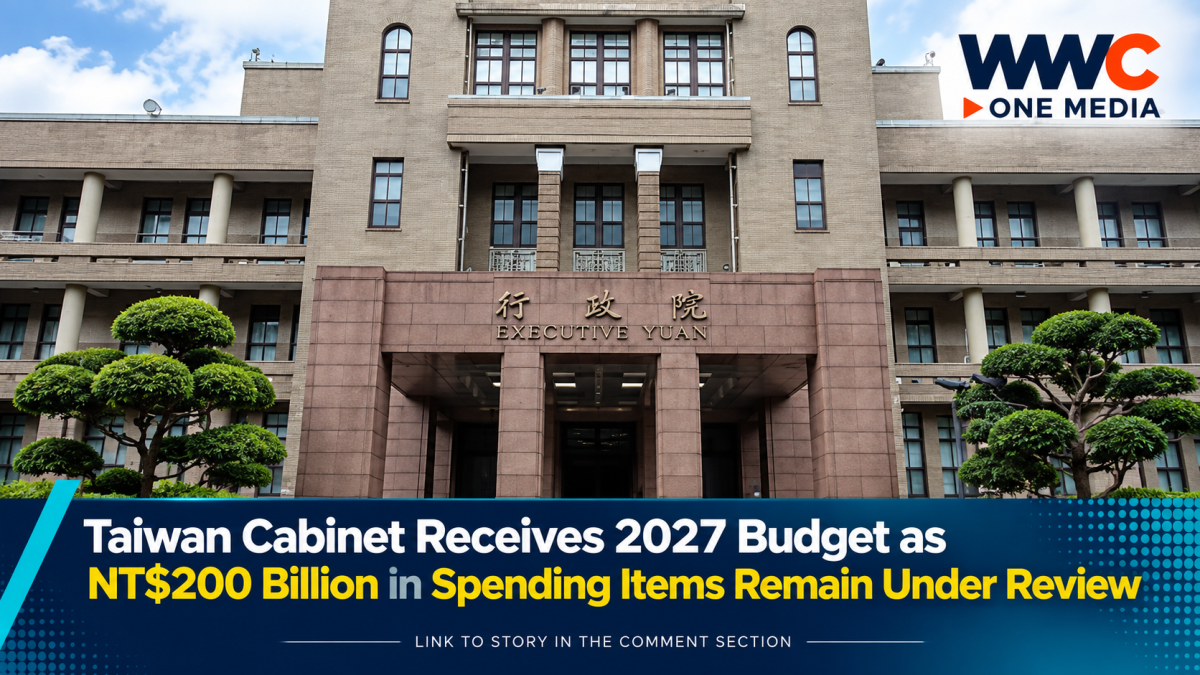
TAIPEI — Taiwan’s Cabinet has formally received the 2027 central government general budget, beginning a review process that could shape funding for defense-related programs, infrastructure and disaster response amid continued debate over the government’s spending priorities.
The Executive Yuan said Thursday that it received the budget from the Legislative Yuan and has about three and a half months to complete its review. The Legislature passed the budget on Aug. 14, but its submission to the Cabinet was delayed while the final compilation was completed.
The budget now moves into another important stage: Cabinet agencies must examine the allocations before the spending plan can proceed through the formal promulgation process.
More Than NT$200 Billion in Items Still Pending
According to Taiwan News, four pending items in the budget are worth more than NT$200 billion (about US$6.28 billion) in total.
Among the most closely watched is a NT$29.9 billion drone industry development plan, which covers programs involving defense-related equipment as well as medical and infrastructure applications.
Other funding includes regular expenditures for defense-equipment maintenance, ammunition and fuel, while major infrastructure projects also remain part of the overall spending picture.
The scale of these allocations comes as Taiwan continues to increase attention on domestic technology and industrial capacity, including drones and other emerging technologies.
Taiwan’s Drone Industry Becomes a Budget Focus
The proposed drone program is particularly significant because Taiwan has been working to expand domestic drone production and strengthen its supply chain.
The government has increasingly viewed unmanned systems as part of a broader industrial-development strategy, rather than simply as a defense procurement issue.
The NT$29.9 billion allocation therefore represents funding connected to several applications, including armaments, medical uses and infrastructure upgrades, according to the Taiwan News report.
That broader approach reflects Taiwan’s efforts to develop domestic capabilities while also expanding the potential civilian applications of drone technology.
Infrastructure Projects Remain a Major Part of Spending
The budget also includes funding for long-term infrastructure projects.
One major example is the Tainan underground railway project, whose total project value is approximately NT$180.5 billion.
The project is intended to place sections of Tainan’s railway system underground, with the long-term goal of improving urban connectivity and addressing the impact of railway infrastructure on the city’s development.
The project is separate from the annual budget allocation itself, meaning its total project value should not be interpreted as a single-year expenditure.
Cabinet Flags Funding Gaps
Taiwan’s Directorate-General of Budget, Accounting and Statistics (DGBAS) has also identified areas where the budget may not fully cover emerging needs.
Among the issues cited are bus fleet upgrades and disaster-relief funding.
The agency said additional funding can be approved after the budget completes its review process, according to Taiwan News.
This could become particularly relevant as Taiwan continues strengthening disaster preparedness following earthquakes, typhoons and other extreme-weather events.
A major earthquake-response exercise was also underway in eastern Taiwan this week, involving participants from multiple countries and simulating a large earthquake that disrupts transportation and critical infrastructure.
Premier Cho Tells Agencies to Stay on Schedule
Premier Cho Jung-tai instructed government agencies to proceed with their planned work once the Office of the President publishes the general budget.
He emphasized that agencies should prioritize professionalism over speed, according to Taiwan News.
The statement comes as the Cabinet navigates the next stage of a budget process that has already drawn attention because of the timing of its submission and the scale of several major spending programs.
Budget Review Comes Amid Wider Economic Uncertainty
The budget review is taking place against a changing economic backdrop.
Taiwan’s central bank kept its key interest rates unchanged for the 10th consecutive quarter on Sept. 17, saying the decision was intended to maintain economic stability amid global uncertainty.
At the same time, Taiwan’s stock market remained volatile. The TAIEX closed at 46,288 points on Sept. 17, gaining 439.1 points, or 0.96%, after briefly rising more than 1,000 points during the session.
That combination of strong technology-sector activity, global monetary uncertainty and continued government spending makes the 2027 budget particularly significant for Taiwan’s economic and industrial planning.
What Happens Next?
The Cabinet now has roughly three and a half months to examine the budget.
Government agencies will need to work through the approved allocations while the administration addresses identified funding gaps and prepares for implementation after the budget is formally promulgated.
The coming months will therefore determine how quickly funding can move into areas such as infrastructure, transportation, disaster response and Taiwan’s emerging drone industry.
For Taiwan, the 2027 budget is more than a collection of annual spending figures. It will help determine how the government balances economic development, infrastructure investment, technological capacity and public-sector needs during a period of considerable regional and global uncertainty.