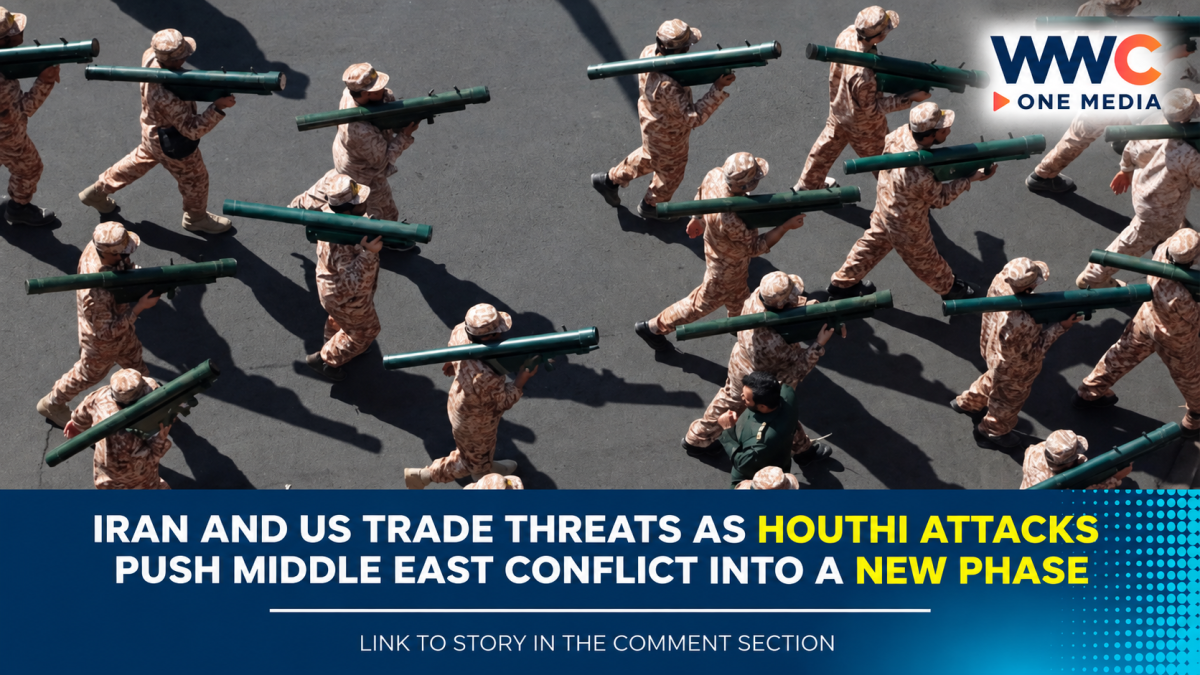
Tensions between Iran and the United States have intensified after a fresh wave of Houthi attacks on Saudi Arabia added another dangerous front to an already expanding Middle East conflict.
US President Donald Trump warned Iran that it faced severe economic consequences or the possibility of its leadership being targeted if Tehran refused to reach a deal with Washington. At the same time, Iran’s military warned that any new attack would trigger sustained retaliation against US bases, interests and regional allies.
The latest escalation follows attacks claimed by Yemen’s Iran-aligned Houthi movement against targets in Riyadh. Explosions and a large plume of smoke were reported near the Saudi capital, while Saudi authorities did not immediately provide details on damage. The United States subsequently issued a security alert warning Americans in the region about possible further escalation, flight disruptions and airspace closures.
The Houthi advance in Yemen has also created a new threat to one of the world’s most important shipping routes. The group has expanded its control toward the Red Sea coast and the Bab el-Mandeb Strait, a strategic waterway linking the Red Sea with the Gulf of Aden and a major route for international trade and energy shipments.
The situation is particularly significant for global oil markets. Iran has restricted shipping through the Strait of Hormuz, while the Houthi presence around Bab el-Mandeb threatens another major route for energy and commercial vessels. Saudi Arabia has consequently increased some oil shipments through the Strait of Hormuz after disruptions affected its alternative export routes.
Despite the military escalation, there are still indications that diplomacy has not completely disappeared. Trump said he would be open to meeting Iranian President Masoud Pezeshkian during the United Nations General Assembly in New York this week. Pezeshkian is expected to attend the gathering, potentially creating an opportunity for direct or indirect diplomatic discussions.
However, there is no clear indication that the two sides have reached an agreement on the conditions needed to revive the ceasefire that collapsed earlier this year. Iran has continued to say that it will combine military pressure with diplomatic efforts, while Washington has maintained pressure on Tehran.
The conflict is also creating serious humanitarian consequences in Yemen. The United Nations refugee agency said more than 100,000 people had been internally displaced by renewed fighting by mid-September, with thousands more fleeing across the Red Sea.
Meanwhile, Saudi Arabia faces a difficult choice as it responds to Houthi attacks while trying to protect its energy infrastructure and shipping routes. Britain has agreed to provide limited defensive support to Saudi Arabia, while France has indicated it is prepared to assist with protecting Saudi energy facilities.
The immediate concern is whether the latest exchange of threats remains limited or develops into a broader confrontation involving more US allies and regional forces.
With the UN General Assembly bringing key leaders together in New York this week, attention is now turning to whether diplomacy can slow the escalation — or whether the Houthi attacks and the latest US-Iran threats will push the Middle East conflict into an even wider phase.