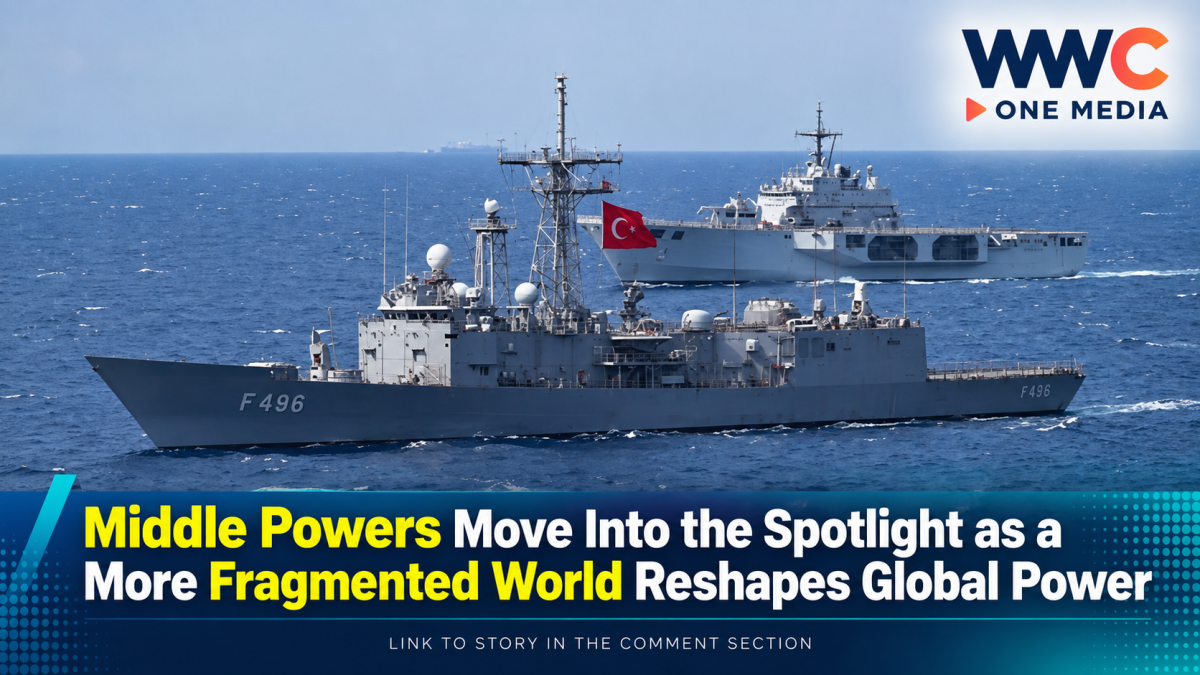
BANGKOK — As competition between major powers increasingly shapes trade, security and diplomacy, a growing group of middle powers is seeking a bigger role in determining how the international system evolves.
The debate has gained momentum as traditional multilateral institutions face greater pressure and countries seek more flexibility rather than placing themselves firmly inside a single geopolitical camp.
A recent Bangkok Post commentary argues that the world’s middle powers could become increasingly important in navigating this period of international uncertainty. The discussion comes as countries across Asia and beyond expand partnerships, diversify economic relationships and pursue greater strategic autonomy.
Why Middle Powers Matter Now
Middle powers generally lack the military, economic or diplomatic reach of the world’s largest powers, but many possess significant regional influence, strong economies or specialized capabilities.
In the Indo-Pacific, countries including Japan, India, Australia, Indonesia, South Korea, Singapore and Vietnam are increasingly important to regional institutions, supply chains and security arrangements.
The Lowy Institute describes the Indo-Pacific as becoming more networked rather than simply divided into two competing camps, with middle powers using partnerships to expand their strategic options.
That shift gives countries outside the traditional superpower rivalry more opportunities to influence regional outcomes.
ASEAN Is at the Center of the Conversation
For Southeast Asia, the issue is particularly significant.
ASEAN members maintain extensive economic and diplomatic relationships with both the United States and China, while simultaneously developing ties with Japan, India, Australia, South Korea, the European Union and other partners.
Recent research published in Frontiers in Political Science found that ASEAN middle powers are responding differently to the increasingly competitive international environment. Indonesia, Malaysia, Thailand and Vietnam, for example, have pursued different combinations of international partnerships based partly on their domestic economic and political circumstances.
This means there is no single “middle-power strategy” across Southeast Asia.
Instead, countries are attempting to preserve flexibility while protecting their individual economic and security interests.
Thailand Wants More Room to Maneuver
Thailand has explicitly placed greater emphasis on a multidirectional foreign policy.
The Thai government’s foreign-policy statement says Bangkok intends to deepen relations with middle powers and new partners while maintaining constructive engagement with different power centers in an increasingly multipolar world.
The policy describes diversification as a way to create alternatives and greater flexibility in Thailand’s external relationships.
Prime Minister Anutin Charnvirakul also highlighted regional and minilateral cooperation during a speech at Australia’s Lowy Institute in August.
He identified regionalism, including ASEAN, as an important mechanism for addressing challenges when global consensus is difficult to achieve.
Thailand’s foreign minister has separately argued that middle powers can play a more active role in areas including maritime, energy and food security.
The Economic Stakes Are Rising
The middle-power debate is not limited to diplomacy.
Trade disputes, supply-chain disruptions, technology competition and energy-security concerns are pushing governments to reconsider how dependent they are on individual markets or suppliers.
The IMF recently highlighted opportunities for Southeast Asian countries to strengthen cooperation with other middle powers in Asia and Europe, particularly in areas such as trade, supply-chain resilience, energy security and climate policy.
Such cooperation could allow countries to diversify their economic relationships without necessarily abandoning existing partnerships.
India Shows How Middle-Power Networks Can Expand
India provides one example of this broader trend.
In July, Prime Minister Narendra Modi visited Indonesia, Australia and New Zealand, with agreements and strategic initiatives spanning defense, energy and bilateral relations.
Commentary published by Channel NewsAsia described the sequence of engagements as evidence of middle powers deepening relationships with one another.
These relationships do not necessarily represent the creation of a single bloc.
Instead, they illustrate how countries can build overlapping partnerships around specific interests.
But Middle Powers Are Not a Unified Group
There is an important limitation to the middle-power strategy.
These countries do not necessarily share the same political systems, economic priorities or foreign-policy goals.
Carnegie Endowment analysis has similarly cautioned that middle powers are a heterogeneous group whose different interests and visions can limit their ability to act collectively.
Their influence may therefore depend less on forming a formal alliance and more on cooperating selectively where interests overlap.
That could include climate action, supply chains, maritime security, technology standards, energy, food security and reform of international institutions.
A More Networked Global Order
The emerging picture is therefore more complicated than a simple contest between Washington and Beijing.
Countries such as Thailand, Indonesia, Japan, India, Australia, South Korea and Singapore are building relationships across multiple directions, while ASEAN continues to serve as an important regional platform.
A 2026 regional survey also found that ASEAN itself remained the most widely identified influential political and strategic actor in Southeast Asia, even as member states diversify their external partnerships.
For middle powers, the opportunity is greater diplomatic room to maneuver.
The challenge is turning that flexibility into coordinated action without forcing countries with different interests into a single geopolitical camp.
As the global system becomes more fragmented, the decisions made by middle powers may increasingly determine whether that fragmentation produces greater competition—or creates new channels for cooperation.