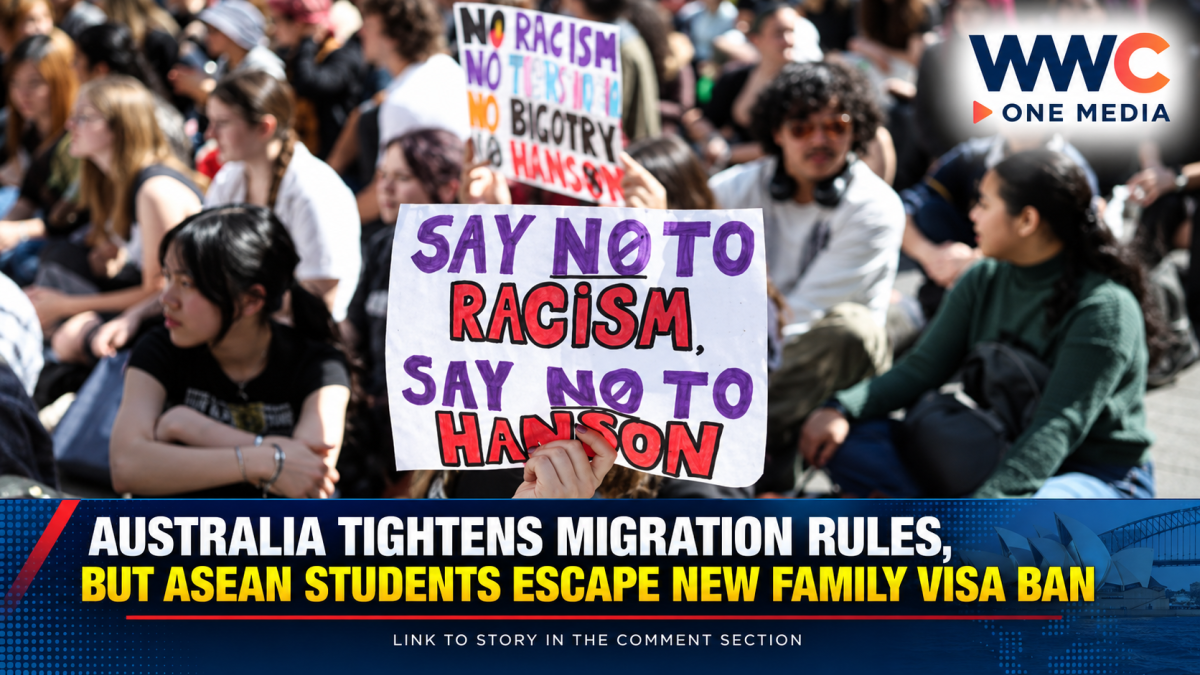
SYDNEY — Australia is tightening its migration system in a sweeping new policy package, but students from ASEAN and Pacific countries will retain the ability to bring eligible family members with them under an important exemption announced by the federal government.
The reforms, unveiled by Home Affairs Minister Tony Burke on Sept. 17, are designed to bring net overseas migration down while giving the government greater control over who enters Australia, how long temporary visa holders remain and which skills are prioritized.
The government is targeting net overseas migration of 245,000 in the 2026–27 financial year and 225,000 in 2027–28. Official data released alongside the announcement showed net overseas migration had already fallen to about 292,000 in the year to March 2026, down 47% from its post-pandemic peak.
ASEAN Students Get a Major Exemption
One of the most closely watched measures concerns international students.
Under the new rules, most international students and graduate-visa holders will no longer be able to automatically add partners or dependent children to their visas.
However, the restriction does not apply to students from ASEAN and Pacific nations. Students undertaking certain courses, including PhD programmes, will also qualify for exemptions.
The exemption is significant for Southeast Asian students considering Australia as a study destination because it preserves an option that will no longer be available to many students from other countries.
The government also confirmed that families already in Australia under existing student arrangements will not be separated because of the changes.
Nearly 46,000 Family Visas Were Granted in the First Half of 2026
The scale of the policy change becomes clearer from Australia’s latest student-visa figures.
In the first half of 2026, Australia granted 337,427 student visas, including 45,991 visas for dependents or other family members.
The new restrictions therefore target a significant secondary component of Australia’s temporary migration system without directly imposing a new numerical cap on the number of international students themselves.
Education-sector representatives have offered mixed reactions.
Phil Honeywood, chief executive of the International Education Association of Australia, supported measures aimed at preventing students from using repeated course changes to extend their stay, but warned that family restrictions could make Australia less attractive to some prospective students.
Australia Also Targets “Visa Hopping”
Family visas are only one part of the overhaul.
The government plans to make it harder for international students to repeatedly switch courses simply to extend their stay in Australia.
Under the new approach, students will need to demonstrate genuine progression to a higher-level qualification when changing courses to continue their student-visa pathway.
Burke said the government wants to prevent Australia’s international education system from being used primarily as a migration pathway rather than for genuine study.
The government is also increasing compliance measures aimed at people who remain in Australia after their visas expire.
Working Holiday Visas Are Also Being Tightened
Australia’s migration changes extend beyond students.
The government plans to reduce the number of working holidaymakers able to extend their stay into a second or third year.
The number of second-year places will fall from 57,000 to 45,000, while third-year places will drop from 31,000 to 5,000.
Those places will be allocated through a ballot, with regional work requirements also being introduced.
The changes are intended to give the government more control over demand-driven temporary migration programmes.
Skilled Migrants to Be Directed Toward Priority Industries
At the same time, Australia says it wants to attract migrants with skills it considers important to the economy.
The government will prioritize skilled migration in sectors including healthcare, construction, education, law enforcement, defence, resources, agriculture, aquaculture and fishing.
Industry groups have welcomed the greater focus on skills but have also warned that excessively reducing migration could worsen labour shortages.
The Australian Industry Group said shortages are already affecting areas such as housing construction, energy projects, data-centre development and defence-related work.
Why Australia Is Cutting Migration
The government’s changes come as migration and housing remain major issues in Australia.
Net overseas migration has fallen sharply from its post-pandemic peak, but the government says further reductions are necessary to meet its budget forecasts.
Home Affairs Minister Tony Burke has linked the policy shift partly to pressure on housing and the need to ensure Australia’s migration programme better matches economic requirements.
At the same time, Australia’s international education industry remains economically significant.
According to Reuters, international education was worth around A$53.6 billion, making it one of Australia’s major export industries. Education-sector representatives have therefore warned that changes affecting international students could have consequences beyond migration statistics.
What This Means for ASEAN Students
For students from Singapore, the Philippines, Malaysia, Indonesia, Thailand, Vietnam and other ASEAN members, the new policy contains a significant distinction.
While many international students will face new restrictions on bringing partners or children, ASEAN students are specifically included in the exemption announced by the government.
That does not mean ASEAN students are exempt from Australia’s wider student-visa requirements. They remain subject to Australia’s ordinary eligibility, visa, study and immigration rules.
The exemption instead applies specifically to the new restriction on attaching family members to student and graduate visas.
For Australia’s universities and international education providers, the policy could also influence where prospective students choose to study, particularly among older students with spouses or children.
The debate now moves to whether Australia’s tighter migration controls can reduce pressure on housing and temporary migration while preserving the international students and skilled workers the economy continues to need.
For ASEAN students, however, one major door remains open — and that exemption could become an increasingly important factor in Australia’s competition for Southeast Asian talent.
WWC ONE MEDIA G,A