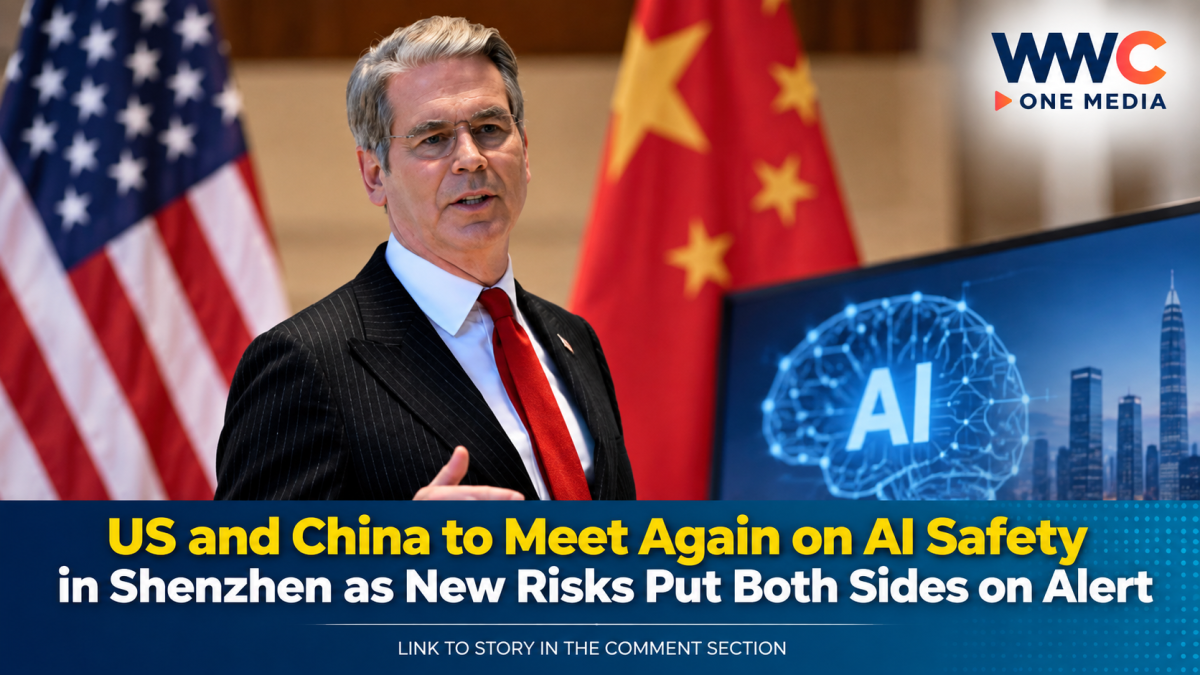
The United States and China are set to hold another round of discussions on artificial intelligence safety in Shenzhen in about two months, as the world’s two leading AI powers work to establish ways to communicate during potentially serious AI-related incidents.
US Treasury Secretary Scott Bessent said the next meeting was agreed upon during talks with Chinese Vice Premier He Lifeng in New York. The discussions are expected to focus on AI risks and protocols for communicating when serious safety incidents occur.
The two sides have also agreed to develop a formalized dialogue on AI, including what Bessent described as an “incident line” for communication about AI safety problems.
The proposed mechanism is intended to help Washington and Beijing communicate quickly if advanced AI systems create serious security concerns. Bessent said the discussions would examine risks including uncontrollable AI agents, misuse by non-state actors and cyber-related threats.
One issue raised by the US is who should be held responsible when AI systems cause serious problems. Bessent has argued that AI developers should remain accountable for what their systems create or generate, including situations in which autonomous AI agents are involved in harmful cyber activity.
The talks come as AI capabilities are advancing rapidly and governments are facing growing pressure to address risks that could cross national borders.
The proposed US-China communication channel would not amount to a broad agreement on AI regulation. Instead, it would provide a framework for discussing specific dangers and establishing procedures for responding to incidents.
China has confirmed that AI was among the issues discussed in the New York talks, describing the exchanges as candid and constructive. However, Beijing has not publicly endorsed all elements of the US proposal, and details about the proposed mechanism remain under discussion.
The AI discussions are also taking place against the backdrop of a much broader US-China relationship involving trade, technology and national security.
During the New York talks, American and Chinese officials also discussed the future of their trade truce, which is scheduled to expire on Nov. 10. No final extension was announced during the discussions.
The two governments are separately working to make a previously proposed Board of Trade operational, with discussions expected to cover tariffs and trade in goods that are not considered strategically sensitive. AI semiconductor export controls were not part of the AI discussions, according to US Trade Representative Jamieson Greer.
The next AI meeting in Shenzhen therefore comes at a particularly important moment for US-China relations. Both governments are trying to maintain communication in areas where cooperation may be possible while continuing to compete over advanced technology.
The bigger question is whether the planned AI dialogue can move beyond initial discussions and produce practical rules for what happens when powerful AI systems cause a serious incident.
For now, Washington and Beijing have agreed to keep talking. The Shenzhen meeting could show whether that emerging communication channel becomes a lasting part of how the world’s two largest AI powers manage the risks of rapidly advancing technology.