
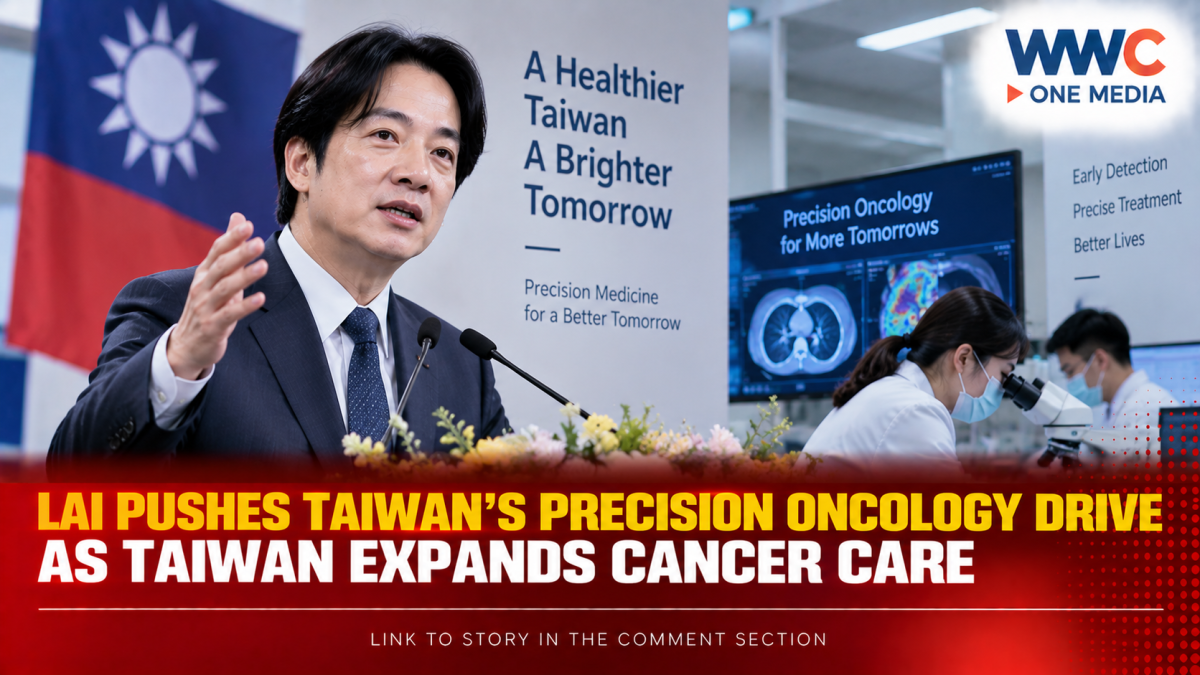
TAIPEI — Taiwan is stepping up its fight against cancer, with President Lai Ching-te highlighting precision medicine, genetic testing and wider access to advanced treatments as key pillars of his government’s “Healthy Taiwan” agenda.
In a video address marking the 20th anniversary of the Taiwan Society for Molecular Medicine, Lai said Taiwan is strengthening cancer research and treatment while expanding the use of molecular medicine to make cancer care more targeted and personalized.
One of the most significant developments is Taiwan’s expansion of next-generation sequencing (NGS) through its National Health Insurance system. NGS analyzes genetic changes in cancer cells, helping physicians identify biomarkers that may point to targeted treatments or other appropriate therapies.
Taiwan began covering NGS testing under National Health Insurance in May 2024. The program was designed to support precision treatment for cancer patients, with the government initially estimating that more than 20,000 patients could benefit each year. Coverage included a range of solid tumors and hematologic cancers, while subsequent NHI changes added further single-gene testing.
The strategy is now moving beyond testing alone.
From genetic testing to personalized treatment
Lai said Taiwan is using NGS to build more comprehensive genetic profiles of tumors. The information can help doctors determine which treatments may be appropriate and can also provide valuable data for research, drug evaluation and the development of improved therapies.
Taiwan’s National Health Insurance Administration has also been working on standardized digital collection of NGS data. In 2026, the NHIA highlighted the adoption of FHIR standards for NGS data, an effort intended to improve interoperability between hospitals and testing institutions and strengthen the infrastructure supporting precision medicine.
The approach reflects a broader shift in cancer care: instead of relying solely on the location or appearance of a tumor, doctors can increasingly examine its molecular characteristics to help guide treatment decisions.
Taiwan has already built substantial experience in this area, particularly in lung cancer. Precision approaches such as genetic testing for EGFR mutations have played an important role in matching some patients with targeted therapies.
A bigger cancer budget — and a tougher target
Lai’s precision-oncology push is part of a much larger national cancer strategy.
The government has set a goal of reducing Taiwan’s age-standardized cancer mortality rate by one-third by 2030. Cancer has remained Taiwan’s leading cause of death for decades, making the target one of the government’s most ambitious public-health objectives.
The government’s strategy combines three major areas: earlier cancer screening, genetic testing and precision medicine, and improved access to new cancer drugs.
Cancer screening funding has been increased from NT$2.8 billion to NT$6.8 billion, while a dedicated fund for new cancer drugs has been developed to help patients gain access to innovative treatments more quickly. Lai has described the measures as central to his vision of a “Healthy Taiwan.”
The scale of the screening effort is also significant. The Presidential Office previously reported that government-supported screening programs detected tens of thousands of cancer and precancerous cases, underscoring the importance of finding disease earlier rather than relying solely on treatment after cancer has progressed.
Why Taiwan’s approach matters
Taiwan’s strategy brings together three strengths: its universal National Health Insurance system, a strong biomedical research sector and an increasingly sophisticated genetic-data infrastructure.
The NHI system has also been expanding access to cancer medicines and other advanced treatments, while digital initiatives seek to connect treatment data, genetic testing and outcomes more effectively.
But precision oncology is not a magic bullet. Genetic testing can identify potentially actionable mutations, but not every patient will have a mutation with an available targeted treatment. Testing can also involve additional costs, and questions remain about how quickly genetic information can be translated into effective treatment.
That makes Taiwan’s long-term challenge bigger than simply sequencing more tumors. The real test will be whether the country can turn genetic information into faster diagnosis, better treatment decisions and improved survival, while keeping innovative therapies accessible through its public health system.
For Lai, the ambition is clear: make precision medicine a central part of Taiwan’s next generation of cancer care — and use it alongside prevention and early detection to move toward the government’s 2030 mortality-reduction goal.
The coming years will show whether Taiwan can turn that ambitious policy into measurable gains for cancer patients.




Leave a Reply