
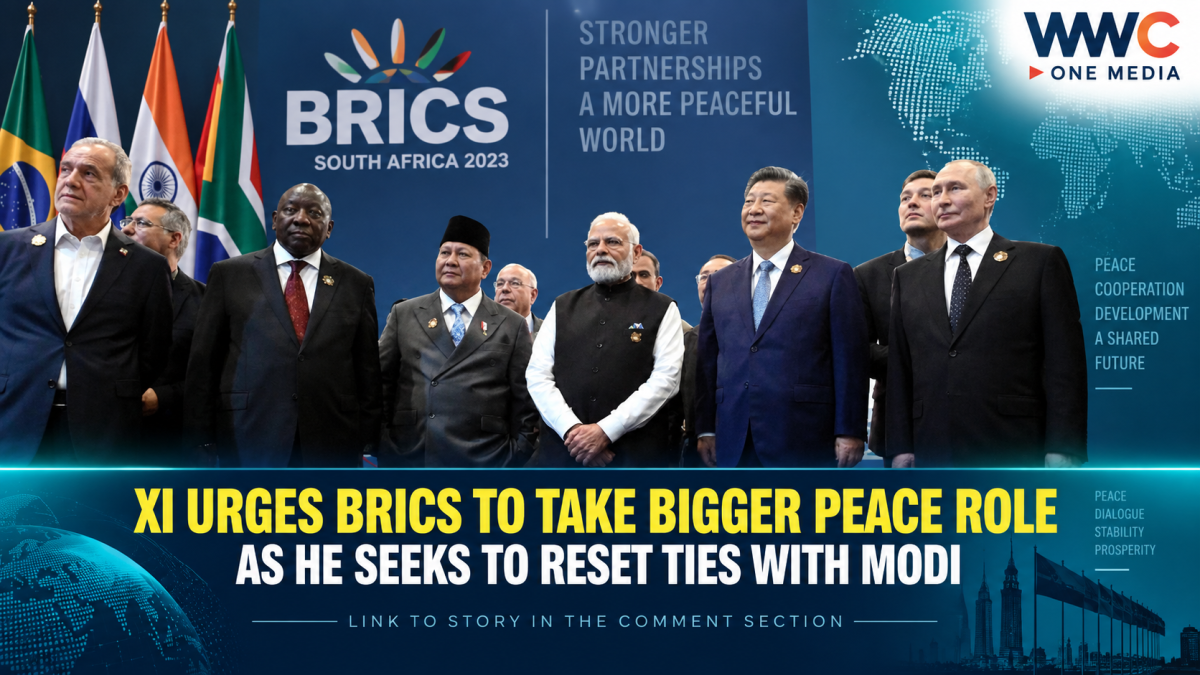
Chinese President Xi Jinping has called on BRICS to play a bigger role in resolving conflicts in the Middle East, while using his first visit to India in seven years to push for closer ties with Prime Minister Narendra Modi.
Speaking at the BRICS summit in New Delhi on Sept. 12, Xi said China was ready to work with other members of the expanded bloc to help promote peace in the Middle East. He argued that the war was not in the common interest of the international community and urged greater international cooperation to address conflicts.
The appeal came as the Middle East conflict dominated the summit, placing pressure on BRICS to demonstrate that its growing economic influence can translate into diplomatic clout. The 11-member group now includes Brazil, Russia, India, China, South Africa, Egypt, Ethiopia, Indonesia, Iran and the United Arab Emirates, representing more than 40 per cent of the world’s population.
BRICS leaders subsequently backed a joint declaration calling for dialogue, diplomacy and de-escalation. The declaration also stressed the importance of protecting civilians, international trade and maritime security as conflicts continue to threaten key global shipping and energy routes.
Xi and Modi seek a fresh start
On the sidelines of the summit, Xi held a closely watched meeting with Modi as Beijing and New Delhi continue efforts to repair relations damaged by years of border tensions.
Xi described China-India ties as a relationship that should be approached from a “strategic, long-term perspective”, while saying the two countries should regard each other as partners rather than rivals. He called for greater cooperation in trade, direct flights and people-to-people exchanges.
Modi likewise stressed that the two countries should maintain peace and tranquillity along their disputed border and resolve differences through dialogue. Both sides agreed that the boundary question should be addressed through negotiations aimed at a fair and mutually acceptable solution.
The meeting was significant because Xi’s visit was his first to India since 2019. Relations deteriorated sharply after a deadly 2020 border clash in Ladakh, in which 20 Indian soldiers and four Chinese soldiers were killed. Although tensions have eased, the territorial dispute remains unresolved and both countries continue to maintain substantial military forces along the frontier.
Trade remains a major obstacle
Improving economic ties will be more complicated.
China has become India’s largest trading partner, with bilateral goods trade reaching about US$151 billion in the 2025-26 financial year. But the relationship is heavily tilted toward China: India imported roughly US$131 billion in goods from China while exporting only about US$19 billion, leaving a record trade deficit of around US$112 billion.
Modi and Xi discussed the need to address the trade imbalance, supply-chain problems and access to each other’s markets. India has also been gradually restoring direct flights and easing some restrictions as diplomatic relations improve.
Still, analysts caution that warmer political ties do not automatically translate into a rapid economic reset. Strategic mistrust, the unresolved border dispute and India’s growing relationship with the United States continue to complicate the relationship.
China prepares to lead BRICS
Xi’s diplomacy at the summit also looked beyond China-India relations.
China will take over the BRICS chairmanship next year and host the bloc’s 19th summit. Xi has argued that the expanded group should become a stronger voice for the Global South and promote greater cooperation in areas including trade, artificial intelligence, finance and technology.
For Beijing, a more influential BRICS provides an opportunity to promote a more multipolar international system while reducing dependence on Western-led institutions.
For India, meanwhile, the summit has offered an opportunity to position itself as a bridge between competing powers while strengthening its own diplomatic influence.
The immediate test for both Xi and Modi will be whether the warmer rhetoric can survive their countries’ unresolved strategic disagreements — and whether BRICS can turn its calls for peace into meaningful diplomatic action as wars continue to reshape the global order.


Leave a Reply