
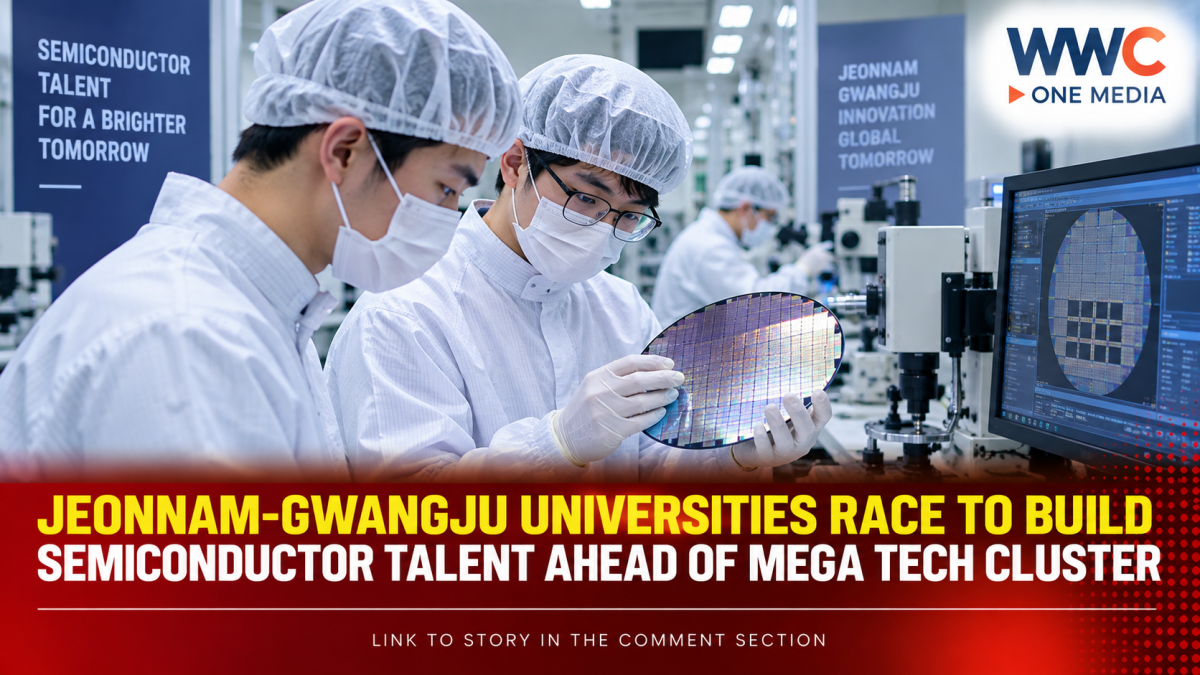
JEONNAM-GWANGJU, South Korea — Universities across southwestern South Korea are moving aggressively to build a new generation of semiconductor engineers and AI specialists as the region prepares for one of the country’s most ambitious technology-development projects.
The push comes as plans for a massive semiconductor and artificial intelligence cluster take shape in the Jeonnam-Gwangju region, with universities expanding specialized majors, research programs and hands-on training facilities to ensure the region has enough skilled workers when new industrial facilities come online.
At the center of the education drive is Chonnam National University, which plans to establish a new college focused on advanced industries with an annual intake of about 300 students. Beginning in March 2028, the college is expected to offer programs covering advanced semiconductors and future energy.
The university also plans to strengthen support for students studying electronics, materials science and chemical engineering — disciplines considered essential to the semiconductor supply chain.
Universities reshape programs for the chip economy
Chosun University is also preparing for the semiconductor boom. The university is reviewing plans for a semiconductor convergence college targeted for 2028 and intends to transform its Department of Photonic Engineering into a semiconductor-focused program beginning next year.
Its existing semiconductor education portfolio already includes training in advanced packaging, graduate-level semiconductor studies and undergraduate courses involving advanced materials, semiconductor devices and packaging technologies.
Meanwhile, Donggang University is preparing to establish a semiconductor department in 2028. The university launched a dedicated task force in June and aims to train around 100 semiconductor specialists annually, focusing on areas such as back-end processing, equipment operation and quality control.
The school is working with industry partners including Amkor Technology Korea and SMC Engineering, highlighting the growing emphasis on connecting university training with actual semiconductor production needs.
The region’s research universities are also expanding their role.
The Gwangju Institute of Science and Technology (GIST) already operates a Department of Semiconductor Engineering focused on semiconductor devices, manufacturing processes, advanced nanoelectronics, photonics, integrated circuits and chip design. Its infrastructure includes nanofabrication and compound-semiconductor research facilities designed to support industry-oriented training and research.
GIST is additionally planning an AI-semiconductor research institute that would bring together the region’s AI and photonics capabilities while supporting fabless companies involved in chip design and development.
A semiconductor cluster worth hundreds of trillions of won
The university expansion is closely tied to South Korea’s broader effort to build a major semiconductor manufacturing base outside the Seoul metropolitan area.
In June, the government announced a large-scale semiconductor investment strategy involving Samsung Electronics and SK hynix, with the two companies planning a combined 800 trillion won ($518 billion) in new semiconductor manufacturing investments in southwestern South Korea.
Samsung identified Gwangju as the site for its planned new chip cluster, while SK hynix said additional work was needed to finalize its site and infrastructure requirements. The companies are expected to build two new fabrication facilities each in the southwest.
Reuters reported that Samsung alone plans to invest about 400 trillion won in new semiconductor fabs in Gwangju, while SK hynix has outlined a similar 400-trillion-won investment for a new southwestern manufacturing base.
The scale of the project explains why universities are moving early.
Advanced semiconductor fabs require not only massive investments in equipment and infrastructure but also large pools of engineers, technicians, researchers and production specialists. Industry leaders have warned that securing sufficient land, electricity, water and skilled workers will be critical to making the southwestern cluster work.
Korea’s AI boom is changing the semiconductor race
The push is also being driven by soaring demand for chips used in artificial intelligence.
South Korea is already a global leader in memory semiconductors, particularly high-bandwidth memory (HBM), which is increasingly important for advanced AI processors. Samsung and SK hynix are seeking to expand production capacity as AI data-center investment accelerates worldwide.
That means the Jeonnam-Gwangju project is not simply about creating factories. It is an attempt to build an entire regional ecosystem — from university education and research to semiconductor manufacturing, packaging, equipment and AI-related technologies.
Korea Polytechnics’ Gwangju Campus is preparing another major piece of that ecosystem: a planned 50 billion won ($37.2 million) Mini Fab. The facility is intended to replicate the semiconductor manufacturing process and provide practical training for students and industry workers. Construction is targeted for next year, subject to government approval and funding.
The talent challenge could determine the project’s success
The ambitious plans also expose one of the biggest challenges facing the southwestern semiconductor strategy: people.
Building fabs is only one part of creating a competitive chip cluster. Companies also need engineers, technicians, researchers and experienced production workers — and attracting highly skilled talent away from South Korea’s established Seoul-area semiconductor ecosystem could prove difficult.
Reuters reported that experts have raised concerns about the southwest’s ability to rapidly secure the infrastructure, skilled workforce, power, water and supplier networks needed for cutting-edge semiconductor production.
That makes the universities’ decision to expand semiconductor education before the industrial cluster is fully established strategically important.
If the education and training pipeline succeeds, Jeonnam-Gwangju could enter the semiconductor race with something more valuable than factories alone: a locally trained workforce ready to support the next generation of AI-chip manufacturing.
And as South Korea tries to spread its technology economy beyond the Seoul metropolitan area, the region’s universities could become one of the most important pieces of the country’s semiconductor strategy.




Leave a Reply