
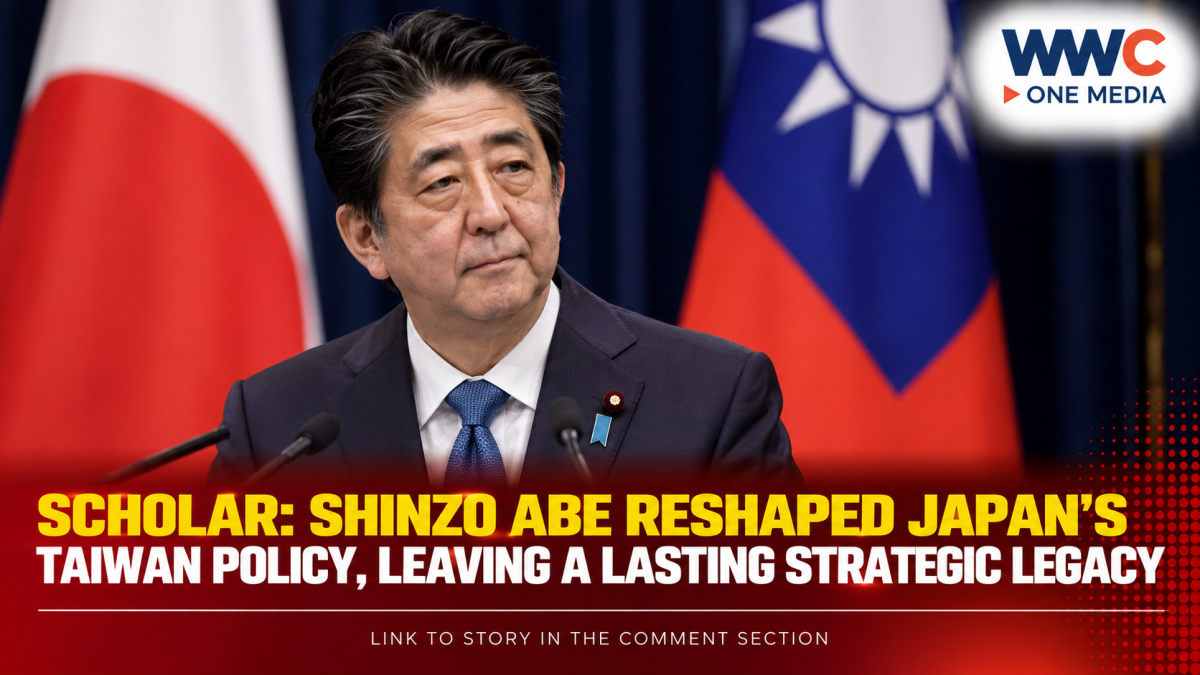
TAIPEI — The late Japanese Prime Minister Shinzo Abe left a lasting mark on Japan’s Taiwan policy, helping push Tokyo away from a traditionally cautious, China-centered approach toward a strategy that places Taiwan more clearly within Japan’s regional security calculations, according to Taiwanese scholar Lai I-chung.
Lai, president of the Prospect Foundation, said Sunday that Abe’s influence remains one of the most significant legacies in modern Taiwan-Japan relations. His assessment comes as Japan’s relationship with Taiwan has become increasingly important amid rising tensions across the Taiwan Strait and growing strategic competition between Japan, China and the United States.
Abe changed the conversation around Taiwan
Abe served as Japanese prime minister twice, first in 2006-07 and later from 2012 to 2020. During his second administration in particular, he promoted a broader Japanese role in regional security and repeatedly emphasized the strategic importance of Taiwan.
Policy analysts at the Council on Foreign Relations have described Abe as a key figure in reorienting Japanese policy toward Taiwan. Before his tenure, Japanese officials were generally reluctant to publicly discuss how a Taiwan conflict could affect Japan or what Tokyo might do in such a scenario. Abe helped change that political conversation by highlighting the shared democratic values and strategic interests between Japan and Taiwan.
One of Abe’s most consequential contributions was his effort to strengthen Japan’s security role beyond its traditional postwar limitations.
His government passed security legislation in 2015 that expanded the circumstances under which Japan could exercise limited forms of collective self-defense, including situations involving attacks on countries closely connected to Japan. Analysts have viewed those reforms as part of Abe’s broader effort to give Tokyo greater flexibility in responding to regional security crises.
From Taiwan’s security to Japan’s security
Abe increasingly linked Taiwan’s security environment with Japan’s own national interests.
In 2021, after leaving office, Abe made the striking argument that a Taiwan emergency would also constitute an emergency for Japan and the U.S.-Japan alliance. The remarks drew considerable attention because they reflected how far the Taiwan issue had moved into Japan’s mainstream strategic debate.
But experts caution against interpreting Abe’s statements as an automatic Japanese commitment to defend Taiwan.
Japan has not formally promised to intervene militarily in every Taiwan contingency. The exact circumstances under which Tokyo could respond would depend on Japan’s laws, the nature of a crisis and decisions by the Japanese government. The Brookings Institution has emphasized that Japan’s government has never made an explicit blanket commitment to defend Taiwan or automatically participate in a potential U.S. military response.
That distinction remains crucial as rhetoric around Taiwan becomes more forceful.
Abe’s Indo-Pacific strategy also mattered
Abe’s Taiwan policy cannot be separated from his broader vision for Japan’s role in the Indo-Pacific.
His government championed the idea of a Free and Open Indo-Pacific, while Abe was also an early advocate of the Quadrilateral Security Dialogue, or Quad, involving Japan, the United States, India and Australia.
These initiatives helped establish a framework in which Japan increasingly viewed regional security through the lens of maritime stability, democratic partnerships and balancing China’s growing strategic influence.
Taiwan consequently became more important within Japan’s strategic calculations—not simply because of its political relationship with Tokyo, but because of its location near key sea lanes and its proximity to Japan’s southwestern islands.
Why Taiwan matters so much to Japan
Taiwan sits close to Japan’s southwestern island chain and near major maritime routes connecting Northeast and Southeast Asia.
Any serious military crisis around Taiwan could therefore create consequences for Japan involving regional stability, trade, shipping and the security of nearby Japanese territory.
That geographic reality has helped drive greater Japanese attention to Taiwan even though Tokyo continues to maintain its formal diplomatic framework with Beijing.
The result is a delicate balancing act: Japan seeks closer practical relations with Taiwan while maintaining official relations with China.
Abe’s influence continues after his death
Abe was assassinated in July 2022, but his strategic ideas continue to influence Japanese policy debates.
Recent Japanese governments have maintained a stronger focus on Taiwan Strait stability, while political leaders have increasingly discussed the consequences a Taiwan conflict could have for Japan.
Japan’s current strategic environment has also become more complicated as tensions with China have intensified.
Recent reporting has highlighted how comments by Prime Minister Sanae Takaichi about a potential Chinese attack on Taiwan could constitute a situation threatening Japan’s survival have triggered serious diplomatic friction with Beijing. Japanese lawmakers subsequently traveled to China in an effort to repair strained relations.
That episode illustrates just how consequential the policy shift associated with Abe has become.
Taiwan-Japan ties move beyond security
The relationship is no longer defined solely by security concerns.
Taiwan and Japan have developed extensive economic, cultural and people-to-people ties, while semiconductor cooperation has added another strategic layer.
Taiwan’s position at the center of the global semiconductor industry has made its relationship with Japan even more economically significant. Japan is also rebuilding its semiconductor manufacturing capabilities and deepening cooperation with Taiwanese technology companies.
In June, Taiwan President Lai Ching-te publicly honored Abe’s contribution to Taiwan-Japan relations and his calls for peace and stability across the Taiwan Strait.
A dedicated Abe School of Politics and Economics also opened in Taipei in April 2026, reflecting continued interest in studying Abe’s political legacy and strengthening Taiwan-Japan exchanges.
Abe’s biggest legacy may be the change in Japan’s mindset
For Lai and other analysts, Abe’s importance may ultimately lie less in any single policy announcement than in how he changed the way Japanese policymakers discuss Taiwan.
Japan’s approach has not transformed into an explicit alliance with Taiwan, and Tokyo continues to maintain its formal diplomatic position toward Beijing.
But the political threshold for discussing Taiwan as a matter directly connected to Japan’s security has clearly shifted.
Abe helped make that conversation mainstream.
And as tensions surrounding Taiwan continue to reshape the Indo-Pacific, the strategic framework he promoted is likely to remain part of Japan’s foreign-policy debate for years to come.




Leave a Reply