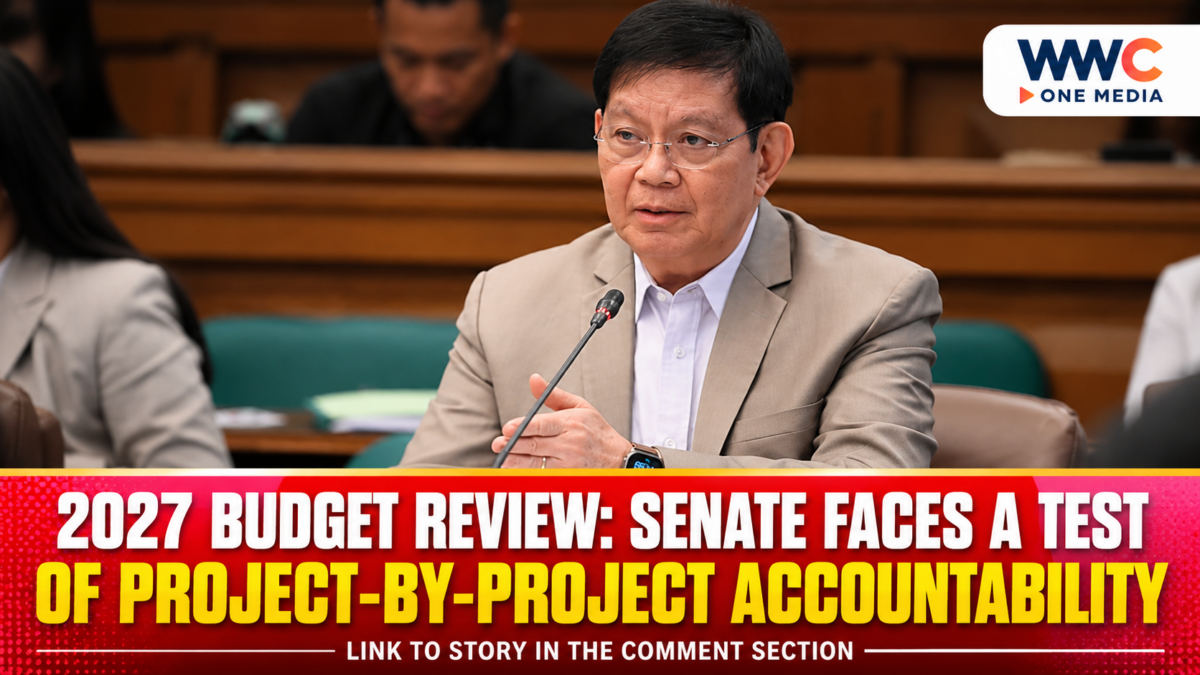
MANILA, Philippines — The Senate’s review of the proposed ₱7.2-trillion national budget for 2027 is moving into a critical stage, with lawmakers scheduled to question government agencies and examine the spending bill before it advances to the next steps of the appropriations process.
The scrutiny comes as Senator Panfilo “Ping” Lacson has raised concerns about proposed allocations for assistance programmes and multipurpose buildings, alongside earlier questions about possible repeated funding for public works projects. The larger issue is whether the final spending plan can show clearly what each allocation is intended to finance, where projects will be implemented and how government agencies will account for the money.
For taxpayers, the distinction between a proposed appropriation and actual government spending is essential. A budget entry does not by itself establish that a project has been built, that funds have been released or that wrongdoing has occurred. Those questions require separate records and verification.
The 2027 budget review enters a detailed Senate stage
The Department of Budget and Management submitted the proposed ₱7.2-trillion Fiscal Year 2027 National Expenditure Program to Congress on August 11, 2026. The proposal is around 6 percent higher than the 2026 budget and equivalent to approximately 21.7 percent of gross domestic product.
The House of Representatives approved House Bill No. 10858, the proposed 2027 General Appropriations Bill, on third and final reading on October 12. That approval completed the House’s stage of the process, but it did not make the measure law.
The Senate is conducting its own examination through the Committee on Finance and related budget proceedings. Its published calendar lists interpellations on general principles from November 23 to 27, followed by questioning on individual departments and agencies.
The schedule includes the Department of Public Works and Highways among the agencies set for interpellation on November 27. That session is particularly relevant to public infrastructure spending, although the published agenda does not establish that every project questioned by senators will be resolved during that hearing.
The Senate’s review is an opportunity to test the assumptions behind the proposed allocations before the chamber settles on its version of the spending bill.
Lacson’s objections put project selection and assistance programmes under scrutiny
In a statement dated November 22, Lacson questioned at least ₱241 billion in fragmented assistance programmes in the Senate version of the proposed budget. He compared that amount with ₱263 billion in similar items in the House version.
He also raised concerns about appropriations for 3,950 multipurpose buildings, separate from 1,584 buildings covered by the Local Government Support Fund’s Financial Assistance to Local Government Units subprogramme for 2022 to 2026.
Lacson argued that the spending mix should give greater weight to investments capable of supporting economic activity. He also questioned whether some multipurpose buildings had received appropriations in earlier budget years despite remaining unbuilt at their designated locations.
These are the senator’s claims and assessments, not final findings that public money was misused. Establishing whether a building was funded repeatedly without being delivered would require matching the relevant budget entries with project locations, implementing-agency records, procurement documents, fund releases, disbursements and physical accomplishment reports.
The same standard applies to assistance programmes. Their inclusion in a budget does not, by itself, prove that beneficiaries were selected improperly. A meaningful review would examine eligibility rules, beneficiary records, implementing procedures and safeguards against political interference.
Why project documentation matters beyond the budget debate
A project’s name or general description is not enough to establish whether two allocations refer to the same work. Infrastructure projects may be divided into phases, cover different locations or require additional funding for a distinct scope.
To establish possible duplication, reviewers need to compare precise project locations, coordinates, engineering descriptions, implementing offices, project identification numbers, funding years and amounts. Procurement and implementation records can then help determine whether the same work was funded more than once or whether separate activities were involved.
The government’s proposed infrastructure programme makes this scrutiny consequential. The Department of Budget and Management has placed the 2027 Build Better More infrastructure allocation at approximately ₱1.467 trillion. The proposed Department of Public Works and Highways budget is also a major part of the spending plan.
WWC has previously examined the government’s proposed 2027 infrastructure programme and its project-screening safeguards. The present debate adds another accountability question: whether the information used to approve projects will also be sufficient to monitor them after funds are authorised.
The importance of that question extends beyond construction. Public spending affects the delivery of roads, flood protection, health services, education and local assistance. Weak project descriptions or unclear implementation records make it harder for lawmakers, auditors and citizens to determine whether an allocation is producing its intended result.
Palace calls for scrutiny, but the legislative process remains Congress’s responsibility
The administration has previously urged lawmakers and budget monitors to identify questionable items in the proposed spending plan. In a November 3 press briefing, Palace Press Officer Claire Castro said the budget would still undergo Senate scrutiny, bicameral conference committee deliberations and review by the President’s economic team before it could be submitted for presidential approval.
The Palace briefing also encouraged people monitoring the budget to provide documents identifying possible red flags. That position places importance on evidence that can be examined, rather than on broad claims that have not been checked against the underlying records.
The constitutional budget process gives Congress the authority to deliberate on and approve appropriations. The Executive Branch prepares and submits its proposed spending plan, while lawmakers examine and may amend the measure through the legislative process. The President’s review comes after Congress completes its work.
That division matters. The Senate can question proposed spending and seek changes, but the final outcome depends on the legislative stages that follow, including the reconciliation of differences between the House and Senate versions.
What happens next
As of November 25, the Senate Committee on Finance calendar lists further interpellations on the proposed 2027 General Appropriations Bill. The Department of Public Works and Highways is included in the November 27 agenda.
The Senate’s published schedule also sets out later stages for amendments, approval on second and third reading, and bicameral conference committee deliberations in December. These are scheduled steps, not confirmation that the bill has already passed them.
The most useful evidence to emerge from the review would be project-level documentation that allows the public to trace proposed allocations to specific locations, scopes of work, implementing agencies and earlier funding records.
For projects questioned by lawmakers, the responsible agencies should be able to explain whether an allocation is new, continuing, revised or part of a separate construction phase. For assistance programmes, the relevant records should make eligibility and beneficiary-selection procedures understandable and auditable.
The final test is not whether the budget contains a large number of projects or whether lawmakers promise tougher scrutiny. It is whether the approved spending plan gives the public enough information to identify what government intends to fund and later determine what was actually delivered.
Frequently asked questions
How much is the proposed Philippine national budget for 2027?
The proposed Fiscal Year 2027 National Expenditure Program totals approximately ₱7.2 trillion. It remains subject to congressional deliberations and the remaining budget approval process.
What is the Senate reviewing in the 2027 budget?
The Senate is examining the proposed General Appropriations Bill, including agency budgets, spending priorities, infrastructure allocations, assistance programmes and other proposed appropriations.
What concerns has Senator Panfilo Lacson raised?
In a November 22 statement, Lacson questioned allocations for fragmented assistance programmes and thousands of multipurpose buildings. He also raised concerns about possible repeated funding for some projects. These concerns require verification against the underlying government records.
Does a budget allocation prove that a project has been completed or paid for?
No. An appropriation is authority to spend for an approved purpose. Fund releases, obligations, payments and completed physical work are separate matters that require their own documentation.
When is the DPWH budget scheduled for Senate questioning?
The Senate Committee on Finance’s published schedule lists the Department of Public Works and Highways among the agencies for interpellation on November 27, 2026.