
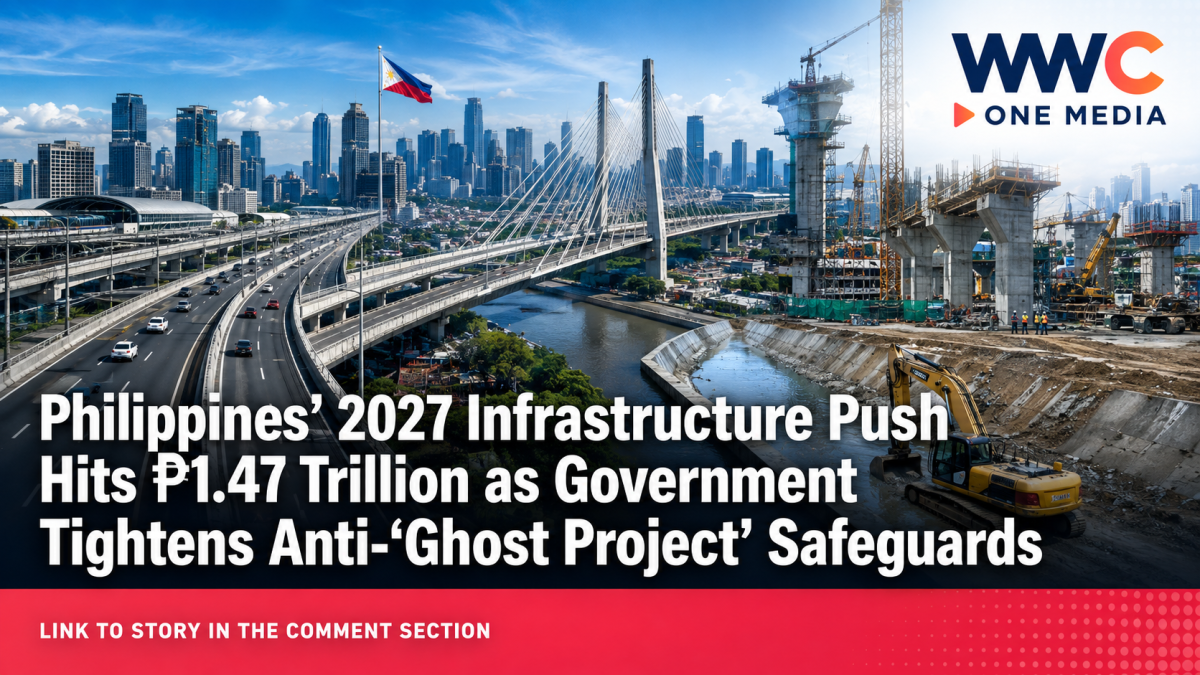
MANILA, Philippines — The Marcos administration is preparing another massive infrastructure push in 2027, proposing roughly ₱1.467 trillion for its Build Better More infrastructure program while promising tighter controls meant to stop duplicate, poorly planned and potentially “ghost” projects from slipping into the national budget.
The proposed infrastructure allocation is equivalent to about 4.4 percent of gross domestic product and is ₱178 billion, or 13.8 percent, higher than the ₱1.29 trillion allocation under the 2026 General Appropriations Act, according to the Department of Budget and Management.
But after the flood-control controversy that placed billions of pesos in public works spending under intense scrutiny, the government is emphasizing that the bigger budget will come with a significantly tougher screening process.
Acting Budget Secretary Kim Robert de Leon said speeding up infrastructure construction would not mean relaxing government controls. Instead, agencies are being required to demonstrate that proposed projects are technically ready, properly located and supported by documents before they can receive funding.
DPWH budget climbs above ₱643 billion
The Department of Public Works and Highways, which will handle a large share of the government’s construction program, has a proposed ₱643.95-billion budget for 2027.
That is an increase of ₱113.05 billion, or 21.29 percent, from its ₱530.90-billion allocation under the 2026 budget. The increase partly reflects funding requirements for ongoing locally funded projects and foreign-assisted infrastructure flagship projects.
The government argues that higher infrastructure investment can create jobs, reduce transport and logistics costs, improve connections between regions and expand the economy’s productive capacity.
But the crucial question hanging over the 2027 program is no longer simply how much government will spend — but whether it can prove that every project is necessary, ready and actually exists.
Geotags, engineering plans and proof projects can actually be built
Under the tighter review process, proposed infrastructure projects are being evaluated based on factors including their alignment with national and regional development plans, implementation readiness, maturity, previous budget utilization, absorptive capacity and expected economic or social benefits.
Depending on the project, agencies may have to provide feasibility studies, detailed engineering requirements, procurement plans, right-of-way documentation, permits and clearances, proof of coordination with local governments and certification that a project does not duplicate another government undertaking.
DBM has also said project details reviewed for the 2027 National Expenditure Program included plans and geotagged locations, a measure designed to make it harder for nonexistent or vaguely located projects to receive funding.
De Leon said the objective is to ensure that projects appearing in the proposed budget are already sufficiently prepared for implementation once Congress approves the spending measure.
DPWH has imposed its own documentary requirements.
Public Works Secretary Vince Dizon told lawmakers that projects must carry an approved program of work, validated geotagged photographs, compliance with DBM budget-preparation requirements, a certificate of implementability and supporting planning or local-development documentation.
Projects that cannot meet the requirements may be excluded from the department’s proposed budget.
Thousands of projects removed
The stricter review has already resulted in a dramatic reduction in the number of projects proposed by DPWH.
Dizon said the agency’s 2027 proposal contains about 11,395 infrastructure projects, compared with 17,861 in 2026, 25,301 in 2025, 25,545 in 2024 and 22,836 in 2023.
The public works chief said duplicate projects were among those removed during the evaluation process.
That sharp reduction is significant because infrastructure projects — particularly flood-control works — have faced allegations in previous budget cycles involving duplication, weak documentation and spending on projects whose locations or actual accomplishments became difficult to verify.
₱107-billion flood-control budget faces another test
The proposed 2027 budget also brings flood-control spending back into the spotlight.
DBM has proposed more than ₱107 billion for flood-control projects, saying some funds are needed to finish ongoing works and support capital requirements for foreign-assisted projects.
Lawmakers, however, are demanding more precise project information.
Senate President Sherwin Gatchalian has said DPWH projects should contain exact geographic coordinates and station numbers to minimize the risk of duplicate or “ghost” projects.
Sen. Panfilo Lacson has separately questioned whether the country’s flood-control spending is being guided by a sufficiently clear long-term strategy, noting that enormous sums have already been spent on flood mitigation while many communities remain vulnerable to severe flooding.
The issue is particularly significant because Dizon acknowledged during congressional hearings that river-basin and flood-mitigation master plans are still incomplete or outdated in some parts of the country.
Billions lined up for major bridges, roads and flood works
Among the major projects proposed for 2027 funding is the Laguna Lakeshore Road Network, which has an allocation of about ₱35.21 billion. The planned 37.6-kilometer corridor is expected to connect Lower Bicutan with Calamba and is targeted for completion in 2028.
The Bataan-Cavite Interlink Bridge is proposed to receive about ₱22.49 billion. The 32.15-kilometer, four-lane crossing would connect Mariveles, Bataan, with Naic, Cavite across Manila Bay.
About ₱11.96 billion is proposed for a package of the Japan-assisted Davao City Bypass Construction Project.
The Cebu-Mactan Bridge and Coastal Road project is proposed to receive ₱8.57 billion, while another ₱8.54 billion is earmarked for Phase IV of the Pasig-Marikina River Channel Improvement Project.
A ₱1.47-trillion promise — and an accountability test
There is an important distinction in the government’s infrastructure figures.
The ₱1.467-trillion figure refers to the broader Build Better More infrastructure program cited by DBM, while separate fiscal-program reporting has placed national-government infrastructure spending at roughly ₱1.34 trillion for 2027. The figures therefore measure somewhat different scopes of infrastructure expenditure and should not be treated as directly interchangeable.
The proposed ₱1.467-trillion infrastructure program is also part of a much larger ₱7.2-trillion 2027 National Expenditure Program, which still has to pass congressional scrutiny before becoming law.
And that scrutiny is already intensifying.
A civil-society coalition examining the proposed 2027 budget has raised concerns over hundreds of billions of pesos in items it considers vulnerable to political intervention or weak accountability, with infrastructure making up a major portion of the projects it flagged. The concerns reinforce pressure on both Congress and the executive branch to demonstrate that new safeguards will work not merely on paper, but throughout procurement and construction.
For the administration, the economic argument for infrastructure remains straightforward: roads, bridges, transport systems and flood defenses can create jobs, unlock investment and reduce the cost of moving people and goods.
But after controversies surrounding previous public works spending, 2027 may become as much a test of government accountability as it is a test of its infrastructure ambitions.
The money is getting bigger. The project list is getting smaller. And the real measure of the new safeguards will come when billions of pesos begin moving from the national budget to construction sites across the Philippines.



Leave a Reply