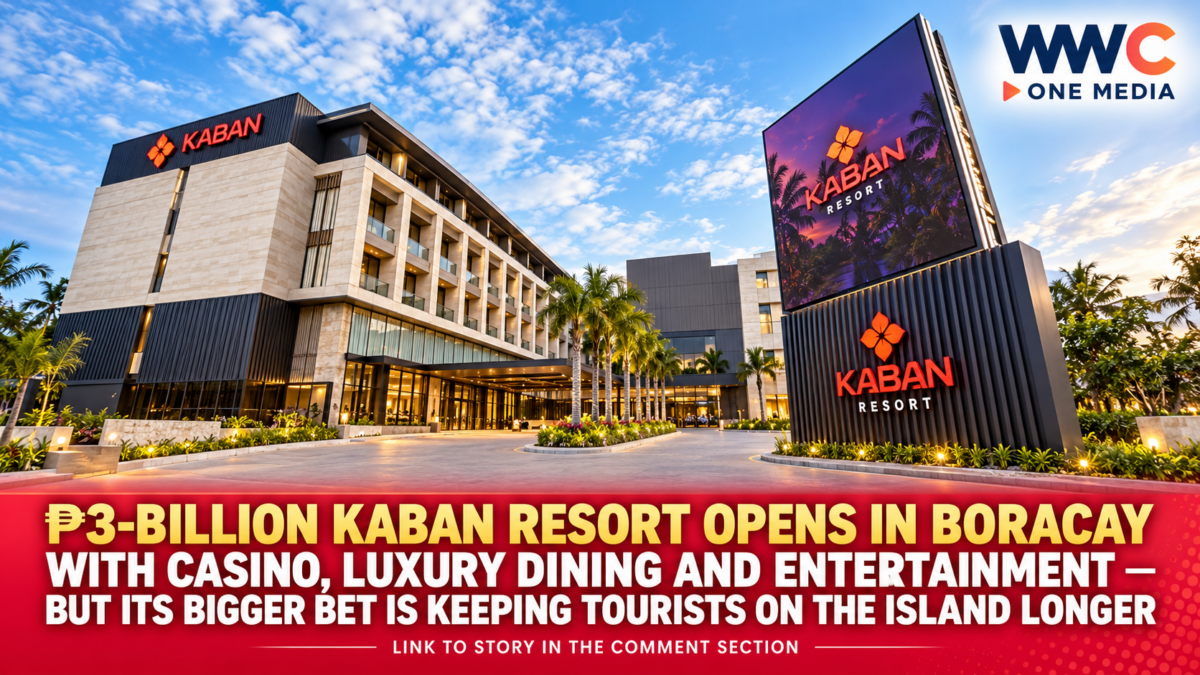
BORACAY, Philippines — Boracay’s tourism industry is entering a new phase as the ₱3-billion KABAN Hotel and Casino officially celebrates its grand opening, introducing a major integrated hospitality development designed to transform how visitors experience one of the Philippines’ most famous island destinations.
Located in Station 0 in Barangay Yapak, the new resort combines upscale accommodations, gaming, international dining, wellness services, retail shopping and live entertainment under one development.
But behind the massive investment lies an ambitious business strategy: convincing visitors to stay longer, spend more and discover experiences beyond Boracay’s world-famous White Beach.
The project, developed by Golden TW Realty and Development Corporation, forms part of a planned 23-hectare mixed-use development that could help reshape the island’s premium tourism market.
₱3-Billion Investment Signals a New Tourism Strategy
KABAN’s grand opening on October 11, 2026, marks a major milestone in Golden TW Realty’s expansion into Boracay’s hospitality and leisure sector.
The hotel began welcoming guests in September before its formal October launch.
According to InsiderPH, KABAN president and CEO Kevin Wong described the hotel as the first phase of the company’s broader development plans for the island.
Rather than relying exclusively on beachfront accommodations, the company is developing a self-contained destination offering multiple experiences within one property.
The strategy reflects a shift in the competitive tourism market, where hospitality operators are seeking to increase visitor spending through entertainment, restaurants, shopping and other attractions.
While Boracay remains internationally recognized for its beaches, KABAN aims to create additional reasons for travelers to extend their vacations.
Inside KABAN: 88 Rooms, a Casino and International Restaurants
KABAN features an 88-room hotel and a casino occupying approximately 2,000 square meters, according to an earlier InsiderPH report published September 14.
The gaming facility operates under a license from the Philippine Amusement and Gaming Corporation (PAGCOR).
The property also offers wellness amenities, dining establishments and entertainment spaces.
Two restaurants are part of its expanded dining portfolio:
- Chung Dam Korean Casual Dining, offering Korean-inspired culinary experiences.
- Umi Matsu Japanese Restaurant, adding Japanese cuisine to the resort’s food and beverage selection.
The addition of Korean and Japanese restaurants reflects the resort’s efforts to serve a diverse tourism market while positioning the property as a dining and lifestyle destination.
Management believes that combining hospitality, entertainment and restaurants can attract both hotel guests and visitors staying elsewhere on the island.
Nearly 400 Jobs Expected as Aklan Economy Benefits
Beyond tourism, the investment is expected to generate local employment.
KABAN projects nearly 400 jobs from the development, with approximately 55% of its workforce coming from the Visayas.
Around 35% of employees are expected to come from Aklan, highlighting the company’s emphasis on local participation.
The development could also create business opportunities for food suppliers, transportation providers, maintenance contractors and other enterprises supporting tourism operations.
However, the wider economic contribution will depend on sustained visitor demand, local procurement and the scale of future development.
Boracay Tourism Generated ₱47 Billion in 2025
KABAN’s expansion comes as Boracay continues to attract millions of visitors.
According to the Aklan Provincial Tourism Office, as reported by the Philippine Information Agency, Boracay welcomed 2,155,217 tourists in 2025.
The island generated approximately ₱47 billion in tourism-related revenues during the year.
Of those visitors:
- 1,765,318 were domestic tourists.
- 357,510 were foreign tourists.
- 32,425 were overseas Filipino workers.
December 2025 was the busiest month, recording 227,828 tourist arrivals.
South Korea remained Boracay’s largest foreign visitor market, followed by the United States, Australia, Taiwan and Russia.
These figures underscore why developers are investing in hospitality and lifestyle facilities as Boracay seeks to strengthen its position in the highly competitive Southeast Asian tourism market.
The local government of Malay also set a target of 2.6 million tourist arrivals for 2026, reflecting expectations of continued tourism growth.
That figure is a target rather than a confirmed full-year result.
Philippine Tourism Industry Seeks Higher Visitor Spending
KABAN’s expansion aligns with broader efforts to strengthen Philippine tourism revenues.
According to the Philippine News Agency, citing Department of Tourism figures released in January 2026, the Philippines generated an estimated ₱694 billion in tourism receipts during 2025.
The country also recorded approximately 6.5 million foreign visitors and returning overseas Filipinos during the year.
For resort operators, attracting more arrivals is only part of the opportunity.
Encouraging travelers to spend more on accommodations, dining, shopping, entertainment and premium experiences could increase tourism revenue without depending entirely on visitor volume.
This is especially relevant for island destinations such as Boracay, where environmental capacity, transportation infrastructure and sustainable development remain important considerations.
Jessica Sanchez Headlines KABAN Grand Opening
KABAN’s official opening featured a high-profile entertainment program headlined by Filipino-American singer Jessica Sanchez.
Sanchez, who was the runner-up on American Idol Season 11 and winner of America’s Got Talent Season 20, performed during the celebration.
The event also featured fireworks, live performances and raffle draws.
Among the attendees were Malay Mayor Frolibar Bautista and PAGCOR Chairman and CEO Alejandro Tengco.
The participation of tourism and gaming officials highlighted the project’s relevance to Boracay’s evolving hospitality sector.
The Bigger Challenge: Can Integrated Resorts Extend Tourist Stays?
KABAN’s concept reflects an increasingly important question for Philippine tourism developers: Can destinations generate more economic value by offering diverse experiences instead of depending primarily on natural attractions?
Integrated hospitality projects can potentially increase spending by giving travelers more options for leisure, dining, shopping and entertainment.
They may also provide additional revenue streams during periods of weaker hotel demand.
However, the success of this strategy is not guaranteed.
KABAN must compete with Boracay’s established luxury resorts, beachfront hotels, restaurants and entertainment establishments.
The project will also need to demonstrate whether its combined hospitality and gaming offerings can attract new visitors rather than simply redistribute tourism spending among existing businesses.
Importantly, there is no publicly verified evidence yet that KABAN has increased the average length of tourist stays on Boracay.
That remains a commercial objective to be tested as operations develop.
What Comes Next for KABAN and Boracay?
Golden TW Realty’s larger 23-hectare master plan suggests that KABAN’s hotel opening is only the beginning of a potentially broader investment program.
Future development could strengthen Station 0’s appeal as an inland leisure and entertainment destination.
But the longer-term results will depend on visitor demand, the performance of existing facilities, infrastructure requirements and the company’s execution of subsequent phases.
For Boracay, the stakes are broader than a single resort.
The island is seeking opportunities to attract higher-value tourism while balancing environmental protection, local employment and sustainable economic growth.
KABAN’s ₱3-billion investment signals confidence in Boracay’s future, but the real measure of success will be whether integrated tourism can bring additional spending, create lasting jobs and persuade visitors to extend their stays without compromising the island’s appeal.
As the Philippines competes for travelers across Asia, Boracay’s next tourism growth opportunity may come not only from attracting more visitors — but from giving them more compelling reasons to stay.